Addition and Subtraction
What this chapter covers
- You can say what add, subtract, total, difference and balance mean (2.1.1)
- You can add numbers within 18 and then within 100, with and without regrouping (2.2.1, 2.2.2)
- You can subtract numbers within 18 and then within 100, with and without regrouping (2.3.1, 2.3.2)
- You can make up and tell a story for an addition or subtraction number sentence (2.4.1)
- You can solve one-step problems about adding and subtracting (2.4.2)
- You can write repeated addition and repeated subtraction for equal groups (2.5.1, 2.6.1)
2.1What add and subtract mean


The difference tells how many more or how many less. The difference of 9 and 7 is 2, because 9 − 7 = 2. The balance is what is left.
Show answerHide answer
Based on the Year 1 textbook, pages 56 to 59 and 74 to 77.
2.2Adding
Add numbers up to 18
Count on from the bigger number. For 8 + 3, say 9, 10, 11. Or make 10 first: 8 + 2 = 10, then 10 + 1 = 11.
Add numbers up to 100
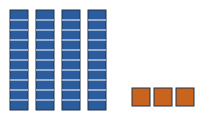
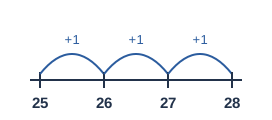
Write the numbers in columns. Ones go under ones and tens go under tens. Add the ones first, then the tens.
Step 2. Tens: 4 + 5 = 9.
Step 3. 43 + 52 = 95.
Add with regrouping
If the ones make 10 or more, change 10 ones into 1 ten. This is regrouping.
Step 2. Tens: 2 + 0 + 1 = 3.
Step 3. 29 + 6 = 35.
Show answerHide answer
Based on the Year 1 textbook, pages 58 to 73.
2.3Subtracting
Subtract numbers up to 18
Count back from the bigger number. For 11 − 4, count back 4 steps: 10, 9, 8, 7. The answer is 7.
Addition and subtraction are partners. 3 + 4 = 7, so 7 − 4 = 3 and 7 − 3 = 4.
Subtract numbers up to 100
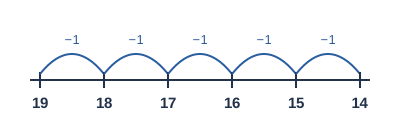
Subtract the ones first, then the tens. Always put the bigger number on top.
Step 2. Tens: 6 − 2 = 4.
Step 3. 68 − 25 = 43.
Subtract with regrouping
If the top ones digit is too small, change 1 ten into 10 ones.
Step 2. Tens: 5 tens left, 5 − 0 = 5.
Step 3. 63 − 7 = 56.
Show answerHide answer
Based on the Year 1 textbook, pages 76 to 92.
2.4Stories and problems
A number sentence can tell a story. 18 + 7 = 25 can be: "There are 18 red cars and 7 blue cars. There are 25 cars altogether."
| Words in the problem | What to do |
|---|---|
| altogether, total, more | add |
| left, balance, give away, difference | subtract |
To solve a problem, read it, find the numbers, write the number sentence, work it out and write the answer.
17 − 4 = 13 plants.
Show answerHide answer
Based on the Year 1 textbook, pages 93 to 107.
2.5Repeated addition and subtraction

Show answerHide answer
Based on the Year 1 textbook, pages 108 to 113.
Summary
- Add to find the total. Subtract to find what is left or the difference.
- Add and subtract the ones first, then the tens.
- If the ones make 10 or more, carry 1 ten. If the top ones are too small, change 1 ten to 10 ones.
- Check subtraction with addition.
- Repeated addition adds equal groups. Repeated subtraction takes away equal groups.