Science notes, unit 8
Absorption
Textbook Science Year 1 (DLP), pages 71–80
What this chapter covers
- You can test objects and say if they absorb water or not (8.1.1)
- You can sort objects into water absorbent and non-water absorbent groups (8.1.2)
- You can compare which object absorbs more water and which absorbs less (8.1.3)
- You can say why water absorbent objects are useful in our life (8.1.4)
- You can say why non-water absorbent objects are useful in our life (8.1.5)
- You can make a simple mini mop and say why you chose the string (8.1.6)
Some things soak up water. Some things do not. In this unit we find out which is which, and why it matters.
8.1Water absorbent objects and non-water absorbent objects
Absorbing water
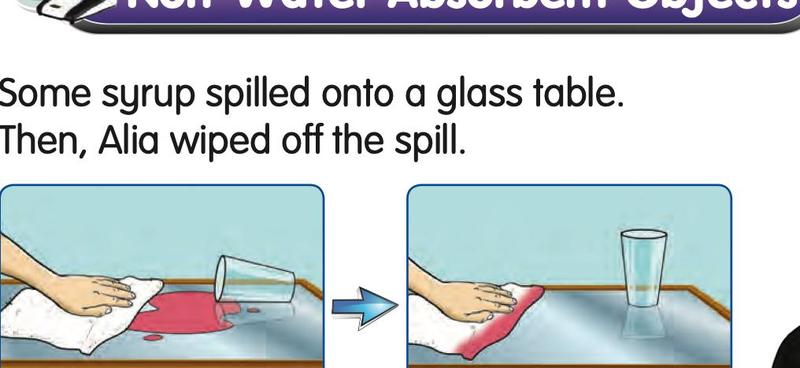
Water absorbent objects take in water. Non-water absorbent objects do not take in water. The water stays on top as drops.
We can test an object. Put a few drops of coloured water on it and look.
- Drops stay on top: the object is non-water absorbent.
- No drops on top: the object is water absorbent.
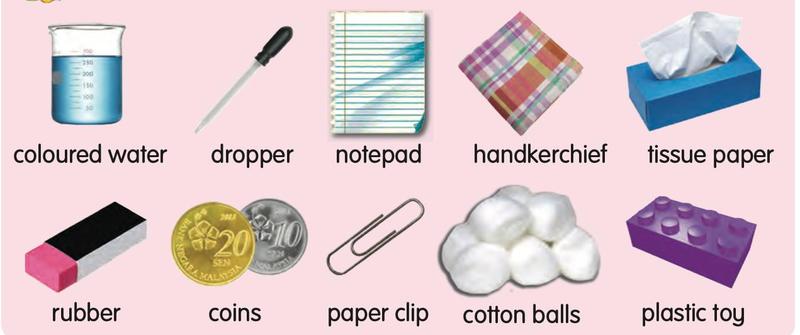
Keep the test fair. Use the same number of drops on each object.
After the drops go on a coin, the drops stay on top. Is a coin water absorbent?
Show answerHide answer
No. A coin is non-water absorbent.
Sorting objects
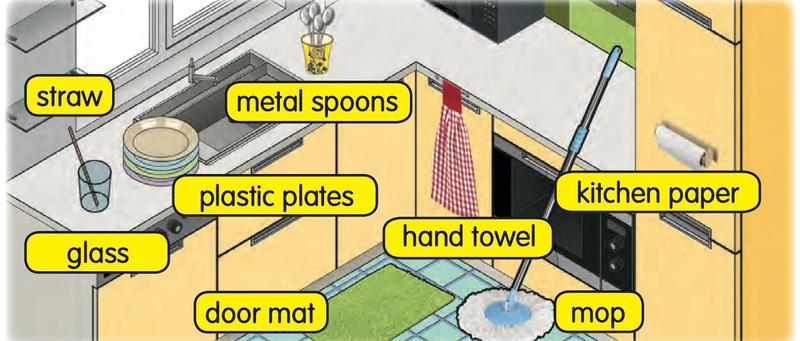
| Water absorbent | Non-water absorbent |
|---|---|
| Kitchen paper | Glass |
| Mop | Metal spoons |
| Door mat | Plastic plates |
| Hand towel | Straw |
Soft things made of paper or cloth usually take in water. Hard, smooth things made of plastic, metal, glass or rubber do not.
Is a handkerchief water absorbent or non-water absorbent?
Show answerHide answer
Water absorbent.
Which absorbs more?
Some objects take in more water than others. In the test, strips of newspaper, kitchen paper and cloth stand in coloured water for 1 minute.
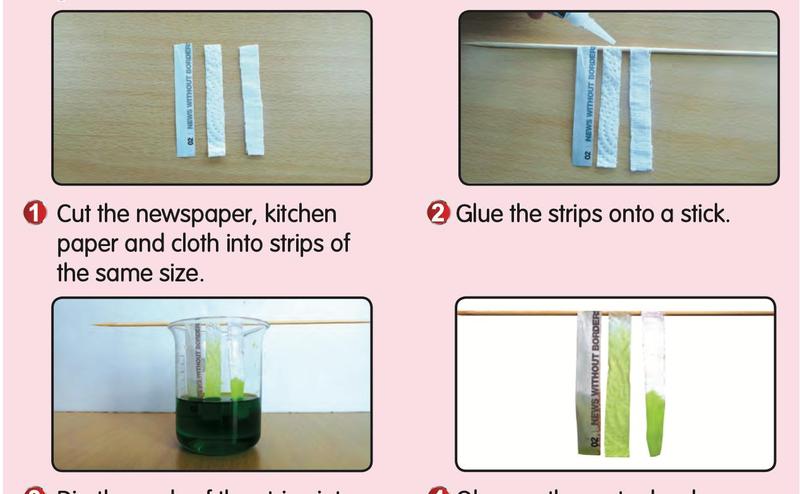
- The kitchen paper absorbed the most water.
- The newspaper absorbed the least water.
Example: a fair test
The three strips must be the same size and same thickness, and they stay in the water for the same time.Which strip absorbed the most water?
Show answerHide answer
The kitchen paper.
8.2Why these objects are useful
Water absorbent objects
| Object | What it does for us |
|---|---|
| Towel | Dries our body after a bath |
| Cotton ball | Cleans a wound |
| Cloth | Dries a jug |
| Handkerchief | Wipes away sweat |
| Mop | Wipes a wet floor |
Non-water absorbent objects
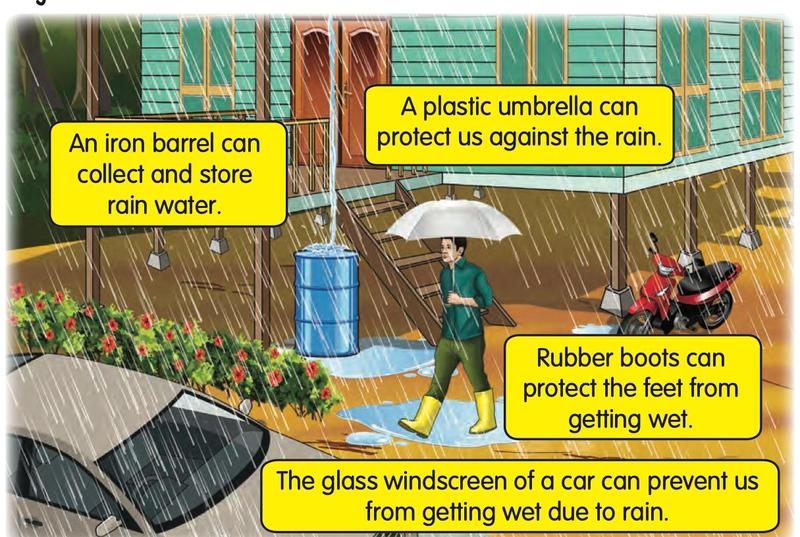
| Object | What it does for us |
|---|---|
| Plastic umbrella | Keeps rain off us |
| Rubber boots | Keep our feet dry |
| Car glass windscreen | Keeps rain out of the car |
| Iron barrel | Collects and keeps rain water |
Do not use a towel as a raincoat or a plastic sheet to dry your body. Pick the right object for the job.
Why do we wear rubber boots in the rain?
Show answerHide answer
Rubber does not absorb water, so our feet stay dry.
Mini mop
We can make a mini mop from string, thread, a pen and rubber bands. The string is used because it absorbs water. Cloth strips can also be used.
Pictures: Science Year 1 (DLP) textbook, pp. 72, 73, 75, 78.
Summary
| Water absorbent | Non-water absorbent | |
|---|---|---|
| Water | Taken in | Stays on top |
| Examples | Tissue paper, towel, cotton ball | Plastic toy, rubber, coin, paper clip |
| Use | Dry and wipe | Keep us dry |