Science questions, unit 8
Nama / NameKelas / ClassTarikh / Date
Absorption
30 marks. Use Practice to check each answer as you go, or Exam to answer everything first. Ask a grown-up to help you mark the written answers.
Section A: objective questions
13 marksChoose the best answer for each question.
1
Question 1
Which object absorbs water?
Show answerHide answer
C
Tissue paper takes in water. The other objects do not.
2
Question 2
Drops of coloured water stay on top of an object. What kind of object is it?
Show answerHide answer
A
Drops that stay on top show that the object does not absorb water.
3
Question 3
Which object is non-water absorbent?
Show answerHide answer
D
A glass does not absorb water. The towel, mop and kitchen paper do.
4
Question 4
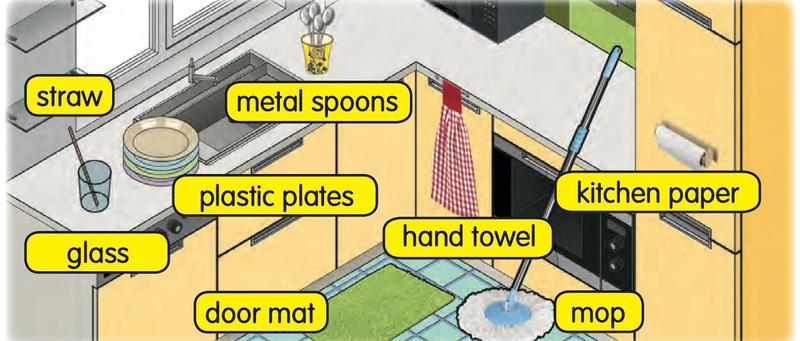
Diagram 1 shows objects in a kitchen. Which one is water absorbent?
Show answerHide answer
A
A door mat takes in water. Metal, plastic and a straw do not.
5
Question 5
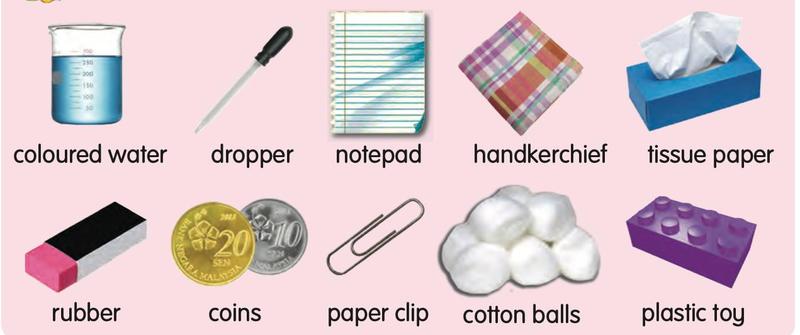
Which object is water absorbent?
Show answerHide answer
B
A cotton ball takes in water.
6
Question 6
Which group has only water absorbent objects?
Show answerHide answer
B
Hand towel, mop and kitchen paper all take in water.
7
Question 7
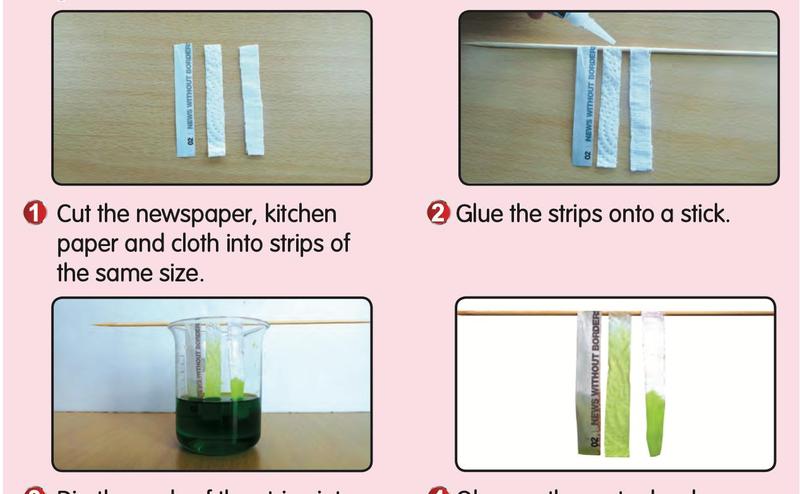
Diagram 3 shows strips dipped in coloured water for 1 minute. Which strip absorbed the most water?
Show answerHide answer
B
The kitchen paper absorbed the most water.
8
Question 8
What must be the same for all strips in the test?
Show answerHide answer
B
Strips of the same size make the test fair.
9
Question 9
Why does father wipe his little son with a towel after a bath?
Show answerHide answer
A
A towel absorbs water, so it dries the body.
10
Question 10
Which object is used to clean a wound?
Show answerHide answer
D
A cotton ball absorbs and wipes up liquid from a wound.
11
Question 11
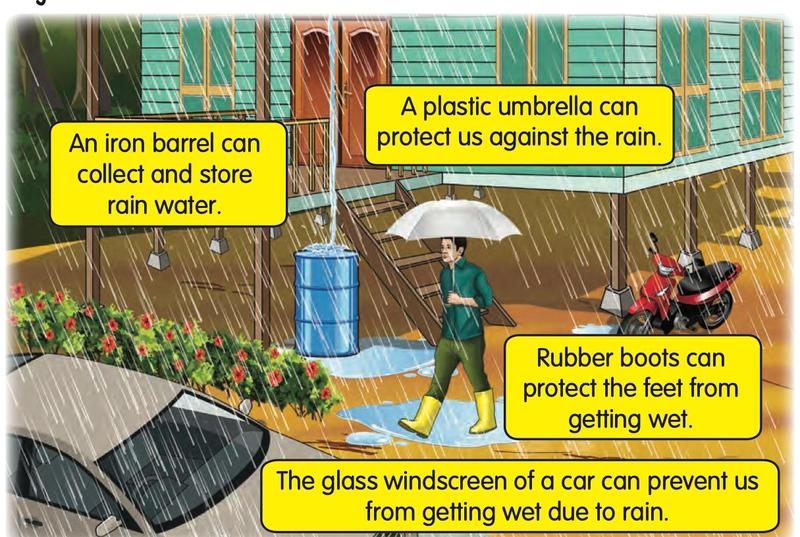
Which object keeps the rain off us?
Show answerHide answer
A
A plastic umbrella does not absorb water, so rain slides off.
12
Question 12
Why do we use an iron barrel to collect rain water?
Show answerHide answer
C
Iron does not absorb water, so the water stays inside the barrel.
13
Question 13
A mini mop is made with string. Why is string a good choice?
Show answerHide answer
D
The mop must soak up water, so the string must be water absorbent.
Section B: structured questions
17 marksAnswer all questions. Circle the answer or write it in the space.
14
Question 14
Diagram 5 shows some objects. Alia tests each one with drops of coloured water.
[1 mark]
(a)Do the drops stay on top of the coin?
Show answerHide answer
Yes
[1 mark]
(b)Is the handkerchief water absorbent or non-water absorbent?
Show answerHide answer
Water absorbent
[1 mark]
(c)Name one more object in Diagram 5 that is non-water absorbent.
Show answerHide answer
Tick each point you got.
15
Question 15
Sort these objects: kitchen paper, glass, mop, metal spoon.
[2 marks]
(a)Write the two water absorbent objects.
Show answerHide answer
Tick each point you got.
[2 marks]
(b)Write the two non-water absorbent objects.
Show answerHide answer
Tick each point you got.
16
Question 16
Diagram 6 shows three strips dipped in coloured water.
[1 mark]
(a)Which strip absorbed the most water?
Show answerHide answer
Tick each point you got.
[1 mark]
(b)In the strip test with newspaper, kitchen paper and cloth, which strip absorbed the least water?
Show answerHide answer
Tick each point you got.
[1 mark]
(c)Why must the three strips be the same size?
Show answerHide answer
Tick each point you got.
17
Question 17
Answer each question about water absorbent and non-water absorbent objects.
[1 mark]
(a)Why do we use a towel after a bath?
Show answerHide answer
Tick each point you got.
[1 mark]
(b)Why do we use a cloth for a wet jug?
Show answerHide answer
Tick each point you got.
[1 mark]
(c)Rubber boots keep our feet dry because rubber ...
Show answerHide answer
does not absorb water
18
Question 18
Hafiz makes a mini mop from string, thread, a pen and rubber bands.
[1 mark]
(a)Why does he use string for the mop?
Show answerHide answer
Tick each point you got.
[1 mark]
(b)Name one other material he can use instead of string.
Show answerHide answer
Tick each point you got.
[2 marks]
(c)Would plastic strips be a good choice? Say why.
Show answerHide answer
Tick each point you got.