Mathematics notes, unit 1
Numbers up to 1 000
Textbook Mathematics Year 2 (DLP), Part 1 and Part 2 (one combined PDF), pages 1–44
What this chapter covers
- You can read and say numbers up to 1 000, and write them in numerals and in words (1.1, 1.2)
- You can show a number with base ten blocks and say what it is worth (1.1)
- You can say the place value and the digit value of a digit, and partition a number (1.4)
- You can compare numbers and arrange them in ascending and descending order (1.1)
- You can count on and count back in ones, twos, fives, tens and hundreds (1.3)
- You can estimate using "about", "less than" and "more than" (1.5)
- You can round off numbers to the nearest ten and the nearest hundred (1.6)
- You can state and complete number patterns (1.7)
- You can solve simple problems about numbers up to 1 000 (1.8)
1.1Reading and writing numbers
In Year 2 you learn numbers up to 1 000 (one thousand). Each Petronas Twin Tower has 88 floors and is about 452 metres high. These are big numbers!
A three-digit number has hundreds, tens and ones. 463 is read "four hundred and sixty-three".
| Numeral | In words |
|---|---|
| 316 | three hundred and sixteen |
| 510 | five hundred and ten |
| 709 | seven hundred and nine |
| 935 | nine hundred and thirty-five |
| 1 000 | one thousand |
Write a number by its value, not by its digits. "One hundred and fifteen" is 115, not 10015 or 1 15.
A zero is not said, but it must be written. Seven hundred and four is 704. Never start a number with 0 (019 is just 19).
Write "six hundred and eight" in numerals. Then write 902 in words.
Show answerHide answer
608. 902 is nine hundred and two.
1.2Place value, digit value and partitioning
Ten ones make one ten. Ten tens make one hundred. Base ten blocks help us see this.
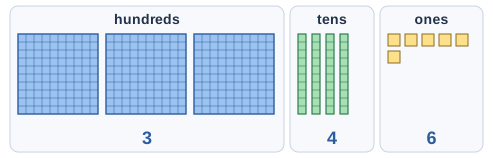
Place value is the place of the digit: hundreds, tens or ones.
Digit value is what the digit is worth. In 579, the digit value of 5 is 500.
Digit value is what the digit is worth. In 579, the digit value of 5 is 500.
| Digit | 5 | 7 | 9 |
|---|---|---|---|
| Place value | hundreds | tens | ones |
| Digit value | 500 | 70 | 9 |
Partitioning
Partition 182 and 640
By place value: 182 = 1 hundred + 8 tens + 2 ones.By digit value: 182 = 100 + 80 + 2.
640 has 0 ones. 640 = 600 + 40 (we need not write + 0).
Digit value is not the same as the digit. In 831, the digit value of 3 is 30, not 3.
In 907, what is the place value of 9? What is the digit value of 9?
Show answerHide answer
Place value: hundreds. Digit value: 900.
1.3Comparing and arranging numbers
How to compare two numbers
Step 1. Start with the hundreds. 356 and 256: 3 hundreds is more than 2 hundreds, so 356 is larger.Step 2. Same hundreds? Compare the tens. 856 and 846: 5 tens is more than 4 tens, so 856 is more.
Step 3. Same tens? Compare the ones. 415 and 418: 5 is less than 8, so 415 is smaller.
A number with more digits is larger. 457 is larger than 97, even though 9 is bigger than 4.

Ascending and descending order
Ascending order: from the smallest to the largest.
Descending order: from the largest to the smallest.
Descending order: from the largest to the smallest.
Cans collected: 206, 170, 160, 215
Ascending: 160, 170, 206, 215.Descending: 215, 206, 170, 160.
Which is smaller, 550 or 505?
Show answerHide answer
The hundreds are the same. Tens: 0 is less than 5. So 505 is smaller.
1.4Counting and number patterns
We can count on (the numbers get bigger) and count back (the numbers get smaller).
- Count on in hundreds: 200, 300, 400, 500, 600
- Count on in tens: 600, 610, 620, 630, 640
- Count on in fives: 100, 105, 110, 115, 120
- Count back in ones: 157, 156, 155, 154
- Count back in hundreds: 518, 418, 318, 218
A number pattern is a list of numbers that follows a rule. We say "increasing in fives" or "decreasing in twos".
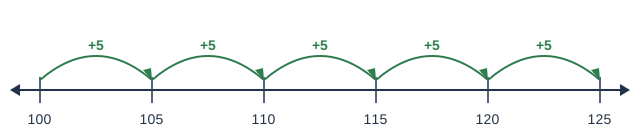
Find the missing number
438, 436, 434, ___, 430The numbers go down by 2 each time. 434 − 2 = 432. The pattern is decreasing in twos.
Complete: 216, 219, 222, ___, ___. State the pattern.
Show answerHide answer
225 and 228. The pattern is increasing in threes.
1.5Estimating
To estimate is to make a sensible guess. We say about, less than or more than.
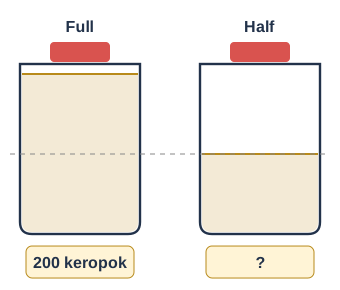
Use a number you know as a guide. Half of 200 is 100. A little less than half is less than 100.
1.6Rounding off
To round off is to change a number to a nearby ten or hundred.
To the nearest ten


Look at the ones digit. If it is 5, 6, 7, 8 or 9, round up. If it is 0, 1, 2, 3 or 4, keep the tens. A number in the middle, like 465, goes up to 470.
To the nearest hundred

Look at the tens digit. If it is 5 or more, round up to the next hundred. If it is less than 5, keep the hundreds. 734 has 3 tens, so it becomes 700.
| Round off to the nearest … | Look at | Example: 586 |
|---|---|---|
| ten | ones | 590 |
| hundred | tens | 600 |
Round off 421 and 655 to the nearest hundred.
Show answerHide answer
421 becomes 400 (tens digit 2). 655 becomes 700 (tens digit 5).
1.7Solving problems
Read the problem. Underline the important facts. Then choose a way: use blocks, arrange the numbers, or draw a number line.
Who read the most books?
Bee Yee read 248, Lim read 268 and Wong read 246.Arrange in ascending order: 246, 248, 268. The largest is 268, so Lim is the winner.
Use a number line
Bala scored 10 marks less than Gana and 10 marks more than Rani. Gana scored 458.Bala = 458 − 10 = 448. (Rani = 448 − 10 = 438.)
Davin presses the keys 6, 0 and 9 on a calculator to make the largest number. What is the number? Say it in words.
Show answerHide answer
960, nine hundred and sixty.
Summary
- Numbers up to 1 000 are read from the hundreds, then tens, then ones. Write them by value.
- Place value is the place; digit value is what the digit is worth (the 5 in 579 is 500).
- Partition: 182 = 100 + 80 + 2.
- Compare from the hundreds, then tens, then ones. Ascending is smallest to largest; descending is largest to smallest.
- A number pattern is "increasing in …" or "decreasing in …".
- Estimate with "about", "less than" and "more than".
- Rounding off: look at the digit to the right. 5 or more, round up.