Addition, Subtraction, Multiplication and Division
What this chapter covers
- You can add two numbers and three numbers within 1 000, with and without regrouping (2.1.1, 2.1.2)
- You can subtract two numbers within 1 000, with and without regrouping, and subtract one number after another (2.2.1, 2.2.2)
- You can show multiplication as equal groups and repeated addition, and say the 0 to 10 times tables (2.3.1, 2.3.2)
- You can share and group to divide, use the division tables, and divide by 1, by 10 and with a remainder (2.4.1, 2.4.2)
- You can complete or make up a story for a number sentence (2.5.1)
- You can solve one-step problems about adding, subtracting, multiplying and dividing (2.5.2)
2.1Adding
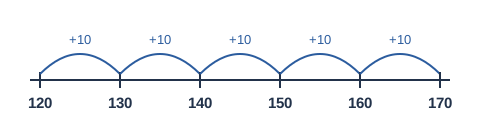
To add is to put numbers together. We can add numbers up to 1 000.
Add on a number line
Add in columns
Step 2. Tens: 3 + 2 = 5.
Step 3. Hundreds: 1 + 2 = 3.
Step 4. 134 + 225 = 359.
Add with regrouping
When the ones make 10 or more, regroup. Keep the ones and carry the ten to the tens column.
Step 2. Tens: 1 + 6 + 5 = 12 tens = 1 hundred + 2 tens. Write 2, carry 1 hundred.
Step 3. Hundreds: 1 + 2 + 3 = 6.
Step 4. 267 + 358 = 625.
Add three numbers
Add two numbers first, then add the answer to the third. You can also add the ones that make 10 first.
Show answerHide answer
Based on the Year 2 textbook, pages 46 to 61.
2.2Subtracting
To subtract is to take away, or to find the difference between two numbers.
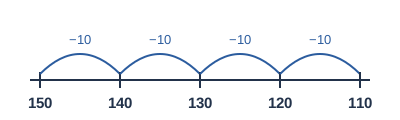
Subtract with regrouping
If the top digit is too small, regroup: change 1 from the next place. 1 ten becomes 10 ones. 1 hundred becomes 10 tens.
Step 2. Tens: 4 is less than 8. Change 1 hundred to 10 tens: 14 tens − 8 tens = 6 tens. Hundreds left: 2.
Step 3. Hundreds: 2 − 1 = 1.
Step 4. 346 − 185 = 161.
Subtract one number after another
Show answerHide answer
Based on the Year 2 textbook, pages 62 to 75.
2.3Multiplying

The order does not change the answer. 2 × 4 = 4 × 2 = 8.


Times tables
Build a times table by counting on. The 3 times table is 3, 6, 9, 12, 15, 18, 21, 24, 27, 30.
| Table | Counting on |
|---|---|
| 2 | 2, 4, 6, 8, 10, 12, 14, 16, 18, 20 |
| 5 | 5, 10, 15, 20, 25, 30, 35, 40, 45, 50 |
| 9 | 9, 18, 27, 36, 45, 54, 63, 72, 81, 90 |
| 10 | 10, 20, 30, 40, 50, 60, 70, 80, 90, 100 |
Show answerHide answer
Based on the Year 2 textbook, pages 81 to 94.
2.4Dividing

Division is the opposite of multiplication. Because 6 × 3 = 18, we know 18 ÷ 3 = 6 and 18 ÷ 6 = 3. Use the times tables to divide.
Special cases
- Any number ÷ 1 = the number itself: 3 ÷ 1 = 3.
- A number ÷ 10: 30 ÷ 10 = 3 (3 groups of ten).
- 0 ÷ any number = 0: 0 ÷ 4 = 0. We cannot divide by 0.
Division with a remainder
Step 2. 20 − 18 = 2 left over.
Step 3. 20 ÷ 6 = 3 remainder 2.
Show answerHide answer
Based on the Year 2 textbook, pages 95 to 115.
2.5Stories and problems
Every number sentence can tell a story. 3 × 5 = 15 can be: "There are 3 vases and each has 5 flowers, so there are 15 flowers."
To solve a problem, follow four steps.
- Read and find the important numbers.
- Decide whether to add, subtract, multiply or divide.
- Write the number sentence and work it out.
- Write the answer with the unit, then check it.
50 ÷ 10 = 5 vans.
Show answerHide answer
Based on the Year 2 textbook, pages 76 to 80 and 116 to 122.
Summary
- Add and subtract in columns, starting from the ones. Regroup when ones or tens are not enough or reach 10.
- Check subtraction with addition.
- 3 × 2 means 3 groups of 2. The order does not matter: 2 × 4 = 4 × 2.
- Any number × 1 is itself and any number × 0 is 0.
- Division is sharing equally and is the opposite of multiplication.
- The remainder is always smaller than the number you divide by.