Mathematics notes, unit 3
Fractions and Decimals
Textbook Mathematics Year 2 (DLP), Part 1 and Part 2 (one combined PDF), pages Part 2, 1–18
What this chapter covers
- {'You can say what a fraction is': 'equal parts of a whole (3.1.1)'}
- You can name and write fractions such as one over six, with a numerator and a denominator (3.1.2, 3.1.3)
- You can write a fraction from a picture, in words and in numerals, and shade a picture to show a fraction (3.1.4)
- You can compare two fractions and say which is larger or smaller (3.1.5)
- You can change tenths to decimals, for example 3/10 = 0.3, and read them on a number line (3.2.1 to 3.2.5)
- You can compare decimals, and compare tenths fractions with decimals (3.2.6, 3.3.1)
- You can solve simple problems about fractions and decimals (3.4.1)
3.1What is a fraction?
Mum cuts a cake into 3 equal parts. Each child gets 1 part. Each part is one over three.
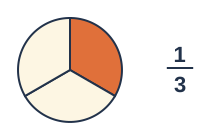
A fraction names equal parts of a whole. The parts must be the same size.
Parts that are not the same size are not a fraction. A cake cut into one big piece and two small pieces is not "one over three".
Numerator and denominator

| Name | What it tells us | In 1⁄6 |
|---|---|---|
| Numerator | how many parts we take | 1 |
| Denominator | how many equal parts in the whole | 6 |
Say a fraction as "numerator over denominator". 3⁄10 is "three over ten". 1⁄2 is "one over two" and 1⁄4 is "one over four".
A pizza is cut into 8 equal slices. What is the denominator?
Show answerHide answer
8. The denominator is the number of equal parts in the whole.
3.2Writing fractions

Worked example: write the fraction
Step 1. Count all the equal parts. This is the denominator: 10.Step 2. Count the parts you are asked about (the shaded ones). This is the numerator: 3.
Step 3. Write numerator over denominator: 3⁄10. In words: three over ten.
We can write fractions in words or in numerals.
| In words | In numerals |
|---|---|
| one over five | 1⁄5 |
| two over four | 2⁄4 |
| four over nine | 4⁄9 |
| seven over ten | 7⁄10 |

If the numerator and the denominator are the same, you have taken the whole thing. 4⁄4 = 1 whole. A proper fraction is always less than 1, so its numerator is smaller than its denominator.
Shade or fold into equal parts only. Every fold on the paper must make parts the same size.
A shape has 9 equal parts. 4 parts are orange and 5 parts are green. Write the fraction for the green parts.
Show answerHide answer
5⁄9 (five over nine).
3.3Comparing fractions
Same denominator
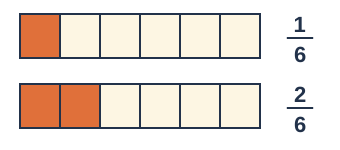
When the denominators are the same, the fraction with the larger numerator is larger. 4⁄7 is more than 3⁄7.
Same numerator
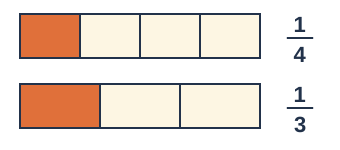
Worked example: which is smaller, 1⁄3 or 1⁄4?
Step 1. The same whole is cut into 3 parts and into 4 parts.Step 2. More parts means each part is smaller.
Step 3. So 1⁄4 is smaller than 1⁄3.
A bigger denominator does not mean a bigger fraction when the numerators are the same. 1⁄10 is smaller than 1⁄2.
Which is larger, 3⁄8 or 5⁄8? Which is smaller, 1⁄5 or 1⁄9?
Show answerHide answer
5⁄8 is larger (same denominator, larger numerator). 1⁄9 is smaller (the whole is cut into more parts).
3.4Tenths and decimals

A decimal has a decimal point between the ones and the tenths. 1⁄10 = 0.1, and we say "zero point one". The 0 in front tells us there are no whole ones.
Look at the number line from 0 to 1. Each step is one tenth.

| Fraction | Decimal | In words |
|---|---|---|
| 2⁄10 | 0.2 | zero point two |
| 5⁄10 | 0.5 | zero point five |
| 9⁄10 | 0.9 | zero point nine |
Worked example: change 3⁄10 to a decimal
Step 1. The denominator is 10, so these are tenths.Step 2. The numerator is 3, so we have 3 tenths.
Step 3. Write 0, then the decimal point, then 3: 0.3.
A decimal in tenths, such as 0.6, is always less than 1.
Do not forget the decimal point. 0.4 is "zero point four". It is not "four" and not "forty".
Write 6⁄10 as a decimal. What fraction is 0.8?
Show answerHide answer
6⁄10 = 0.6. 0.8 = 8⁄10.
3.5Comparing decimals, and decimals with fractions
To compare tenths decimals, look at the digit after the decimal point. On a number line, the further to the right, the larger the number.
Worked example: compare
0.2 and 0.4: 2 tenths is less than 4 tenths, so 0.2 is smaller than 0.4.0.5 and 0.8: 8 tenths is more than 5 tenths, so 0.8 is larger than 0.5.
To compare a fraction with a decimal, change the fraction to a decimal first.
Worked example: which is larger, 3⁄10 or 0.7?
Step 1. 3⁄10 = 0.3.Step 2. Compare 0.3 and 0.7. 7 tenths is more than 3 tenths.
Step 3. 0.7 is larger than 3⁄10.
Compare 0.9 and 4⁄10. Write "larger than" or "smaller than".
Show answerHide answer
4⁄10 = 0.4. So 0.9 is larger than 4⁄10.
3.6Solving problems
Read the problem and underline the important information. Draw a picture, shade a diagram or use a number line.
Worked example: the cake
Muhi gave 3 out of 8 equal parts of a cake to Mogan. What fraction did Mogan get?3 parts out of 8 parts = 3⁄8.
Worked example: the pizza
Chong ate 1⁄6 of a pizza. His brother ate 1⁄4 of the same pizza. Who ate more?The numerators are the same (1). 1⁄4 is cut into fewer parts than 1⁄6, so each part is bigger. Chong's brother ate more.
Worked example: the ribbon
Tie a gift: 6⁄10 of the ribbon. Make a flower: 0.4 of the ribbon. Which is longer?6⁄10 = 0.6. 0.6 is more than 0.4, so the ribbon to tie a gift is longer.
Muna ate 5 out of 8 equal parts of a chocolate. What fraction did she eat?
Show answerHide answer
5⁄8 of the chocolate.
Summary
- A fraction names equal parts of a whole. Numerator = parts taken. Denominator = all the equal parts.
- Say it "numerator over denominator": 3⁄10 is "three over ten".
- A proper fraction is less than 1. If the numerator and denominator are the same, it is 1 whole.
- Same denominator: the larger numerator is the larger fraction. Same numerator: the larger denominator is the smaller fraction.
- Tenths as decimals: 1⁄10 = 0.1, 2⁄10 = 0.2, up to 9⁄10 = 0.9. Say "zero point …".
- To compare a fraction with a decimal, change the fraction to a decimal first.