Shapes
What this chapter covers
- You can name the cube, cuboid, pyramid, cone and cylinder and say their flat faces, curved faces, vertices and edges (7.1.1)
- You can name the basic shapes that make up a 3-D shape (7.1.2)
- You can recognise the nets of a cube, cuboid, pyramid, cone and cylinder (7.1.3)
- You can name the square, rectangle, triangle and circle by their sides and corners (7.2.1)
- You can trace and draw 2-D shapes (7.2.2)
- You can solve simple problems about shapes by guess and check or by drawing (7.3.1)
7.13-D shapes
A dice, a tin of milk and an ice cream cone are all 3-D shapes. You can pick them up and hold them. Here are five 3-D shapes to know.
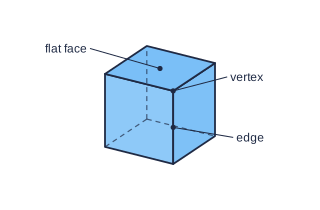
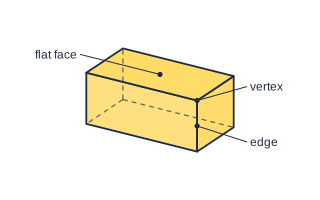
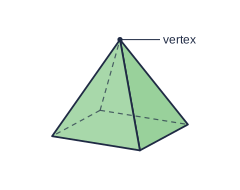
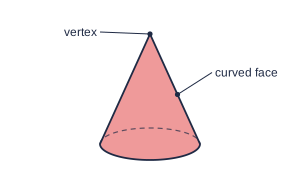
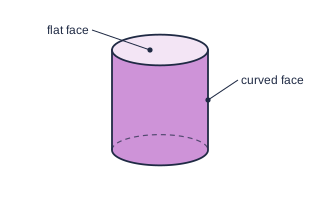
| Shape | Flat faces | Curved faces | Vertices | Straight edges |
|---|---|---|---|---|
| Cube | 6 squares, all the same size | 0 | 8 | 12 |
| Cuboid | 6 (rectangles, maybe 2 squares) | 0 | 8 | 12 |
| Pyramid | 5 (4 triangles and 1 square) | 0 | 5 | 8 |
| Cone | 1 | 1 | 1 | 0 |
| Cylinder | 2 | 1 | 0 | 0 |
It has 1 flat face, 1 curved face and 1 vertex. Which shape is it?
Look at the table. Only the cone has 1 flat face, 1 curved face and 1 vertex.
Show answerHide answer
Basic shapes in 3-D shapes
The flat faces of a 3-D shape are basic shapes, such as squares, rectangles, triangles and circles.
| 3-D shape | Basic shapes |
|---|---|
| Cube | 6 squares |
| Cuboid | 4 rectangles and 2 squares (or 6 rectangles) |
| Pyramid | 1 square and 4 triangles |
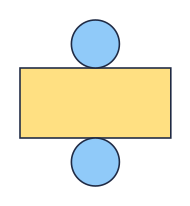
| Cylinder | 2 circles and 1 rectangle |
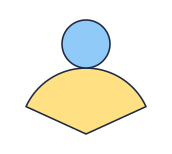
| Cone | 1 circle and 1 sector (a slice of a circle) |
Show answerHide answer
Nets
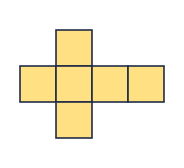
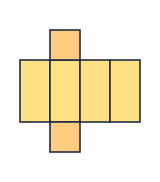
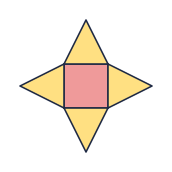
Show answerHide answer
7.22-D shapes
The faces of 3-D objects are 2-D shapes. A picture frame has a square surface. A 2-D shape is flat.
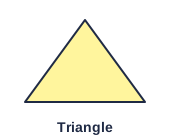
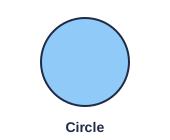
| Shape | Straight sides | Curved sides | Corners |
|---|---|---|---|
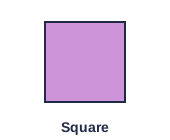
| Square | 4 (all the same length) | 0 | 4 |
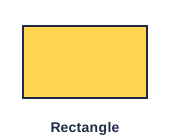
| Rectangle | 4 (opposite sides the same) | 0 | 4 |
| Triangle | 3 | 0 | 3 |
| Circle | 0 | 1 | 0 |
It has 3 straight sides and 3 corners. It is a triangle.
Show answerHide answer
Drawing 2-D shapes
You can trace a flat face of a 3-D shape on paper to get a 2-D shape. Trace the bottom of a tin of milk and you get a circle. Trace the face of a dice and you get a square. You can also join dots with a ruler on dot paper.
Show answerHide answer
7.3Solving problems
Read the problem slowly and underline the clues. Then try one of these methods.
- Guess and check: guess a shape, then check it against the clues.
- Draw a diagram: draw the faces or the net.
Sarjit pastes coloured paper on 6 flat faces of the same size to make a money box. What is its shape?
- Guess a pyramid. A pyramid has only 5 flat faces. Wrong.
- Guess a cube. A cube has 6 flat faces of the same size. Correct.
The money box is a cube.
Rini opens out a 3-D shape and gets 2 circles and 1 rectangle. These are the basic shapes of a cylinder.
Show answerHide answer
Summary
- 3-D shapes: cube, cuboid, pyramid, cone and cylinder. A cube and a cuboid have 6 faces, 8 vertices and 12 edges.
- A pyramid has 5 flat faces: 1 square and 4 triangles. A cone has 1 flat face, 1 curved face and 1 vertex. A cylinder has 2 flat faces and 1 curved face.
- A net folds into a 3-D shape. Count the basic shapes in the net to find the shape.
- 2-D shapes: a square and a rectangle have 4 sides and 4 corners, a triangle has 3 and a circle has 1 curved side and no corners.