Numbers up to 10 000
What this chapter covers
- You can read and write numbers up to 10 000 in numerals and in words (1.1, 1.2)
- You can show a number with base ten blocks and an abacus, and say its place value and digit value (1.1, 1.4)
- You can partition a number by place value and by digit value (1.4)
- You can compare numbers and arrange them in ascending and descending order (1.1, 1.3)
- You can count on and count back, and complete number patterns (1.3, 1.7)
- You can estimate using "more than", "less than" and "more or less" (1.5)
- You can round off numbers to the nearest ten, hundred and thousand (1.6)
- You can solve problems about numbers up to 10 000 (1.8)
1.1Reading and writing numbers
In Year 3 you learn numbers all the way up to 10 000 (ten thousand). You see big numbers everywhere: a chocolate factory makes 2 780 packets a day, and Kuala Lumpur Bird Park has about 3 000 birds.
To read a number, start from the left. Say the thousands, then the hundreds, then the tens and ones.
| Numeral | In words |
|---|---|
| 2 780 | two thousand seven hundred and eighty |
| 1 130 | one thousand one hundred and thirty |
| 3 589 | three thousand five hundred and eighty-nine |
| 9 027 | nine thousand and twenty-seven |
| 3 006 | three thousand and six |
| 10 000 | ten thousand |
Counting in thousands
10 hundreds make 1 thousand. When we count in thousands we go 1 000, 2 000, 3 000, 4 000, 5 000 … all the way to 10 000. Ten thousands make ten thousand.
Show answerHide answer
1.2Place value, digit value and partitioning
Every digit sits in a place. The place tells us how much the digit is worth.
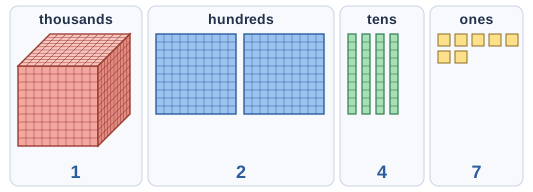
Digit value is how much the digit is worth in that place. The 2 in 1 247 is in the hundreds place, so its digit value is 200.
| Digit | 1 | 2 | 4 | 7 |
|---|---|---|---|---|
| Place value | thousands | hundreds | tens | ones |
| Digit value | 1 000 | 200 | 40 | 7 |
Partitioning
To partition a number means to break it into parts. We can do it in two ways.
Step 2. By digit value: 1 247 = 1 000 + 200 + 40 + 7.
Step 3. 6 035 has a 0 in the hundreds place. By place value: 6 thousands + 0 hundreds + 3 tens + 5 ones.
Step 4. By digit value we can leave out the 0: 6 035 = 6 000 + 30 + 5.
Reading an abacus
On the abacus, the beads that touch the middle bar are counted. An upper bead is worth 5. Each lower bead is worth 1.
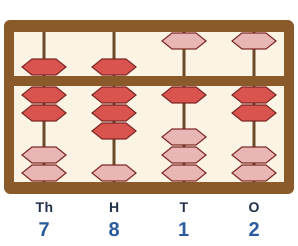
So 7 812 = 7 000 + 800 + 10 + 2.
Show answerHide answer
1.3Comparing and arranging numbers
At a Hari Kebangsaan sale, a stall sold 967 caps and 1 835 flags. Which was sold more?
Step 2. Same number of digits? Compare the thousands first. 1 835 and 1 249 both have 1 thousand.
Step 3. Equal? Compare the hundreds. 2 hundreds is smaller than 8 hundreds, so 1 249 is smaller than 1 835.
Step 4. Still equal? Move on to the tens, then the ones.
A number line helps too. The more to the right, the larger the number.

Ascending and descending order
Descending order: from the largest to the smallest (going down).
Step 1. Find the smallest: 2 800. Find the largest: 3 100.
Step 2. Ascending order: 2 800, 2 900, 3 000, 3 100.
Step 3. Descending order: 3 100, 3 000, 2 900, 2 800.
Show answerHide answer
1.4Counting and number patterns
We can count on (the numbers get bigger) or count back (the numbers get smaller) in ones, twos, fives, tens, hundreds, thousands and more.
- Count on in ones from 5 821: 5 821, 5 822, 5 823, 5 824
- Count on in tens from 5 821: 5 821, 5 831, 5 841, 5 851
- Count back in fives from 5 840: 5 840, 5 835, 5 830, 5 825
- Count on in hundreds: 5 730, 5 830, 5 930, 6 030, 6 130
- Count back in thousands: 7 930, 6 930, 5 930, 4 930, 3 930
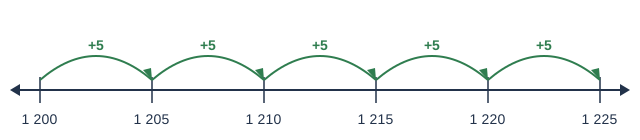
Step 1. Find the rule: 3 076 − 3 070 = 6. The numbers go down by 6 each time.
Step 2. 3 064 − 6 = 3 058.
Step 3. Check: 3 058 − 6 = 3 052. Correct! The pattern is decreasing in sixes.
Show answerHide answer
1.5Estimating
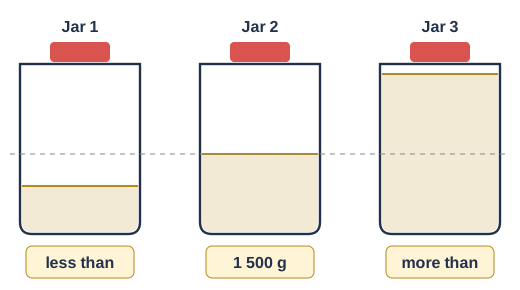
Step 1. Half of 1 200 ml is 600 ml.
Step 2. So the second bottle has more or less 600 ml.
1.6Rounding off
Sometimes we do not need the exact number. We round off to a "nice" number that is near it. A news report may say "about 6 000 cm" instead of "5 820 cm".
To the nearest ten

So 1 362 rounded off to the nearest ten is 1 360.
To the nearest hundred

To the nearest thousand
Step 2. The rule: if the hundreds digit is 5, 6, 7, 8 or 9, add 1 to the thousands. If it is 0, 1, 2, 3 or 4, keep the thousands the same.
Step 3. 8 is in the first group, so 5 thousands becomes 6 thousands.
Step 4. Change the hundreds, tens and ones to 0: 6 000.

Mount Kinabalu is 4 095 metres high. The hundreds digit is 0, so we keep 4 thousands: 4 095 rounds off to 4 000.
| Round off to the nearest … | Look at this digit | Example: 8 519 |
|---|---|---|
| ten | ones | 8 520 |
| hundred | tens | 8 500 |
| thousand | hundreds | 9 000 |
Show answerHide answer
1.7Solving problems
Read the problem carefully. Find the important information. Then choose a way to solve it: make a table, look for a pattern, draw a number line or work backwards.
| thousands | hundreds | tens | ones | |
|---|---|---|---|---|
| Juli | 2 | 6 | 0 | 5 |
| Stacy | 2 | 7 | 1 | 9 |
1 302, 1 304, 1 306, 1 308, 1 310, 1 312. The purple chalet is number 1 312.
Step 1. Draw a number line from 1 490 to 1 510. Numbers from 1 495 up to 1 504 are nearer to 1 500 (1 495 is in the middle, so it is rounded up).
Step 2. The number became 1 500 after rounding, so it was not 1 500 to start with. The textbook answer: the audience could be 1 495 to 1 499 or 1 501 to 1 504.
Show answerHide answer
Summary
- Numbers up to 10 000 are read from the left: thousands, hundreds, tens, ones. A 0 is not said, but it must be written.
- Place value is the name of the place; digit value is what the digit is worth (the 2 in 1 247 is worth 200).
- Partition by place value (1 thousand + 2 hundreds + 4 tens + 7 ones) or by digit value (1 000 + 200 + 40 + 7).
- To compare, look at the thousands first, then hundreds, tens and ones. On a number line, larger numbers are on the right.
- Ascending = smallest to largest. Descending = largest to smallest.
- A number pattern is "increasing in …" or "decreasing in …". Find the rule by subtracting two numbers next to each other.
- Estimate with "more than", "less than" and "more or less".
- Rounding off: look at the digit to the right of the place you want. 5 or more, round up; 4 or less, keep it.
- Solve problems by making a table, looking for a pattern, drawing a number line or working backwards.