Addition, Subtraction, Multiplication and Division
What this chapter covers
- You can add two or three numbers with a total up to 10 000, with and without regrouping (2.1)
- You can subtract numbers up to 10 000, including subtracting two numbers one after another (2.2)
- You can multiply a number by a one-digit number, and by 10, 100 and 1 000 (2.3)
- You can divide a number by a one-digit number, and by 10, 100 and 1 000, with and without a remainder (2.4)
- You can work out number sentences that mix addition and subtraction (2.5)
- You can find the unknown in a number sentence (2.6)
- You can create stories from number sentences and solve problems in daily life (2.7)
2.1Addition
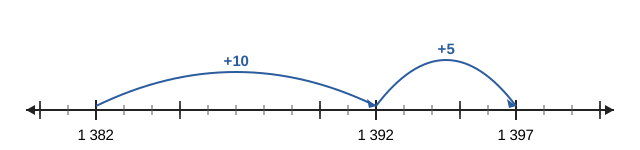
At the zoo there are 1 382 birds and 15 crocodiles. How many birds and crocodiles are there altogether? We can count on along a number line: jump 10, then jump 5.
Adding in columns
For bigger numbers, write them in a place-value chart: thousands, hundreds, tens and ones. Always start adding from the ones.
Example 1: 3 215 + 1 997 (p. 34)
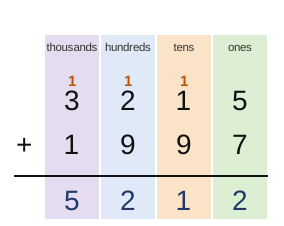
- Ones: 5 + 7 = 12. Write 2, carry 1 ten.
- Tens: 1 + 9 + 1 = 11. Write 1, carry 1 hundred.
- Hundreds: 2 + 9 + 1 = 12. Write 2, carry 1 thousand.
- Thousands: 3 + 1 + 1 = 5.
3 215 + 1 997 = 5 212
Smart way: 1 997 is very near 2 000. Take 3 from 3 215 and give it to 1 997: 3 212 + 2 000 = 5 212.
Finding a missing number. 5 602 tickets are sold. The target is 5 648. How many more? 5 602 + ☐ = 5 648. Take away: 5 648 − 5 602 = 46 (p. 31).
Using an abacus
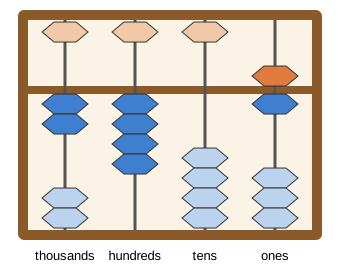
On an abacus, the top bead is worth 5 and each bottom bead is worth 1 when it is pushed to the middle bar. The abacus below shows 2 406: 2 thousands, 4 hundreds, 0 tens and 6 ones (top bead + 1 bottom bead).
Adding three numbers
Add all three numbers in the same chart, column by column. You can also add two of the numbers first and then add the third.
Example 2: 169 + 3 547 + 49 (p. 37)
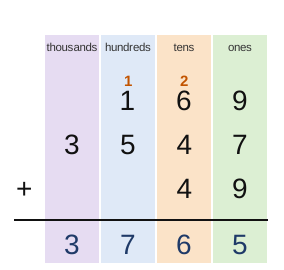
- Ones: 9 + 7 + 9 = 25. Write 5, carry 2 tens.
- Tens: 6 + 4 + 4 + 2 = 16. Write 6, carry 1 hundred.
- Hundreds: 1 + 5 + 1 = 7. Thousands: 3.
169 + 3 547 + 49 = 3 765
Show answerHide answer
2.2Subtraction
Start from the ones. If the top digit is too small, regroup: change 1 from the next column into 10.
Example 3: 1 283 − 790 (adult and teenage train passengers, p. 44)
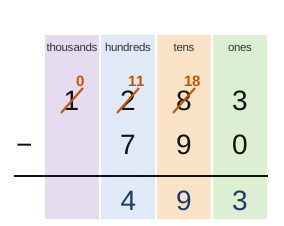
- Ones: 3 − 0 = 3.
- Tens: 8 − 9 cannot. Change 1 hundred into 10 tens: 18 − 9 = 9. The hundreds digit becomes 1.
- Hundreds: 1 − 7 cannot. Change 1 thousand into 10 hundreds: 11 − 7 = 4. The thousands digit becomes 0.
1 283 − 790 = 493
Example 4: 8 000 − 1 203 (p. 45)
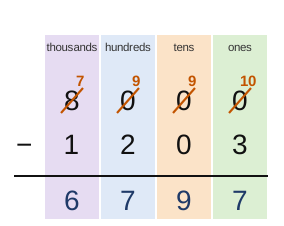
There are no ones, tens or hundreds in 8 000, so regroup from the thousands: 8 thousands become 7 thousands, 9 hundreds, 9 tens and 10 ones. Then subtract each column.
8 000 − 1 203 = 6 797
Smart way: take 1 from both numbers. 7 999 − 1 202 = 6 797. No regrouping needed!
Subtracting one after another
There are 2 458 young plants at a nursery. One customer buys 103, another buys 12. How many are left? (p. 48)
| Method 1: one at a time | Method 2: add what was taken first |
|---|---|
| 2 458 − 103 = 2 355 2 355 − 12 = 2 343 | 103 + 12 = 115 2 458 − 115 = 2 343 |
Both ways give 2 343 plants left.
Show answerHide answer
2.3Multiplication
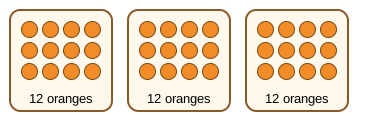
Example 5: 6 school buses with 44 pupils each (p. 64)
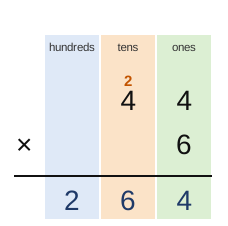
- Ones: 6 × 4 = 24 ones. Write 4, carry 2 tens.
- Tens: 6 × 4 = 24 tens, plus the 2 carried = 26 tens. Write 6 tens and 2 hundreds.
6 × 44 = 264 pupils.
Example 6: 576 × 8 by place value (p. 65)
Break 576 into 500 + 70 + 6 and multiply each part by 8:
500 × 8 = 4 000 70 × 8 = 560 6 × 8 = 48
4 000 + 560 + 48 = 4 608
Multiplying by 10, 100 and 1 000
| Multiply by | What happens | Examples |
|---|---|---|
| 10 | Add one 0 at the end | 9 × 10 = 90 596 × 10 = 5 960 |
| 100 | Add two 0s | 9 × 100 = 900 78 × 100 = 7 800 |
| 1 000 | Add three 0s | 9 × 1 000 = 9 000 10 × 1 000 = 10 000 |
Show answerHide answer
2.4Division
24 small stones are put equally into 2 jars. 24 ÷ 2 = 12 stones in each jar (p. 66).
Long division
For bigger numbers we use long division. Start from the digit on the left (the biggest place value).
Example 7: 628 doughnuts packed in fours (p. 67)
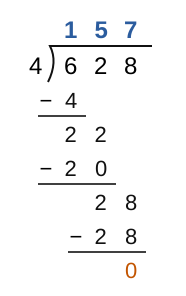
- Hundreds: 6 ÷ 4 = 1, and 6 − 4 = 2 left. Bring down the 2 to make 22.
- Tens: 22 ÷ 4 = 5, and 22 − 20 = 2 left. Bring down the 8 to make 28.
- Ones: 28 ÷ 4 = 7, and 28 − 28 = 0.
628 ÷ 4 = 157 packets. Check: 157 × 4 = 628.
Division with a remainder
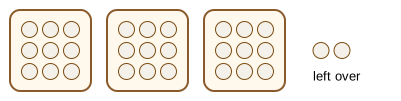
Check: 3 × 9 = 27, and 27 + 2 = 29.
Dividing by 10, 100 and 1 000
| Number sentence | Answer |
|---|---|
| 690 ÷ 10 | 69 |
| 8 600 ÷ 100 | 86 |
| 7 000 ÷ 1 000 | 7 |
| 682 ÷ 10 | 68 remainder 2 |
Show answerHide answer
2.5Mixed addition and subtraction
Some number sentences have both + and −. Work from left to right, one step at a time.
Example 8: 8 728 − 524 + 39 (p. 52)
- Left first: 8 728 − 524 = 8 204.
- Then: 8 204 + 39 = 8 243.
8 728 − 524 + 39 = 8 243
Example: there are 15 red hats and 20 blue hats. 3 hats are worn. 15 + 20 − 3 = 35 − 3 = 32 hats are not worn (p. 51).
Show answerHide answer
2.6Finding the unknown
| Story | Number sentence | Unknown |
|---|---|---|
| 7 fish in the tank. Father adds some. Now there are 10. | 7 + ☐ = 10 | 3 |
| 12 cupcakes. Some are eaten. 9 are left. | 12 − ☐ = 9 | 3 |
| 3 comics with the same pages. 150 pages in all. | 3 × ☐ = 150 | 50 |
| 20 papers shared equally. Each pupil gets 5. | 20 ÷ ☐ = 5 | 4 |
A bar model helps you see the unknown. At a supermarket car park, 40 spaces are occupied and 596 are empty. What is the total? (p. 58)

☐ = 40 + 596 = 636 parking spaces.
Show answerHide answer
2.7Create stories and solve problems
Create a story
A number sentence can become a story. Example: 3 × 24 = 72. Puan Zurina gives bags of souvenirs to 3 group leaders. Each leader gets 24 bags. She gives out 72 bags in all. (p. 73)
Solve problems in 4 steps
- Understand: underline what is given and what you must find.
- Plan: draw a picture or a bar model and choose +, −, × or ÷.
- Solve: write the number sentence and calculate.
- Check: use the opposite operation or estimate.
| Key words | Operation |
|---|---|
| total, altogether, more are added | + |
| left, difference, how many more, given away | − |
| each … how many in all, times as many | × |
| shared equally, each gets, packed into | ÷ |
Example 9: water for Sports Day (p. 56)
A school has 1 340 bottles of mineral water. The PTA gives another 960 bottles. 1 550 bottles are given to guests. How many bottles are left?
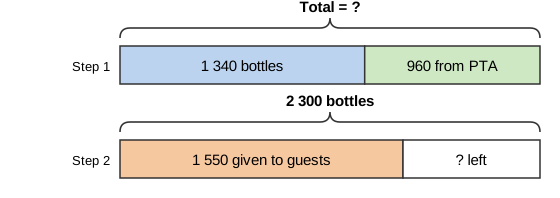
- 1 340 + 960 = 2 300
- 2 300 − 1 550 = 750
750 bottles are left. Check: 750 + 1 550 = 2 300.
Example 10: soursop juice (p. 76)
A factory makes 9 507 bottles of soursop juice. 8 bottles go in each box. How many boxes? How many bottles are left over?
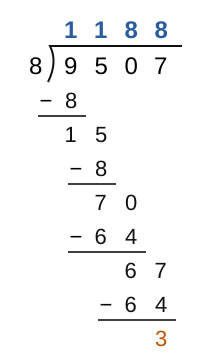
9 507 ÷ 8 = 1 188 remainder 3. There are 1 188 boxes and 3 bottles left over. Check: 1 188 × 8 + 3 = 9 507.
Show answerHide answer
Summary
| Operation | Remember | Example |
|---|---|---|
| Addition + | Start from the ones; carry when a column is 10 or more | 3 215 + 1 997 = 5 212 |
| Subtraction − | Start from the ones; regroup when the top digit is smaller; check by adding | 1 283 − 790 = 493 |
| Multiplication × | Equal groups; add the carried number; × 10, 100, 1 000 adds 0s | 6 × 44 = 264 |
| Division ÷ | Start from the left; remainder is smaller than the divisor; check by multiplying | 628 ÷ 4 = 157 |
| Mixed + and − | Work from left to right | 8 728 − 524 + 39 = 8 243 |
| Unknown ☐ | Use the opposite operation | ☐ + 90 = 105, ☐ = 15 |