Fractions, Decimals and Percentages
What this chapter covers
- You can name proper fractions and say which part is the numerator and which is the denominator (3.1.1)
- You can find equivalent fractions and write a fraction in its simplest form (3.1.2, 3.1.3)
- You can tell mixed numbers and improper fractions apart and change one into the other (3.1.7)
- You can add and subtract fractions, including when one denominator is a multiple of the other (3.1.5, 3.1.6)
- You can read, write and compare decimals up to hundredths (3.1.4, 3.2.1–3.2.3)
- You can add and subtract decimals by lining up the decimal points (3.2.4, 3.2.5)
- You can change between fractions of hundredths, decimals and percentages (3.3, 3.4)
- You can solve everyday problems and create stories with fractions, decimals and percentages (3.5.1, 3.5.2)
Fractions, decimals and percentages are everywhere. A shop sign says 50% off. Your pen tip is 0.7 mm. Mak cuts a cake into equal pieces and gives you 14. In this unit you will learn to read, write, add and subtract them.
3.1Proper fractions
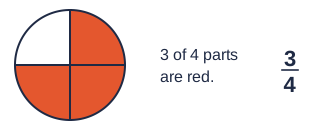
| Part | What it tells us | In 34 |
|---|---|---|
| Numerator (top) | How many parts we take | 3 |
| Denominator (bottom) | How many equal parts in the whole | 4 |
34 is a proper fraction. In a proper fraction the numerator is smaller than the denominator, so its value is less than 1.
We can also find fractions of a group of things. Count all the things. That is the denominator.

Show answerHide answer
3.2Equivalent fractions and the simplest form
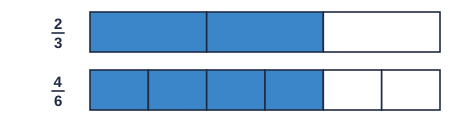
Use the fraction chart. Look at the red dashed line. In the rows for halves, quarters, sixths, eighths and tenths, the parts fit exactly up to the line, so each of these shows a fraction equal to 12. In the rows for thirds and fifths, the line cuts through the middle of a part, so no number of thirds or fifths is equal to 12.
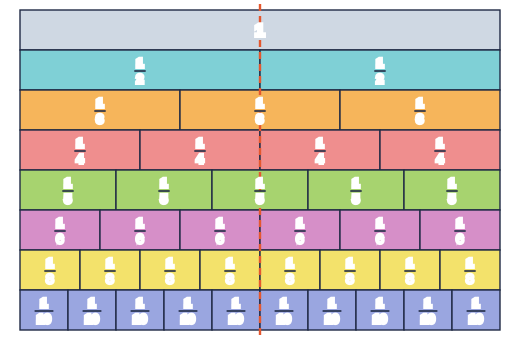
Example 1: Find an equivalent fraction
23 = ?6
- 3 becomes 6. We multiplied by 2.
- Do the same to the top: 2 × 2 = 4.
- So 23 = 46.
Simplest form
A fraction is in its simplest form when the numerator and the denominator can only both be divided by 1.
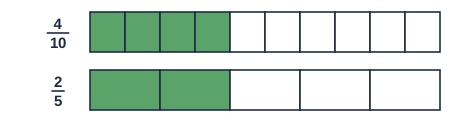
Example 2: Simplify 410
- 4 and 10 can both be divided by 2.
- 4 ÷ 2 = 2 and 10 ÷ 2 = 5.
- 2 and 5 cannot both be divided again. So 410 = 25.
Show answerHide answer
3.3Mixed numbers and improper fractions

Example 3: Two hexagons

- Each hexagon has 6 equal parts, so each part is 16.
- Count the green parts: 6 + 5 = 11.
- As an improper fraction: 116. As a mixed number: 156.
3.4Adding and subtracting fractions
Same denominator
When the denominators are the same, add or subtract the numerators only. Keep the denominator.
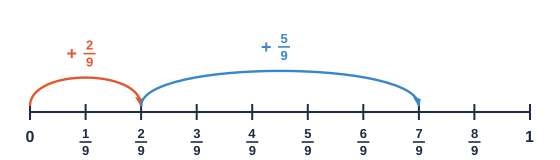
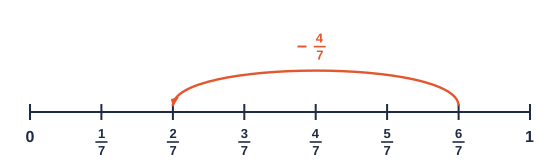
Different denominators
First make the denominators the same. Use an equivalent fraction.
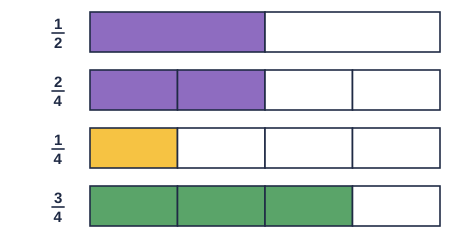
Example 4: 12 + 14
- Change halves into quarters: 12 = 24.
- Add: 24 + 14 = 34.
Example 5: 56 − 12
- Change halves into sixths. Multiply the top and bottom by 3: 12 = 36.
- Subtract: 56 − 36 = 26.
- Simplify: 26 = 13.
b) 910 − 25 = ?
Show answerHide answer
b) 25 = 410, so 910 − 410 = 510 = 12.
3.5Decimals
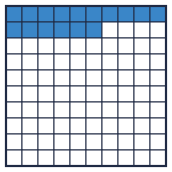
The kitchen floor has 100 tiles. 16 tiles are blue.
| Fraction | Ones | . | Tenths | Hundredths | Decimal | Read as |
|---|---|---|---|---|---|---|
| 16100 | 0 | . | 1 | 6 | 0.16 | zero point one six |
| 4100 | 0 | . | 0 | 4 | 0.04 | zero point zero four |
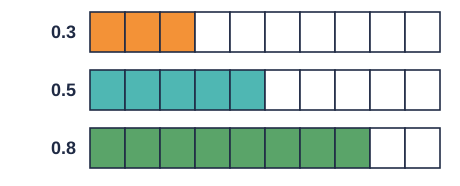
| 310 | 0 | . | 3 | 0.3 | zero point three |
Comparing decimals
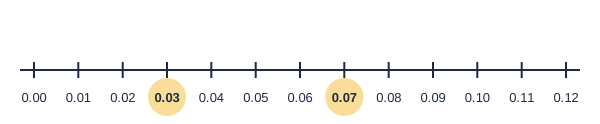
Which is heavier, 0.45 kg or 0.2 kg? Line up the decimal points. Compare the tenths first: 4 tenths is more than 2 tenths. So 0.45 kg is heavier.
3.6Adding and subtracting decimals
Add and subtract decimals just like whole numbers. The big rule: line up the decimal points.
Example 6: 0.25 ℓ + 0.4 ℓ
- Write 0.4 as 0.40 so both have hundredths.
- Line up the points: 0.25 + 0.40.
- Add hundredths: 5 + 0 = 5. Add tenths: 2 + 4 = 6.
- Answer: 0.65 ℓ.
Example 7: 0.6 kg − 0.13 kg
- Write 0.6 as 0.60.
- We cannot take 3 hundredths from 0 hundredths. Regroup 1 tenth into 10 hundredths: 0.60 becomes 5 tenths and 10 hundredths.
- 10 − 3 = 7 hundredths. 5 − 1 = 4 tenths.
- Answer: 0.47 kg. Check: 0.47 + 0.13 = 0.60 ✓
b) 0.87 − 0.09 = ?
Show answerHide answer
b) 0.87 − 0.09 = 0.78 (regroup: 17 − 9 = 8 hundredths).
3.7Percentages
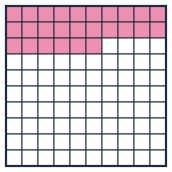
A fraction of hundredths, a decimal and a percentage can show the same amount:
| Fraction | Decimal | Percentage |
|---|---|---|
| 42100 | 0.42 | 42% |
| 8100 | 0.08 | 8% |
| 69100 | 0.69 | 69% |
| 95100 | 0.95 | 95% |
3.8Solving problems and creating stories
Use four steps: Given (what you know), Find (what is asked), Method (number sentence) and Check.
Example 8: At the pasar malam
Aisyah buys 0.9 kg of prawns and 0.55 kg of squid. How much more prawns than squid does she buy?
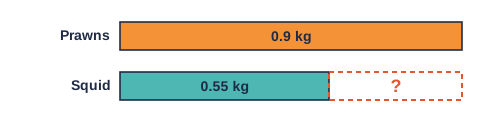
- Given: prawns 0.9 kg, squid 0.55 kg. Find: the difference.
- Method: 0.90 − 0.55 = 0.35
- Check: 0.35 + 0.55 = 0.90 ✓
- Answer: She buys 0.35 kg more prawns.
Example 9: Kuih for the kenduri
Mak Long uses 12 kg of flour and 14 kg of sugar. What is the total mass?
- 12 kg = 24 kg
- 24 kg + 14 kg = 34 kg
- The total mass is 34 kg.
Example 10: Chess Club
There are 100 pupils in the Chess Club. 45 are girls. What percentage are boys?
- Boys: 100 − 45 = 55
- 55 of 100 = 55100 = 55%
Create a story
You can turn a number sentence into a story. Use words like altogether and total for +, and left, difference and how much more for −.
Story for 0.6 ℓ − 0.25 ℓ = 0.35 ℓ
A bottle has 0.6 ℓ of mineral water. Ali drinks 0.25 ℓ after football. There is 0.35 ℓ of water left.
Show answerHide answer
Summary
- Fraction: numerator (parts taken) over denominator (equal parts in the whole). A proper fraction is less than 1.
- Equivalent fractions have the same value. Multiply or divide the top and bottom by the same number.
- Simplest form: divide top and bottom until only 1 divides both.
- Mixed number = whole number + proper fraction, e.g. 114. Improper fraction: numerator ≥ denominator, e.g. 54.
- Add or subtract fractions: make the denominators the same, then work with the numerators only. Simplify the answer.
- Decimals: 310 = 0.3, 16100 = 0.16. Line up the decimal points to add and subtract.
- Percent means out of 100: 42100 = 0.42 = 42%.