Length, Mass and Volume of Liquid
What this chapter covers
- You can change metres to centimetres and centimetres to metres (6.1.1)
- You can add, subtract, multiply and divide lengths in m and cm (6.1.2–6.1.5)
- You can change kilograms to grams and grams to kilograms (6.2.1)
- You can add, subtract, multiply and divide masses in kg and g (6.2.2–6.2.5)
- You can change litres to millilitres and millilitres to litres (6.3.1)
- You can add, subtract, multiply and divide volumes of liquid in ℓ and mℓ (6.3.2–6.3.5)
- You can create stories and solve everyday problems about length, mass and volume of liquid (6.4.1–6.4.2)
In this unit we measure three things: how long something is (length), how heavy it is (mass) and how much liquid a container holds (volume of liquid). You will change between units and then add, subtract, multiply and divide with them.
6.1Length: metres and centimetres
1 m = 100 cm
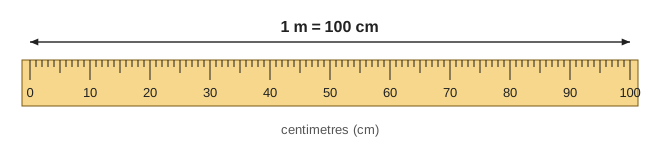
A door is about 2 m tall. Your finger is about 1 cm wide. We use m for long things and cm for short things.
Changing units
| From | To | What to do | Example |
|---|---|---|---|
| m | cm | multiply by 100 | 3 m = 3 × 100 = 300 cm |
| cm | m | divide by 100 | 400 cm = 400 ÷ 100 = 4 m |
Step 1: 9 m = 9 × 100 = 900 cm
Step 2: 900 cm + 20 cm = 920 cm
b) An orangutan is 150 cm tall. Write this in m and cm.
150 cm = 100 cm + 50 cm = 1 m + 50 cm = 1 m 50 cm
Adding and subtracting lengths
Add or subtract the same way as whole numbers. Keep m with m and cm with cm.
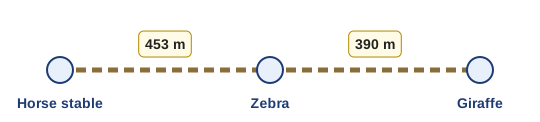
87 cm + 1 m 64 cm + 1 m 32 cm = ?
Step 1: add the cm: 87 + 64 + 32 = 183 cm
Step 2: add the m: 1 + 1 = 2 m
Step 3: 183 cm is more than 100 cm, so change 100 cm into 1 m: 183 cm = 1 m 83 cm
Step 4: 2 m + 1 m 83 cm = 3 m 83 cm
30 m 58 cm − 23 m 77 cm = ?
Step 1: 58 cm is less than 77 cm. Take 1 m from 30 m and change it to 100 cm.
Step 2: now we have 29 m 158 cm.
Step 3: cm: 158 − 77 = 81 cm. m: 29 − 23 = 6 m.
Answer: 6 m 81 cm
Multiplying and dividing lengths
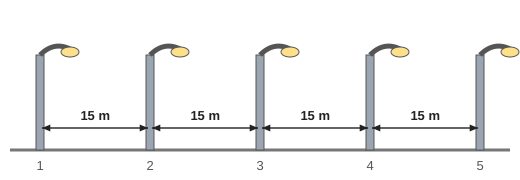
b) A terrace house is 6 m 80 cm wide. How long is a row of 6 houses?
6 × 80 cm = 480 cm = 4 m 80 cm
6 × 6 m = 36 m
36 m + 4 m 80 cm = 40 m 80 cm
c) A horse stable 17 m 40 cm long has 3 equal sections. How long is each section?
Change to cm: 17 m 40 cm = 1 740 cm
1 740 ÷ 3 = 580 cm = 5 m 80 cm
c) 13 m 78 cm − 6 m 90 cm d) 864 cm ÷ 8 (answer in m and cm)
Show answerHide answer
b) 4 m 30 cm
c) 1 378 cm − 690 cm = 688 cm = 6 m 88 cm
d) 864 ÷ 8 = 108 cm = 1 m 8 cm
6.2Mass: kilograms and grams
1 kg = 1 000 g and half a kilogram = 500 g
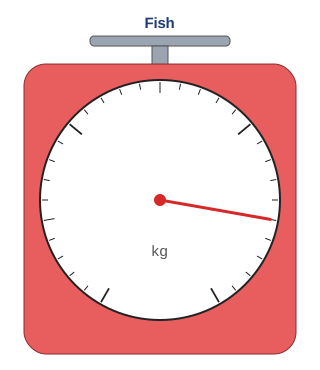
A packet of sugar is 1 kg. A sweet is only a few grams. At the pasar, the seller puts fish on a weighing scale to find its mass.
Changing units
| From | To | What to do | Example |
|---|---|---|---|
| kg | g | multiply by 1 000 | 4 kg = 4 × 1 000 = 4 000 g |
| g | kg | divide by 1 000 | 7 000 g = 7 000 ÷ 1 000 = 7 kg |
b) An ostrich egg is 1 400 g. 1 400 g = 1 000 g + 400 g = 1 kg 400 g
Adding and subtracting mass
Step 1: g: 450 + 950 + 780 = 2 180 g
Step 2: kg: 2 + 1 + 2 = 5 kg
Step 3: 2 180 g = 2 kg 180 g, so add 2 kg to the 5 kg.
Answer: 7 kg 180 g
Step 1: 90 g is less than 780 g. Change 1 kg into 1 000 g: 7 kg 90 g = 6 kg 1 090 g
Step 2: g: 1 090 − 780 = 310 g. kg: 6 − 5 = 1 kg.
Answer: 1 kg 310 g
Multiplying and dividing mass
9 × 300 g = 2 700 g = 2 kg 700 g. 9 × 2 kg = 18 kg.
18 kg + 2 kg 700 g = 20 kg 700 g
b) 5 kg of mussels is packed equally into 8 packets.
5 kg = 5 000 g. 5 000 ÷ 8 = 625 g in each packet.
c) 8 kg 400 g ÷ 7
8 kg 400 g = 8 400 g. 8 400 ÷ 7 = 1 200 g = 1 kg 200 g
Show answerHide answer
b) 6 × 4 129 g = 24 774 g = 24 kg 774 g
c) 25 200 g ÷ 7 = 3 600 g = 3 kg 600 g
6.3Volume of liquid: litres and millilitres
1 ℓ = 1 000 mℓ
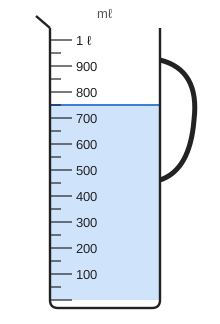
A big carton of milk is 1 ℓ. A spoonful of medicine is about 5 mℓ. We use a measuring jug to measure liquids.
Changing units
| From | To | What to do | Example |
|---|---|---|---|
| ℓ | mℓ | multiply by 1 000 | 2 ℓ = 2 × 1 000 = 2 000 mℓ |
| mℓ | ℓ | divide by 1 000 | 8 000 mℓ = 8 000 ÷ 1 000 = 8 ℓ |
b) A bottle of fabric softener holds 2 350 mℓ. 2 350 mℓ = 2 000 mℓ + 350 mℓ = 2 ℓ 350 mℓ
Adding and subtracting volumes
mℓ: 720 + 80 + 980 = 1 780 mℓ = 1 ℓ 780 mℓ. ℓ: 5 + 2 = 7 ℓ.
7 ℓ + 1 ℓ 780 mℓ = 8 ℓ 780 mℓ
b) A big bottle has 10 ℓ of water. 4 095 mℓ is poured into a small bottle. How much is left?
10 ℓ = 10 000 mℓ. 10 000 − 4 095 = 5 905 mℓ
Multiplying and dividing volumes
8 × 450 mℓ = 3 600 mℓ = 3 ℓ 600 mℓ. 8 × 2 ℓ = 16 ℓ.
16 ℓ + 3 ℓ 600 mℓ = 19 ℓ 600 mℓ
b) 11 ℓ of air sirap is shared equally into 8 jugs.
11 ℓ = 11 000 mℓ. 11 000 ÷ 8 = 1 375 mℓ = 1 ℓ 375 mℓ in each jug.
Show answerHide answer
b) 730 + 407 = 1 137 mℓ = 1 ℓ 137 mℓ, so 15 ℓ + 1 ℓ 137 mℓ = 16 ℓ 137 mℓ
c) 6 000 mℓ ÷ 8 = 750 mℓ
6.4Creating stories and solving problems
Create a story
A number sentence can tell a story. Look at the numbers and units, then think of a real thing at home, at school or at the pasar malam.
Mak uses 3 blocks of butter to bake Hari Raya biscuits. Each block is 250 g. She uses 750 g of butter altogether.
1 ℓ 200 mℓ ÷ 4 = 300 mℓ
There is 1 ℓ 200 mℓ of sugarcane juice in a jug at the pasar malam stall. It is poured equally into 4 glasses. Each glass has 300 mℓ.
Solve the problems
Use four steps: Given (what do I know?), Find (what must I work out?), Method (which operation?) and Answer (with the unit). Drawing a bar model helps you see whether to add, subtract, multiply or divide.
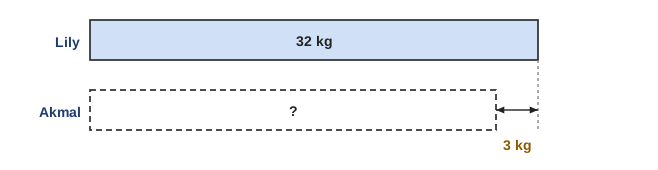
Given: Lily 32 kg, 3 kg more than Akmal. Find: Akmal's mass.
Method: 32 kg − 3 kg = 29 kg
Answer: Akmal's mass is 29 kg.
a) Bandung: 5 × 3 ℓ 400 mℓ = 5 × 3 400 mℓ = 17 000 mℓ = 17 ℓ
b) She pours the bandung equally into 8 jugs: 17 000 mℓ ÷ 8 = 2 125 mℓ = 2 ℓ 125 mℓ in each jug.
Check: 8 × 2 125 = 17 000. ✔
b) A yellow hose is 1 m 35 cm long. A green hose is 4 times as long. How long is the green hose?
Show answerHide answer
b) 1 m 35 cm = 135 cm. 4 × 135 cm = 540 cm = 5 m 40 cm
Summary
| Measure | Units | Big to small | Small to big |
|---|---|---|---|
| Length | 1 m = 100 cm | m → cm: × 100 | cm → m: ÷ 100 |
| Mass | 1 kg = 1 000 g | kg → g: × 1 000 | g → kg: ÷ 1 000 |
| Volume of liquid | 1 ℓ = 1 000 mℓ | ℓ → mℓ: × 1 000 | mℓ → ℓ: ÷ 1 000 |
- Add, subtract, multiply and divide like whole numbers. Keep big units with big units and small units with small units.
- When the small units reach 100 cm, 1 000 g or 1 000 mℓ, change them into 1 m, 1 kg or 1 ℓ.
- When you cannot subtract the small units, change 1 big unit into small units first.
- For division, it is often easier to change everything into the small unit first.
- Always write the unit in your answer, and check whether the question wants cm, m and cm, g, kg and g, mℓ, or ℓ and mℓ.
- Solve problems with Given, Find, Method and Answer. A bar model helps.