myUASARevision for UASA
Mathematics notes, unit 5

Time

Textbook Mathematics Year 3 (DLP), Part 1 and Part 2, pages Part 2, 25–48

What this chapter covers

  • You can say and record the time of activities from a programme or a timetable (5.1)
  • You can read a calendar and know that 1 week = 7 days and 1 year = 12 months (5.2, 5.3)
  • You can change seconds to minutes, minutes to hours, and back again (5.2)
  • You can add and subtract time in hours, minutes and seconds, and regroup when you need to (5.4, 5.5, 5.6)
  • You can multiply and divide time by a one-digit number (5.7, 5.8)
  • You can create stories from number sentences and solve problems about time (5.9)

5.1Say and record time

Every day we do things at different times. A programme is a list that tells us what happens and when it happens. A timetable tells us when each lesson starts and ends.
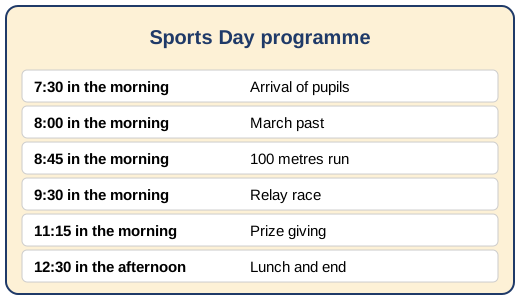
We say the time with the part of the day: in the morning (after midnight until noon), in the afternoon (after noon), in the evening and at night. For example, 8:30 in the morning and 3:15 in the afternoon.
Sports Day programme from 7:30 in the morning to 12:30 in the afternoon
A Sports Day programme. Read it from top to bottom: the times go in order.

Let's read the programme out loud and record it in sentences:

  • Pupils arrive at 7:30 in the morning.
  • The march past starts at 8:00 in the morning. Before that, the pupils arrive.
  • The relay race starts at 9:30 in the morning, after the 100 metres run.
  • Lunch is at 12:30 in the afternoon. It is the last activity.
Did you know? 12:00 in the afternoon is called noon (tengah hari). That is when many families in Malaysia have lunch.
Do not forget the part of the day. "8:00" alone could be 8:00 in the morning or 8:00 at night. Always write 8:00 in the morning or 8:00 at night.
Look at the Sports Day programme. What starts at 11:15 in the morning? What happens just before it?
Show answerHide answer
The prize giving starts at 11:15 in the morning. Just before it is the relay race (9:30 in the morning).

5.2Days, weeks, months and the calendar

A calendar shows the days, weeks and months of a year. We use it to find dates such as birthdays, school holidays, Hari Raya and Hari Merdeka.

1 week = 7 days  (Sunday, Monday, Tuesday, Wednesday, Thursday, Friday, Saturday)
1 year = 12 months  (January to December)
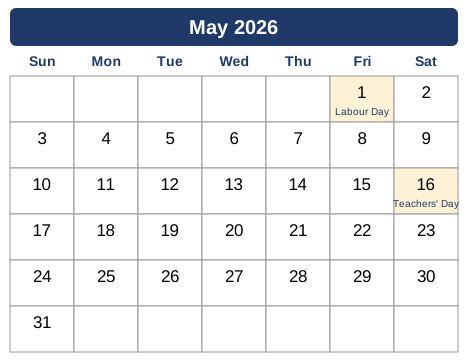
Calendar for May 2026
The calendar for May 2026. Each row is one week, from Sunday to Saturday.
Reading the calendar
1. The first day of May 2026 is a Friday (look at the column above the 1).
2. Teachers' Day, 16 May, is a Saturday.
3. The last day of May is the 31st. It is a Sunday.
4. May has 31 days.
Number of daysMonths
31 daysJanuary, March, May, July, August, October, December
30 daysApril, June, September, November
28 days (29 in a leap year)February
Did you know? Make two fists and count the months on your knuckles and the spaces between them. Months on a knuckle have 31 days. Months in a gap have 30 days (or 28/29 for February).
Look at the May 2026 calendar. (a) What day is 25 May? (b) How many Saturdays are there in May 2026?
Show answerHide answer
(a) Monday. (b) 5 Saturdays: 2, 9, 16, 23 and 30 May.

5.3Seconds, minutes and hours

A clock can have three hands. The short, thick hand is the hour hand. The long hand is the minute hand. The thin hand that moves quickly is the second hand.
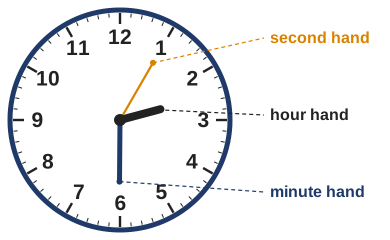
Clock showing 2:30 and 5 seconds with the three hands labelled
The clock shows 2:30 and 5 seconds.

Minutes and seconds

The second hand moves one small mark every second. When it goes 1 complete circle, 60 seconds have passed, and the minute hand moves 1 small mark.
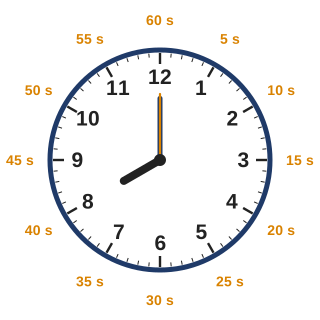
Clock face with 5 s, 10 s, 15 s up to 60 s marked around it
Count in fives as the second hand goes round: 5 s, 10 s, 15 s, … 60 s.
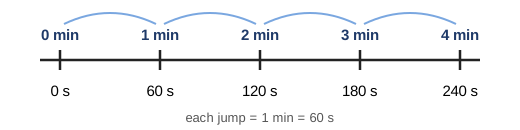
60 seconds = 1 minute    60 minutes = 1 hour
Number line: 0, 1, 2, 3, 4 minutes match 0, 60, 120, 180, 240 seconds
Each jump of 1 minute is 60 seconds.
Minutes to seconds: Mak boils eggs for 4 minutes. How many seconds?
1 minute = 60 seconds, so multiply by 60.
4 minutes = 4 × 60 seconds = 240 seconds.
Seconds to minutes
360 seconds: count 60, 120, 180, 240, 300, 360. That is 6 jumps of 60.
360 seconds = 6 minutes.
200 seconds is not a whole number of minutes. Take out the biggest group of 60s first:
200 seconds = 180 seconds + 20 seconds
= 3 minutes + 20 seconds = 3 minutes 20 seconds.

Hours and minutes
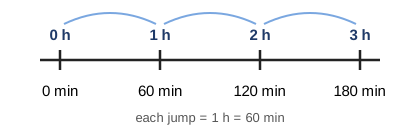
Number line: 0, 1, 2, 3 hours match 0, 60, 120, 180 minutes
Each jump of 1 hour is 60 minutes.
Hours and minutes
Aiman does revision for 2 hours. 2 hours = 60 minutes + 60 minutes = 120 minutes.
180 minutes: 180 − 60 − 60 − 60 = 0. We took away 60 three times, so 180 minutes = 3 hours.
140 minutes = 120 minutes + 20 minutes = 2 hours + 20 minutes = 2 hours 20 minutes.
1 hour is 60 minutes, not 100 minutes. So 150 minutes is not "1 hour 50 minutes". It is 120 + 30 = 2 hours 30 minutes.
Complete: (a) 7 minutes = ___ seconds   (b) 250 seconds = ___ minutes ___ seconds   (c) 3 hours = ___ minutes   (d) 135 minutes = ___ hours ___ minutes
Show answerHide answer
(a) 7 × 60 = 420 seconds
(b) 250 = 240 + 10 = 4 minutes 10 seconds
(c) 3 × 60 = 180 minutes
(d) 135 = 120 + 15 = 2 hours 15 minutes

5.4Adding and subtracting time

We add and subtract time just like numbers. Write the same units under each other: hours under hours, minutes under minutes, seconds under seconds.

Adding time

Siti's house to the surau 16 minutes, surau to the kedai runcit 19 minutes
Siti walks from her house past the surau to the kedai runcit (sundry shop).
How long does Siti take to walk to the kedai runcit?
16 minutes + 19 minutes = 35 minutes.
Siti takes 35 minutes to walk to the kedai runcit.
Add 9 hours 15 minutes and 4 hours 30 minutes
Minutes: 15 + 30 = 45 minutes.
Hours: 9 + 4 = 13 hours.
Answer: 13 hours 45 minutes.

Sometimes the seconds (or minutes) add up to 60 or more. Then we regroup: change 60 seconds into 1 minute (or 60 minutes into 1 hour).
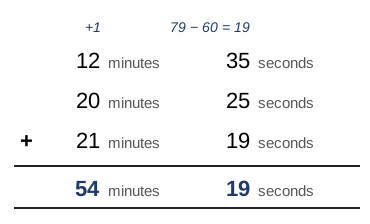
12 min 35 s + 20 min 25 s + 21 min 19 s = 54 min 19 s
12 minutes 35 seconds + 20 minutes 25 seconds + 21 minutes 19 seconds.
Steps
1. Add the seconds: 35 + 25 + 19 = 79 seconds.
2. 79 seconds is more than 60. 79 − 60 = 19 seconds, and carry 1 minute.
3. Add the minutes: 12 + 20 + 21 + 1 = 54 minutes.
4. Answer: 54 minutes 19 seconds.

Subtracting time

Subtract 1 hour 15 minutes from 6 hours 40 minutes
Minutes: 40 − 15 = 25 minutes.
Hours: 6 − 1 = 5 hours.
Answer: 5 hours 25 minutes.

If the top minutes are smaller than the bottom minutes, borrow 1 hour and change it into 60 minutes.
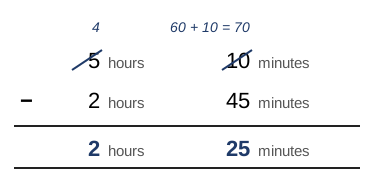
5 hours 10 minutes minus 2 hours 45 minutes equals 2 hours 25 minutes
5 hours 10 minutes − 2 hours 45 minutes.
Steps
1. 10 minutes − 45 minutes? We cannot. Borrow 1 hour: 5 hours becomes 4 hours.
2. 1 hour = 60 minutes, so 60 + 10 = 70 minutes.
3. Minutes: 70 − 45 = 25 minutes. Hours: 4 − 2 = 2 hours.
4. Answer: 2 hours 25 minutes.
A common mistake is to swap the numbers: "45 − 10 = 35". That is wrong! The top number must be the bigger one, so borrow 1 hour = 60 minutes first.

Adding and subtracting in one sentence

Work from left to right.

5 hours + 2 hours 5 minutes − 1 hour 30 minutes
1. Add first: 5 hours + 2 hours 5 minutes = 7 hours 5 minutes.
2. Then subtract: 7 hours 5 minutes − 1 hour 30 minutes. Borrow 1 hour: 6 hours 65 minutes.
3. 65 − 30 = 35 minutes; 6 − 1 = 5 hours.
4. Answer: 5 hours 35 minutes.

A bar model helps us see what to do. Mak Long helps at a kenduri for 3 hours. She spends 1 hour 20 minutes cutting vegetables. The rest of the time she stirs the rendang.

Bar model: 3 hours total, 1 hour 20 minutes and an unknown part
The whole bar is 3 hours. One part is known. Subtract to find the other part.
How long does she stir the rendang?
3 hours − 1 hour 20 minutes = 2 hours 60 minutes − 1 hour 20 minutes = 1 hour 40 minutes.
(a) 2 hours 35 minutes + 4 hours 50 minutes = ?   (b) 8 minutes 20 seconds − 3 minutes 45 seconds = ?
Show answerHide answer
(a) Minutes: 35 + 50 = 85 = 1 hour 25 minutes. Hours: 2 + 4 + 1 = 7. Answer 7 hours 25 minutes.
(b) Borrow 1 minute: 7 minutes 80 seconds. 80 − 45 = 35 seconds; 7 − 3 = 4 minutes. Answer 4 minutes 35 seconds.

5.5Multiplying and dividing time

Multiplying time

Multiply when the same time happens again and again.
Hilmi practises bowling 12 hours a week. How many hours in 4 weeks?
4 × 12 hours = 48 hours.
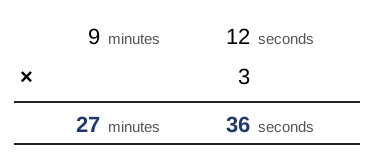
9 minutes 12 seconds times 3 equals 27 minutes 36 seconds
3 × 9 minutes 12 seconds.
Steps
1. Multiply the seconds: 3 × 12 = 36 seconds.
2. Multiply the minutes: 3 × 9 = 27 minutes.
3. Answer: 27 minutes 36 seconds.
A fruit cake bakes in 48 minutes. How long for 4 cakes, in hours and minutes?
1. 4 × 48 minutes = 192 minutes.
2. 192 minutes = 180 minutes + 12 minutes = 3 hours + 12 minutes.
3. Answer: 3 hours 12 minutes.

Dividing time

Divide when a time is shared equally. Use long division, starting with the bigger unit.

Danial rides his bike 28 hours in 2 weeks. How long in 1 week?
28 hours ÷ 2 = 14 hours.
Puan Alia gardens 5 hours 45 minutes in 5 days. How long each day?
1. Hours: 5 ÷ 5 = 1 hour.
2. Minutes: 45 ÷ 5 = 9 minutes.
3. Answer: 1 hour 9 minutes every day.
56 minutes 32 seconds ÷ 4
Minutes: 56 ÷ 4 = 14 minutes. Seconds: 32 ÷ 4 = 8 seconds. Answer: 14 minutes 8 seconds.
Check a division by multiplying back: 4 × 14 minutes 8 seconds = 56 minutes 32 seconds. It matches!
(a) 3 × 2 hours 20 minutes = ?   (b) 9 hours 36 minutes ÷ 3 = ?
Show answerHide answer
(a) 3 × 20 = 60 minutes = 1 hour; 3 × 2 = 6 hours; 6 + 1 = 7 hours.
(b) 9 ÷ 3 = 3 hours; 36 ÷ 3 = 12 minutes. Answer 3 hours 12 minutes.

5.6Create stories and solve problems

Create a story

A number sentence can become a short story. Use names, places and things you know.

3 × 3 hours 15 minutes = 9 hours 45 minutes
"Encik Azhar takes 3 hours 15 minutes to draw one batik pattern. He draws 3 patterns. He needs 9 hours 45 minutes altogether."
A good story has: who, what they do, the times from the number sentence, and the answer at the end. "×" means the same time again and again; "÷" means sharing equally.

Solve the problems

Use four steps: Given (what you know), Find (what you are asked), Method (the number sentence) and Answer (a full sentence).

Siva flies from Kuala Lumpur to Sydney (8 hours 15 minutes), then from Sydney to Auckland (3 hours 11 minutes). Find the total time.
Given: 8 hours 15 minutes and 3 hours 11 minutes.
Find: the total time.
Method: 8 hours 15 minutes + 3 hours 11 minutes = 11 hours 26 minutes.
Answer: The total time taken is 11 hours 26 minutes.
Hasni's father stamps 7 pieces of batik in 7 hours 56 minutes. How long for one piece?
Method: 7 hours 56 minutes ÷ 7. Hours: 7 ÷ 7 = 1. Minutes: 56 ÷ 7 = 8.
Answer: One piece takes 1 hour 8 minutes.
Read the question to the end. If it says "give your answer in hours and minutes", change the minutes at the end (for example 192 minutes = 3 hours 12 minutes).
(a) Haikal plays badminton 6 days a week for 720 minutes in total. How many minutes each day? (b) A car takes 5 hours 30 minutes from Johor Bahru to Kuala Lumpur without stopping. Mr Tan stops for 20 minutes at Pagoh and 15 minutes at Ayer Keroh. What is his total travelling time?
Show answerHide answer
(a) 720 ÷ 6 = 120 minutes (that is 2 hours) each day.
(b) 5 hours 30 minutes + 20 minutes + 15 minutes = 5 hours 65 minutes = 6 hours 5 minutes.

Summary

RememberExample
Say the time with the part of the day3:15 in the afternoon
1 week = 7 days; 1 year = 12 months2 weeks = 14 days
1 minute = 60 seconds200 seconds = 3 minutes 20 seconds
1 hour = 60 minutes140 minutes = 2 hours 20 minutes
Add: line up the units; 60 or more → regroup79 seconds = 1 minute 19 seconds
Subtract: too small on top → borrow 1 hour = 60 minutes5 h 10 min − 2 h 45 min = 2 h 25 min
Multiply: the same time again and again4 × 48 minutes = 3 hours 12 minutes
Divide: share the time equally5 hours 45 minutes ÷ 5 = 1 hour 9 minutes
Problems: Given, Find, Method, AnswerWrite the answer as a sentence