Shapes
What this chapter covers
- You can name square prisms (cubes), rectangular prisms (cuboids) and triangular prisms (7.1.1)
- You can count the flat surfaces, vertices and edges of a prism and find its base (7.1.2)
- You can tell prisms from non-prisms such as the sphere, cone, cylinder and pyramid (7.2.1)
- You can name regular polygons (pentagon, hexagon, heptagon, octagon) by their sides and corners (7.3.1)
- You can make patterns using polygons (7.3.2)
- You can find and draw axes of symmetry (7.4.1)
- You can solve problems about shapes with a checklist table, trial and error or drawing (7.5.1)
7.1Prisms
Look around your house. A box of tissue, a Rubik's cube and a slice of kek lapis all have the same kind of shape. They are prisms.
A prism has three kinds of parts. Learn their names:
| Word | What it means |
|---|---|
| Flat surface | A flat side of the shape. You can put a book flat on it. |
| Edge | A line where two flat surfaces meet. |
| Vertex (more than one: vertices) | A corner where edges meet. It is a pointy part. |
| Base | One of the 2 opposite surfaces that have the same shape. A prism is named after its base. |
Three prisms you must know
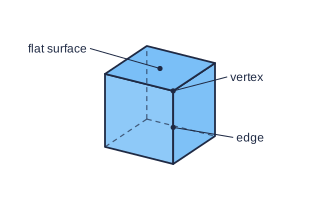
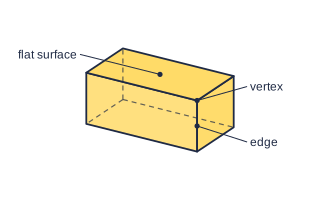
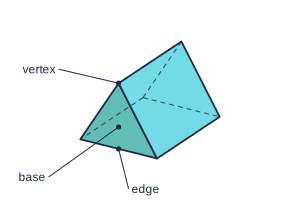
The dashed lines show edges at the back that you cannot see.
| Prism | Shape of base | Flat surfaces | Vertices | Edges | Example |
|---|---|---|---|---|---|
| Cube (square prism) | square | 6 (all the same size) | 8 | 12 | dice, Rubik's cube |
| Cuboid (rectangular prism) | rectangle | 6 | 8 | 12 | tissue box, brick |
| Triangular prism | triangle | 5 | 6 | 9 | tent, Toblerone box |
- Count the flat surfaces: 2 triangles (the bases) + 3 rectangles = 5 flat surfaces.
- Count the vertices: 3 on the front triangle + 3 on the back triangle = 6 vertices.
- Count the edges: 3 on the front + 3 on the back + 3 joining them = 9 edges.
Show answerHide answer
7.2Prisms and non-prisms
Some 3-D shapes are not prisms. We call them non-prisms. Here are four of them.
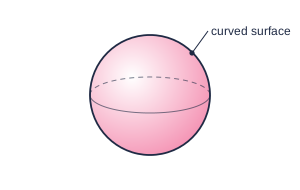
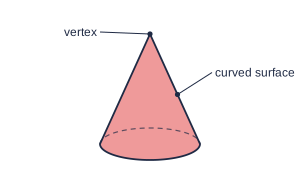
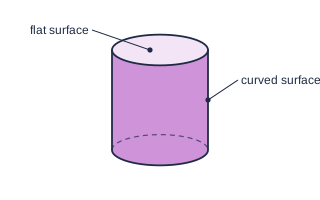
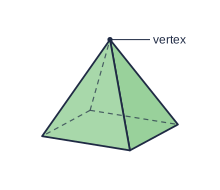
To check if a shape is a prism, ask three questions. A prism must get three ticks.
| Shape | 5 or more flat surfaces? | 2 opposite surfaces of the same shape? | No curved surfaces? | Prism? |
|---|---|---|---|---|
| Cuboid | ✓ | ✓ | ✓ | Yes |
| Sphere | ✗ | ✗ | ✗ | No |
| Cone | ✗ | ✗ | ✗ | No |
| Pyramid | ✓ | ✗ | ✓ | No |
| Cylinder | ✗ | ✓ | ✗ | No |
Nets
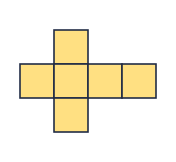
A net is a flat shape that you can fold to make a 3-D shape. Cut it out, fold along the lines and stick the edges together.
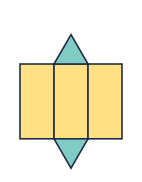
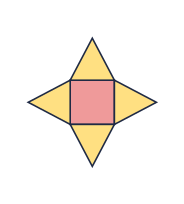
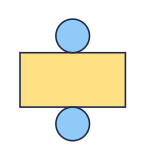
Show answerHide answer
7.3Regular polygons and patterns
A polygon has sides (the straight lines) and corners (where two sides meet). A polygon always has the same number of corners as sides.
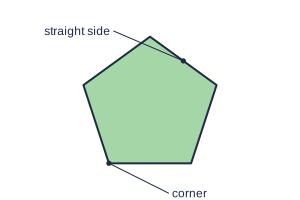
Four regular polygons to learn
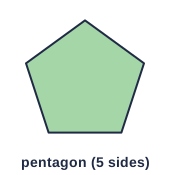
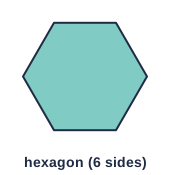
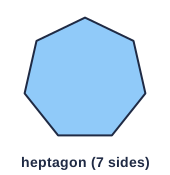
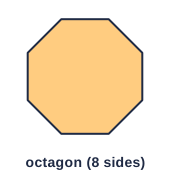
| Name | Straight sides | Corners | Where you may see it |
|---|---|---|---|
| Pentagon | 5 | 5 | the patches on some footballs |
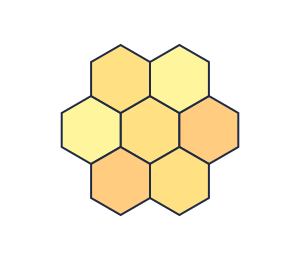
| Hexagon | 6 | 6 | honeycomb, the head of a nut (bolt) |
| Heptagon | 7 | 7 | some badges and tiles |
| Octagon | 8 | 8 | the "Berhenti" (stop) road sign |
Regular or not?
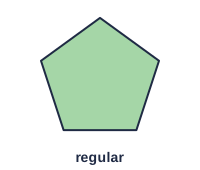
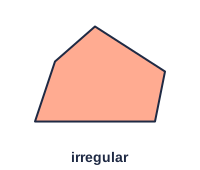
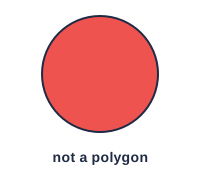
Both pentagons have 5 sides. Only the first one is regular, because all its sides are the same length. The second one has sides of different lengths, so it is irregular. A circle has a curved side, so it is not a polygon at all.
Show answerHide answer
Making patterns
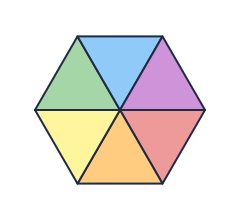
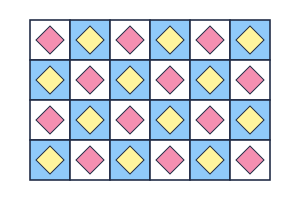
We can join polygons together to make beautiful patterns, like the tiles on a floor or a honeycomb made by bees.
7.4Axis of symmetry
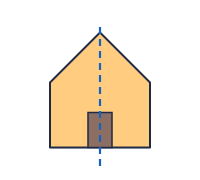
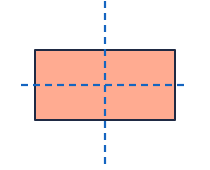
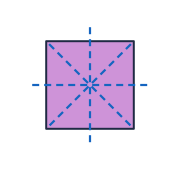
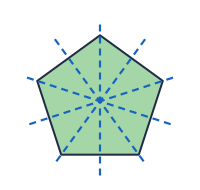
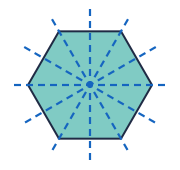
Fold a picture along a line. If the two parts overlap each other exactly, the fold line is an axis of symmetry.
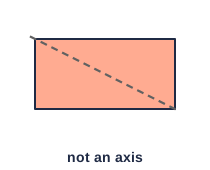
- Cut a paper rectangle along the diagonal. You get two triangles of the same size.
- Now fold the rectangle along the diagonal instead. The corners stick out. The two parts do not overlap exactly.
- So the diagonal is not an axis of symmetry. A rectangle has only 2 axes: one across the middle and one down the middle.
Show answerHide answer
7.5Solving problems
Here are three ways to solve problems about shapes.
Puan Salina sticks pictures of a cone, a cuboid and a sphere on the whiteboard. Azian must choose the prism. Which one does she choose?
| Shape | 5 or more flat surfaces | 2 opposite surfaces the same | No curved surfaces |
|---|---|---|---|
| Cone | ✗ | ✗ | ✗ |
| Cuboid | ✓ | ✓ | ✓ |
| Sphere | ✗ | ✗ | ✗ |
Only the cuboid gets three ticks. Azian chooses the cuboid, because it has 6 flat surfaces, its opposite surfaces are the same shape and it has no curved surfaces.
Wong cuts a shape. It has 2 corners more than a pentagon. What is the shape?
- A pentagon has 5 corners.
- Try a hexagon: 6 corners. That is only 1 more. No.
- Try a heptagon: 7 corners. 7 − 5 = 2 more. Yes!
The shape is a heptagon.
Chin has three picture cards: a triangle road sign with a traffic light drawn inside it, a handkerchief (rectangle) and a kite. Zaki must take the card with more than one axis of symmetry.
- Traffic light road sign: 1 axis (down the middle). The lights are red at the top and green at the bottom, so no other fold works.
- Handkerchief: 2 axes (across and down).
- Kite: 1 axis (down the middle).
Zaki takes the handkerchief.
Show answerHide answer
Summary
- A prism has 5 or more flat surfaces, 2 opposite bases of the same shape and size, and no curved surfaces. It is named after its base.
- Cube (square prism) and cuboid (rectangular prism): 6 flat surfaces, 8 vertices, 12 edges. Triangular prism: 5 flat surfaces, 6 vertices, 9 edges.
- Non-prisms: sphere, cone, cylinder (curved surfaces) and pyramid (no 2 opposite bases).
- A regular polygon is a flat shape with 3 or more straight sides of equal length. Pentagon 5, hexagon 6, heptagon 7, octagon 8 sides (and the same number of corners).
- Polygons can be joined to make patterns.
- An axis of symmetry divides a shape into two parts that overlap exactly when folded. A regular polygon has as many axes as sides. A rectangle has 2; its diagonal is not an axis.
- Solve problems with a checklist table, trial and error, or by drawing axes of symmetry.