In the past
What this chapter covers
- I can talk about what ancient Egyptians did to make a mummy, using past verbs like washed and wrapped (3.1)
- I can ask and answer "Did you ...?" with Yes, I did. / No, I didn't. (3.2)
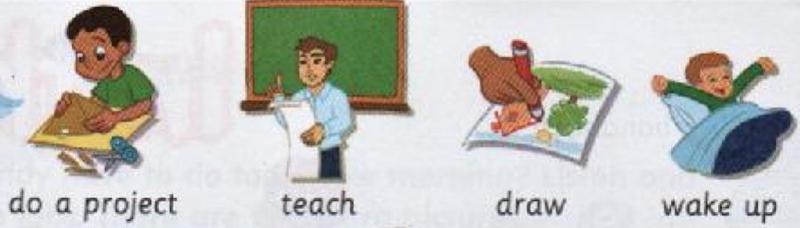
- I can use irregular past verbs such as do - did, draw - drew, teach - taught and wake up - woke up (3.2)
- I can ask and answer "How old was he?", "How did he die?" and "What was his name?" about people in the past (3.3)
- I can use went, found, saw and bit to retell a story about the past (3.3)
- I can say whether a fact is about the past or the present (3.4)
- I can write an email about a trip using the past tense, adjectives, and and but (3.5)
- I can read a story about a museum visit and answer questions about it (3.6)
- I can say the -ed endings /t/, /d/ and /id/ (3.7)
Welcome to Module 3! This module is about the past: ancient Egypt, mummies and Tutankhamun's tomb. You will learn to say what people did, ask Did you ...?, and write about a trip.
3.1Do a quiz: Mummies
The quiz asks what ancient Egyptians did to make a mummy. These are the key words.
Get Smart Plus 4, p. 27.
Show answerHide answer
3.2Smart kids: Did you ...?
Get Smart Plus 4, p. 28.
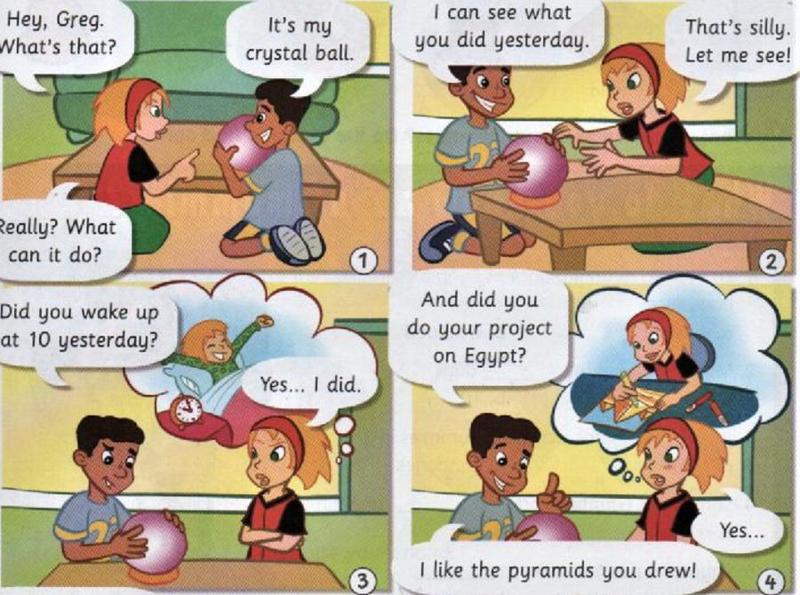
Get Smart Plus 4, p. 28.
The story: Greg tells Anna his crystal ball can see the past. He asks, "Did you wake up at 10 yesterday?" and "Did you do your project on Egypt?" Anna says yes each time. Then Greg asks about the pyramids she drew and whether her brother taught her a computer game. Anna asks Tony if he was there before, and we learn that Tony told Greg everything. The crystal ball did not really see anything.
Pattern: Did ...?
| Question | Yes | No |
|---|---|---|
| Did you wake up at 10 yesterday? | Yes, I did. | No, I didn't. |
| Did she draw a pyramid? | Yes, she did. | No, she didn't. |
The same did is used for I, you, he, she, it, we and they. After did and didn't the verb goes back to its plain form: "Did she draw?" (not "Did she drew?").
Irregular verbs
| Now | Past | Example |
|---|---|---|
| do | did | I did my project. |
| draw | drew | I drew pyramids. |
| teach | taught | My brother taught me a game. |
| wake up | woke up | She woke up at 10. |
Show answerHide answer
3.3Our world: The curse
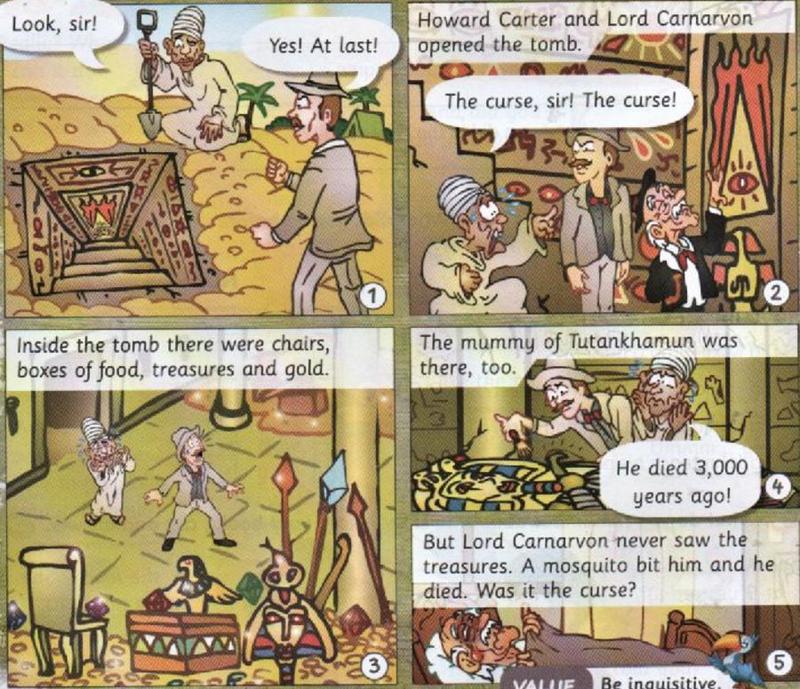
Get Smart Plus 4, p. 30.
The story: Tutankhamun, an 18-year-old king of ancient Egypt, died and was put in a tomb with treasures. A curse said, "Go into the tomb and die!" In 1922, on 4th November, Howard Carter and Lord Carnarvon opened the tomb in the Valley of the Kings. Inside there were chairs, boxes of food, treasures and gold, and Tutankhamun's mummy. He died 3,000 years ago. Lord Carnarvon never saw the treasures: a mosquito bit him and he died. Was it the curse?
| Question | Answer |
|---|---|
| How old was he? | He was 18. |
| How did he die? | A mosquito bit him. |
| What was his name? | His name was Tutankhamun. |
| Now | Past |
|---|---|
| go | went |
| find | found |
| see | saw |
| bite | bit |
Show answerHide answer
3.4Let's play: Past or present?
Some facts are true now (present). Some happened long ago (past). The verb tells you which.
| Sentence | Past or present? | Clue |
|---|---|---|
| Egyptians speak Arabic. | Present | speak (not spoke) |
| Egyptians made cat mummies. | Past | made |
| Egyptian camels have got one hump. | Present | have got |
| Egyptians wore wigs at celebrations. | Past | wore |
| The weather in Egypt is very hot. | Present | is |
Get Smart Plus 4, p. 32 (sentences about Egypt).
Show answerHide answer
3.5Project: An email about a trip
Writing tip
- Use the past tense to write about the past: I took a lot of photos.
- Use adjectives for feelings: They were very scary.
- Use and for similar ideas: It was very hot and sunny.
- Use but for different ideas: They were scary, but they were interesting too.
| Now | Past |
|---|---|
| is / are | was / were |
| go | went |
| ride | rode |
| take | took |
| see | saw |
Show answerHide answer
3.6Story time: Prince Nebi's ring
On Thursday morning Selva and Nora ask each other about their project. Nora finished late, went to bed at 12 and woke up at 6, so she is sleepy. Their teacher, Miss Anita, takes the class to a museum. They see the mummy of a prince from Egypt.
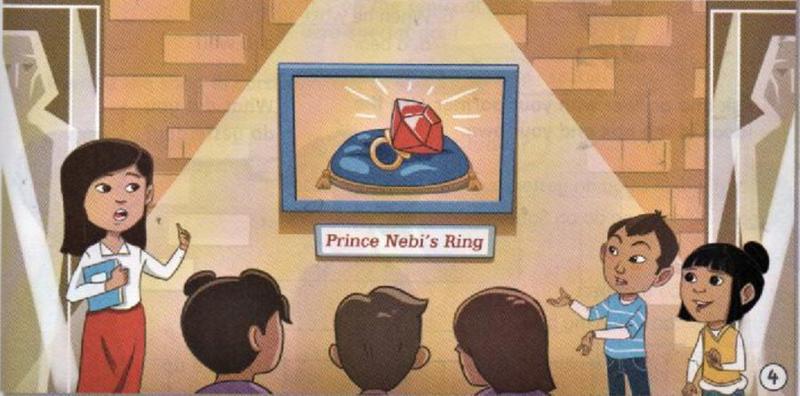
Get Smart Plus 4, p. 35.
| Question | Answer |
|---|---|
| What was the prince's name? | Prince Nebi. |
| How did he die? | A snake bit him. |
| How old was he? | He was 12 years old. |
| What happened to his ring? | Someone stole it last week. The police are looking for it. |
| What does the ring look like? | It's gold and it's got a big, red stone. |
Show answerHide answer
3.7Phonics: -ed endings
The ending -ed in a past verb has three sounds.
| Sound | When | Examples |
|---|---|---|
| /t/ | after sounds like k, s, sh, ch | watched, walked, talked, fished |
| /d/ | after most other sounds | smelled, listened, lived, played |
| /id/ | after t or d, a new syllable | invented, painted |
Get Smart Plus 4, p. 121 (Phonics 3, chant "In the past").
Show answerHide answer
Summary
| Topic | Remember |
|---|---|
| Past questions | Did you wake up? Yes, I did. / No, I didn't. Plain verb after did. |
| Irregular verbs | do - did, draw - drew, teach - taught, wake up - woke up, go - went, find - found, see - saw, bite - bit |
| Be in the past | was / were: How old was he? He was 18. |
| Past or present | Check the verb: made (past), speak (present). |
| Writing | Past tense, adjectives, and (similar), but (different). |
| Phonics | -ed says /t/, /d/ or /id/. |
| Values | Don't believe everything others tell you. Be inquisitive. |