Fractions, Decimals and Percentages
What this chapter covers
- You can change mixed numbers to improper fractions and improper fractions to mixed numbers (2.1.1)
- You can add mixed numbers, proper fractions and whole numbers, with answers in the simplest form (2.1.2)
- You can subtract fractions and mixed numbers, including from a whole number (2.1.3)
- You can solve sums that mix addition and subtraction of fractions, working from left to right (2.1.4)
- You can find a fraction of a quantity, including a mixed number of a quantity (2.1.5)
- You can add, subtract, multiply and divide decimals up to three decimal places, and multiply and divide by 10, 100 and 1 000 (2.2.1 to 2.2.4)
- You can change fractions to percentages and percentages to fractions, and find a percentage of objects (2.3.1, 2.3.2)
- You can solve problems with fractions, decimals and percentages in daily life (2.4.1)
2.1Improper fractions and mixed numbers
Mixed numbers and improper fractions are two ways to write the same amount. A cake is cut into 4 equal parts. One whole cake and 3 parts of another cake is 1 3/4 cakes, or 7/4 cakes.
An improper fraction has a numerator that is larger than (or equal to) the denominator, for example 7/4.

Mixed number to improper fraction
Step 2. Add the numerator: 15 + 2 = 17. This is the new numerator.
Step 3. Keep the denominator: 3 2/5 = 17/5.
Improper fraction to mixed number
Step 2. The quotient is the whole number (3). The remainder is the new numerator (5). The divisor is the denominator (6).
Step 3. 23/6 = 3 5/6.

Methods follow Mathematics Year 4 (DLP), pp. 67-70.
Show answerHide answer
2.2Adding fractions
Add the numerators and keep the denominator, as long as the denominators are the same. If the answer is an improper fraction, change it to a mixed number.
Step 2. 11/9 is an improper fraction. 11 ÷ 9 = 1 remainder 2.
Step 3. 2/9 + 4/9 + 5/9 = 1 2/9.
Adding mixed numbers
Add the whole numbers first, then the fractions. Make the denominators the same before you add. The smallest common denominator is the smallest number that both denominators divide into (a common multiple, found from the times tables).
Step 2. Fractions: the smallest common denominator of 3 and 2 is 6. 2/3 = 4/6 and 1/2 = 3/6.
Step 3. 4/6 + 3/6 = 7/6 = 1 1/6.
Step 4. 3 + 1 1/6 = 4 1/6.
Methods follow Mathematics Year 4 (DLP), pp. 71-74.
Show answerHide answer
2.3Subtracting fractions
The rule is the same: the denominators must match first. Subtract the numerators and keep the denominator. Then write the answer in the simplest form (divide the numerator and denominator by the same number).
Step 2. Simplify 2/8 by dividing by 2: 1/4.
Step 3. 1 7/8 − 5/8 = 1 1/4.
Subtracting from a whole number, or when the fraction is too small
5 1/4 − 2 3/4. 1/4 is smaller than 3/4, so regroup: 5 1/4 = 4 5/4. Then 4 5/4 − 2 3/4 = 2 2/4 = 2 1/2.
Different denominators
Step 2. Whole numbers: 4 − 1 = 3. Fractions: 3/6 − 2/6 = 1/6.
Step 3. 4 1/2 − 1 1/3 = 3 1/6.
Methods follow Mathematics Year 4 (DLP), pp. 75-79.
Show answerHide answer
2.4Adding and subtracting in one sum
Work from left to right. Do the first operation, then the second. Make the denominators the same before you start.
Step 2. Left to right: 6/8 + 5/8 = 11/8.
Step 3. 11/8 − 4/8 = 7/8. It is already in the simplest form.
Methods follow Mathematics Year 4 (DLP), pp. 80-82.
Show answerHide answer
2.5Fractions of a quantity
Step 2. Take 5 parts: 5 × 5 = 25.
Step 3. 5/7 of 35 = 25.

Step 2. 1/2 of 30 = 15.
Step 3. 60 + 15 = 75 m. (Or change 2 1/2 to 5/2: 5 × 30 ÷ 2 = 75.)
Methods follow Mathematics Year 4 (DLP), pp. 83-85.
Show answerHide answer
2.6Adding and subtracting decimals
Decimals up to three decimal places have tenths, hundredths and thousandths. Add and subtract them like whole numbers, but line up the decimal points.
| Ones | . | Tenths | Hundredths | Thousandths |
|---|---|---|---|---|
| 4 | . | 2 | 0 | 7 |
Write 0 as a placeholder so that every number has the same number of decimal places.
Step 2. Add as whole numbers: 1 300 + 4 207 + 960 = 6 467.
Step 3. Put the decimal point in the same column: 6.467 kg.
Step 2. 10 000 − 3 462 = 6 538.
Step 3. 10 − 3.462 = 6.538. Check by adding: 6.538 + 3.462 = 10.000.
Methods follow Mathematics Year 4 (DLP), pp. 86-89.
Show answerHide answer
2.7Multiplying and dividing decimals
By a whole number
Multiply or divide as if there is no decimal point. Then put the point back so the answer has the same number of decimal places as the decimal number.
Step 2. 2.54 has 2 decimal places, so the answer has 2 decimal places.
Step 3. 4 × 2.54 = 10.16 cm.
Step 2. Place the decimal point so there are 2 decimal places: 1.87.
Step 3. 14.96 ÷ 8 = 1.87 m. Check: 1.87 × 8 = 14.96.
By 10, 100 and 1 000
| Operation | What happens | Example |
|---|---|---|
| × 10 | point moves 1 place right | 10 × 1.25 = 12.5 |
| × 100 | point moves 2 places right | 100 × 7.342 = 734.2 |
| × 1 000 | point moves 3 places right | 1 000 × 0.956 = 956 |
| ÷ 10 | point moves 1 place left | 4.32 ÷ 10 = 0.432 |
| ÷ 100 | point moves 2 places left | 657.8 ÷ 100 = 6.578 |
| ÷ 1 000 | point moves 3 places left | 2 749 ÷ 1 000 = 2.749 |
Methods follow Mathematics Year 4 (DLP), pp. 90-93.
Show answerHide answer
2.8Fractions and percentages
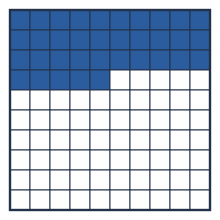
Method 2. Multiply by 100%. 4/5 × 100% = 4 × 20% = 80%.
Methods follow Mathematics Year 4 (DLP), pp. 94-96.
Show answerHide answer
2.9Solving problems
Use four steps: understand the problem, plan the strategy, solve, then check.
Step 1. Year 4: 3/7 × 140 = 20 × 3 = 60.
Step 2. Year 5: 1/2 × 140 = 70.
Step 3. Difference: 70 − 60 = 10.
Step 4. Check: 60 + 10 = 70.
Methods follow Mathematics Year 4 (DLP), pp. 97-104.