Money
What this chapter covers
- You can add and subtract values of money up to RM100 000, including sen, and check your answer with an estimate (3.1.1, 3.1.2)
- You can multiply and divide values of money by one-digit, two-digit numbers, 10 and 100 (3.1.3, 3.1.4)
- You can solve addition and subtraction together, and multiplication and division together, working from left to right (3.2.1, 3.2.2)
- You can record savings and expenses in a budget and say why a budget helps you save (3.3.1, 3.3.2, 3.3.3)
- You can tell needs from wants, choose a priority and plan how to reach it (3.4.1, 3.4.2, 3.4.3)
- You can name the currencies of some countries and use an exchange rate (3.5.1, 3.5.2)
- You can name payment instruments and choose a suitable one (3.6.1, 3.6.2)
- You can solve money problems in several steps (3.7.1)
3.1Adding and subtracting money
In Year 4 we work with money up to RM100 000, and with sen as well. Add and subtract money just like whole numbers, but line up the decimal points.
Step 2. Line up the decimal points. Add from the sen, then ringgit, tens, hundreds and thousands, and regroup when needed.
Step 3. RM23 156.75 + RM4 857.00 = RM28 013.75.
Estimate first. Round each amount to the nearest thousand ringgit, then add. For RM6 932.86 + RM48 900 + RM10 973.42, the estimate is RM7 000 + RM49 000 + RM11 000 = RM67 000. The exact answer is RM66 806.28, which is near RM67 000, so the answer is reasonable.
Step 1. RM85 000 − RM35 500 = RM49 500.
Step 2. Write RM49 500 as RM49 500.00 and subtract RM30 287.95.
Step 3. RM49 500.00 − RM30 287.95 = RM19 212.05.
Show answerHide answer
3.2Adding and subtracting in one sum
When a number sentence has both + and −, work one step at a time from left to right.
Step 2. RM2 749.50 + RM800 = RM3 549.50.
| Particular | Cash in | Cash out | Balance |
|---|---|---|---|
| Savings | RM85 600.40 | ||
| Tuition fees | RM27 000 | RM58 600.40 | |
| Cheque | RM33 565 | RM92 165.40 |
3.3Multiplying money
Multiply money like whole numbers, then put the decimal point back so there are two sen places.
Step 2. 30 × RM2 400 = RM72 000 and 8 × RM2 400 = RM19 200.
Step 3. RM72 000 + RM19 200 = RM91 200.
Show answerHide answer
3.4Dividing money
Dividing by 10 moves the decimal point one place to the left (by 100, two places): RM10 907.50 ÷ 10 = RM1 090.75. When the ringgit do not divide exactly, put a decimal point and carry on with the sen: RM29 063 ÷ 5 = RM5 812.60.
To check a division, estimate: RM70 213 ÷ 52 is about RM70 000 ÷ 50 = RM1 400, and the exact answer RM1 350.25 is near it.
3.5Multiplying and dividing in one sum
Again, work from left to right. Do not multiply the two numbers on the right first.
3.6Managing money wisely
- Record your income and spending every day, then add them up for the week and month.
- A record helps you see where money goes, spend less on things you only want, and reach your target sooner.
- Keeping records also helps you avoid debt, control spending, put needs first and save for the future.
- Ways to save: bring food from home, switch off lights, set aside money first, keep it in a savings account.
- Ways to earn extra money: wash cars, sell kuih, sell used items.
| Day | Money received | Expense | Savings |
|---|---|---|---|
| Monday | RM4.00 | RM1.20 | RM2.80 |
| Tuesday | RM4.00 | RM1.50 | RM2.50 |
| Total | RM8.00 | RM2.70 | RM5.30 |
3.7Foreign currency and payment instruments
Every country has its own currency: the USA uses the dollar, Great Britain the pound sterling, Japan the yen, South Korea the won, China the renminbi, Bangladesh the taka and France the euro. Several countries share the name "dollar".
An exchange rate tells us how much foreign money RM1 can buy. In the textbook table, RM1 = 25.823 yen and RM1 = 0.238 US dollar. So RM10 = 10 × 25.823 = 258.23 yen. Rates change from day to day.
| Payment instrument | How it works |
|---|---|
| Cash | Direct payment using notes and coins |
| Debit card | Pays straight from your savings account |
| Credit card | Spend first and pay the bank later |
| Internet banking | Pays through an online account |
| E-wallet / prepaid card | Uses a balance you topped up |
| Cheque | A written order to the bank to pay a stated amount |
| Postal order | Cash sent to a named person, issued by the post office |
3.8Solving money problems
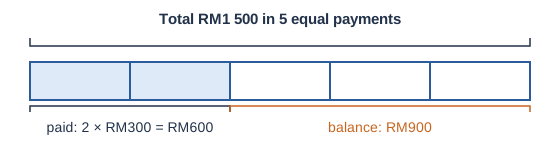
Follow four steps: understand the problem (underline the keywords), plan the strategy (draw a bar model or write a number sentence), solve, then check.
Plan. April, May and June are 3 of the 5 instalments.
Paid = RM75 000 ÷ 5 × 3 = RM45 000.
Balance = RM75 000 − RM45 000 = RM30 000.