Mathematics notes, unit 4
Time
Textbook Mathematics Year 4 (DLP), pages 139–170
What this chapter covers
- You can relate the 12-hour and 24-hour systems and convert time from one to the other (4.1.1)
- You can calculate the duration between two times, in both systems (4.2.1)
- You can estimate the time taken for an activity (4.3.1)
- You can state the relationship between a millennium, century, decade and year (4.4.1)
- {'You can convert units of time': 'hours, days, weeks, months, years, decades and centuries (4.4.2)'}
- You can add, subtract, multiply and divide time with regrouping (4.5.1, 4.5.2)
- You can solve problems involving time (4.6.1)
4.112-hour and 24-hour systems
A train timetable says the ETS leaves at 1805 hours, but your father says "6:05 in the evening". Both mean the same time. They use two different systems.
12-hour system: uses a colon, such as 6:05, and says which part of the day it is (a.m. or p.m.).
24-hour system: uses four digits and the word "hours", from 0000 hours to 2359 hours. 1805 hours is read "eighteen zero five hours".
24-hour system: uses four digits and the word "hours", from 0000 hours to 2359 hours. 1805 hours is read "eighteen zero five hours".
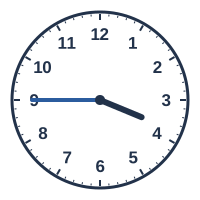
| Time of day | 12-hour system | 24-hour system |
|---|---|---|
| midnight | 12:00 midnight | 0000 hours |
| just after midnight | 12:40 a.m. | 0040 hours |
| morning | 7:47 a.m. | 0747 hours |
| noon | 12:00 noon | 1200 hours |
| afternoon | 5:13 p.m. | 1713 hours |
| just before midnight | 11:59 p.m. | 2359 hours |
a.m. is from midnight until before noon. p.m. is from noon until before midnight.
Changing from 12-hour to 24-hour
Worked example
6:45 a.m. Write the hour with 2 digits and keep the minutes: 0645 hours.12:10 a.m. The hour 12 at night becomes 00: 0010 hours.
10:40 p.m. From 1:00 p.m. onwards, add 12 hours to the hour: 10 + 12 = 22. So 2240 hours.
12:30 p.m. Just after noon, do not add 12: 1230 hours.
Changing from 24-hour to 12-hour
Worked example
0825 hours is before noon, so write a colon and a.m.: 8:25 a.m.1545 hours is after 1259, so subtract 12 hours: 15 − 12 = 3. It is 3:45 p.m.
0005 hours has hour 00, which is 12 at night: 12:05 a.m.
Write 0010 hours, not "010 hours" or "00:10 hours". The 24-hour system always has four digits. Also, 12:10 a.m. is 0010 hours but 12:10 p.m. is 1210 hours.
Write 11:46 p.m. in the 24-hour system, and 1616 hours in the 12-hour system.
Show answerHide answer
11 + 12 = 23, so 11:46 p.m. = 2346 hours. 16 − 12 = 4, so 1616 hours = 4:16 p.m.
4.2Duration
Duration is how long something takes. It is the difference between the start time and the end time.
The school gotong-royong started at 8:10 a.m. and ended at 11:40 a.m. We can find the duration with a timeline.
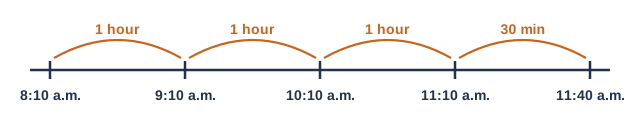
Or we can subtract. Write the hours and minutes in columns, and the end time on top.
Worked example: father works from 7:30 a.m. to 5:00 p.m.
Step 1. Change to the 24-hour system: 5:00 p.m. = 1700 hours, 7:30 a.m. = 0730 hours.Step 2. Subtract. 17 h 00 min − 7 h 30 min. We cannot take 30 from 0, so change 1 hour to 60 minutes: 16 h 60 min − 7 h 30 min.
Step 3. 16 − 7 = 9 hours and 60 − 30 = 30 minutes.
The duration is 9 hours 30 minutes.
Check by adding: 7:30 a.m. + 9 hours 30 minutes = 5:00 p.m. Yes!
A bus leaves at 0920 hours and arrives at 1850 hours. What is the duration of the journey?
Show answerHide answer
18 h 50 min − 9 h 20 min = 9 hours 30 minutes.
4.3Estimating time
To estimate time, use a fact you know and build on it. Estimates are "more or less" and "about", so reasonable answers are accepted.
Worked example
A worker labels 60 bottles in 30 minutes. About how long will 250 bottles take?Step 1. 4 groups of 60 bottles = 240 bottles. 4 × 30 minutes = 120 minutes.
Step 2. 250 is a little more than 240, so the time is a little more than 120 minutes (about 2 hours).
Do not expect an estimate to match exactly. If a car goes 100 km in 1 hour, a 96 km journey takes about 1 hour, not exactly 1 hour.
4.4Units of time and conversion
| Relationship | Value |
|---|---|
| 1 day | 24 hours |
| 1 week | 7 days |
| 1 year | 12 months |
| 1 decade | 10 years |
| 1 century | 100 years (10 decades) |
| 1 millennium | 1 000 years (10 centuries) |
Going to a smaller unit: multiply. Going to a larger unit: divide. 3 days = 3 × 24 = 72 hours. 56 days = 56 ÷ 7 = 8 weeks.
Worked example: more conversions
10 days 21 hours = 10 × 24 + 21 = 240 + 21 = 261 hours.180 hours ÷ 24 = 7 remainder 12, so 180 hours = 7 days 12 hours.
16 days ÷ 7 = 2 remainder 2, so 16 days = 2 weeks 2 days.
172 months ÷ 12 = 14 remainder 4, so 172 months = 14 years 4 months.
2 centuries 7 years = 200 + 7 = 207 years.
134 years = 1 century 34 years.
The remainder is in the smaller unit. 46 days = 6 weeks 4 days, not 6 weeks 4 weeks.
Convert 5 days 6 hours to hours, and 46 days to weeks and days.
Show answerHide answer
5 × 24 + 6 = 126 hours. 46 ÷ 7 = 6 remainder 4, so 6 weeks 4 days.
4.5Calculating with time
Addition
Worked example: 3 days 4 hours + 2 days 9 hours + 1 day 12 hours
Step 1. Add each unit: days 3 + 2 + 1 = 6, hours 4 + 9 + 12 = 25.Step 2. 25 hours is more than a day: 25 hours = 1 day 1 hour.
Step 3. 6 days + 1 day 1 hour = 7 days 1 hour.
Subtraction
Worked example: 10 years 7 months − 1 year 9 months
Step 1. We cannot take 9 months from 7 months. Change 1 year to 12 months: 9 years 19 months.Step 2. 9 years 19 months − 1 year 9 months = 8 years 10 months.
Answer: 8 years 10 months.
Multiplication
Worked example: 9 × 3 hours, and 8 × 2 weeks 4 days
9 × 3 hours = 27 hours = 1 day 3 hours.8 × 2 weeks 4 days: 8 × 2 weeks = 16 weeks and 8 × 4 days = 32 days. 32 days = 4 weeks 4 days. Total 20 weeks 4 days (= 144 days).
Division
Worked example: 12 days 9 hours ÷ 3
Step 1. 12 days ÷ 3 = 4 days. 9 hours ÷ 3 = 3 hours.Answer: 4 days 3 hours = 96 + 3 = 99 hours.
If the units do not divide exactly, change the leftover bigger unit to the smaller one: 9 years 4 months ÷ 7. 9 years = 7 + 2, so 2 years = 24 months, and 24 + 4 = 28 months. 28 ÷ 7 = 4. The answer is 1 year 4 months.
Regroup using the right number: 1 day = 24 hours, 1 week = 7 days, 1 year = 12 months. The 60 only belongs to minutes and seconds.
Calculate 7 years 8 months + 5 years 10 months.
Show answerHide answer
Years 7 + 5 = 12, months 8 + 10 = 18 = 1 year 6 months. Total 13 years 6 months.
4.6Solving problems
Follow four steps: understand the problem, plan the strategy, solve, then check with the opposite operation.
Worked example
Jamal reads one book in 3 weeks 5 days and another in 9 days. How long does he take for both?Plan: add. 3 weeks 5 days + 9 days = 3 weeks 14 days. 14 days = 2 weeks.
Total: 5 weeks.
Check: 5 weeks − 9 days = 4 weeks 7 days − 9 days = 3 weeks 5 days. Correct.
A timeline helps you see whether to add or subtract.