Mathematics notes, unit 5
Length, Mass and Volume of Liquid
Textbook Mathematics Year 4 (DLP), pages 171–198
What this chapter covers
- You can recognise millimetre and kilometre and say which unit suits an object or a distance (5.1.1)
- You can measure the length of an object in millimetres (5.1.4)
- You can change between cm and mm, and between km and m (5.1.2, 5.1.3)
- You can estimate a distance by comparing it with a known distance (5.1.5)
- You can add, subtract, multiply and divide lengths with regrouping (5.1.6 to 5.1.9)
- You can add, subtract, multiply and divide masses in kg and g (5.2.1, 5.2.2)
- You can add, subtract, multiply and divide volumes of liquid in ℓ and mℓ (5.3.1, 5.3.2)
- You can solve and create problems about length, mass and volume of liquid (5.4.1)
In this unit we measure length (how long), mass (how heavy) and volume of liquid (how much a container holds). You already know m, cm, kg, g, ℓ and mℓ. Now you meet two new length units, millimetre and kilometre, and you add, subtract, multiply and divide measurements with regrouping.
Rule to remember: before you calculate, write every measurement in the same unit. Then it is just whole-number arithmetic. Change back to the bigger unit at the end if the question asks for it.
5.1Length: millimetres and kilometres
Millimetre (mm) measures small, short things such as a wick, a screw or the width of an A4 paper (210 mm).
Kilometre (km) measures the distance between two places that are far apart.
1 cm = 10 mm 1 km = 1 000 m
Kilometre (km) measures the distance between two places that are far apart.
1 cm = 10 mm 1 km = 1 000 m
Measuring in millimetres
Put the 0 mm mark at one end of the object. Read the number at the other end.

Changing units
| From | To | What to do | Example |
|---|---|---|---|
| cm | mm | multiply by 10 | 5 cm = 5 × 10 = 50 mm |
| mm | cm | divide by 10 | 40 mm = 40 ÷ 10 = 4 cm |
| km | m | multiply by 1 000 | 3 km = 3 × 1 000 = 3 000 m |
| m | km | divide by 1 000 | 23 000 m = 23 km |
Worked examples (textbook pp. 174-175)
a) 19 cm 7 mm = ? mm19 cm = 190 mm, so 19 cm 7 mm = 190 mm + 7 mm = 197 mm.
b) 68 mm = ? cm ? mm
68 mm = 60 mm + 8 mm = 6 cm 8 mm.
c) 6 km 743 m = ? m
6 km = 6 000 m, so 6 km 743 m = 6 000 m + 743 m = 6 743 m.
d) 40 025 m = ? km ? m
40 025 m = 40 000 m + 25 m = 40 km 25 m.
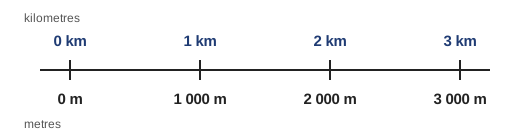
Watch the zeros. 8 006 m is 8 km 6 m, not 80 km 6 m. Always fill the three digits of the metres: 6 m is 006 when you write it after the km.
Complete: (a) 6 cm 8 mm = ___ mm (b) 3 km 5 m = ___ m (c) 507 mm = ___ cm ___ mm
Show answerHide answer
(a) 60 + 8 = 68 mm
(b) 3 000 + 5 = 3 005 m (not 305 m)
(c) 507 = 500 + 7 = 50 cm 7 mm
(b) 3 000 + 5 = 3 005 m (not 305 m)
(c) 507 = 500 + 7 = 50 cm 7 mm
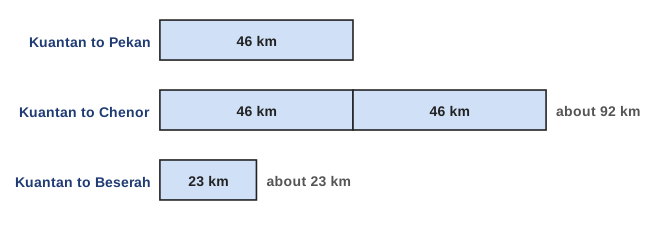
Estimating distance
To estimate, compare with a distance you already know. Use "about 2 times" or "about half".
Adding and subtracting length
Line up the units: km under km, m under m (or cm under cm, mm under mm). Add or subtract the smaller unit first. When the smaller unit reaches the next unit, regroup: 1 km = 1 000 m, 1 cm = 10 mm.
Adding (textbook pp. 177-178)
29 km 800 m + 19 km 600 mMetres: 800 + 600 = 1 400 m = 1 km 400 m. Write 400 m and carry 1 km.
Kilometres: 29 + 19 + 1 = 49 km.
Answer: 49 km 400 m.
Or in one unit: 66 cm 5 mm + 36 cm 8 mm = 665 mm + 368 mm = 1 033 mm.
Subtracting
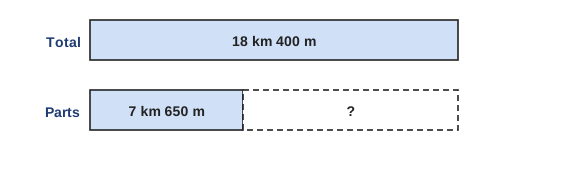
18 km 400 m − 7 km 650 m400 m is less than 650 m, so take 1 km and change it to 1 000 m: 17 km 1 400 m.
Metres: 1 400 − 650 = 750 m. Kilometres: 17 − 7 = 10 km.
Answer: 10 km 750 m. Check: 10 km 750 m + 7 km 650 m = 18 km 400 m.
Multiplying and dividing length
Multiply and divide
5 × 7 cm 6 mm: change to mm first: 76 mm × 5 = 380 mm = 38 cm.120 cm 8 mm ÷ 4 (one side of a square frame): 1 208 mm ÷ 4 = 302 mm = 30 cm 2 mm.
7 km 280 m ÷ 4: 7 280 m ÷ 4 = 1 820 m = 1 km 820 m.
Change the measurement to the smaller unit (mm or m) so you only multiply or divide one number. Then change the answer back to the units the question asks for.
(a) 15 cm 6 mm + 8 cm 7 mm = ? (b) 4 × 12 cm 3 mm = ?
Show answerHide answer
(a) 156 mm + 87 mm = 243 mm = 24 cm 3 mm
(b) 123 mm × 4 = 492 mm = 49 cm 2 mm
(b) 123 mm × 4 = 492 mm = 49 cm 2 mm
5.2Mass
1 kg = 1 000 g. The same rules as length apply: write the mass in one unit, calculate, then change back.
Tablets and medicine are often measured in milligrams (mg), a much smaller unit than the gram.
Tablets and medicine are often measured in milligrams (mg), a much smaller unit than the gram.
Add and subtract mass (textbook p. 184)
4 kg + 1 kg − 130 g4 kg + 1 kg = 5 kg = 5 000 g. Then 5 000 g − 130 g = 4 870 g.
8 kg 20 g − 630 g + 4 kg
8 kg 20 g = 8 020 g. 8 020 − 630 = 7 390 g. 7 390 + 4 000 = 11 390 g = 11 kg 390 g.
Write 67 kg 50 g as 67 050 g, not 67 500 g. The grams part always has three digits.
Multiply and divide mass (textbook p. 186)
Father repacks 2 packets of 10 kg rice into 8 small packets. Mass of one small packet?2 × 10 kg = 20 kg = 20 000 g. 20 000 ÷ 8 = 2 500 g.
9 × 1 600 g ÷ 4 = 14 400 g ÷ 4 = 3 600 g = 3 kg 600 g.
6 kg 200 g − 2 750 g = ? Give the answer in kg and g.
Show answerHide answer
6 200 g − 2 750 g = 3 450 g = 3 kg 450 g
5.3Volume of liquid
1 ℓ = 1 000 mℓ. Volume of liquid is calculated in the same way as length and mass.
Add and subtract (textbook p. 188)
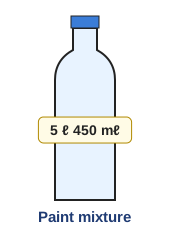
5 ℓ 450 mℓ − 500 mℓ = 5 450 mℓ − 500 mℓ = 4 950 mℓ remains.4 ℓ 80 mℓ − 360 mℓ + 7 ℓ: 4 080 − 360 = 3 720 mℓ, then 3 720 + 7 000 = 10 720 mℓ = 10 ℓ 720 mℓ.
Multiply and divide (textbook pp. 190-191)
3 boxes of 1 ℓ juice shared equally by 8 people: 3 ℓ = 3 000 mℓ, 3 000 ÷ 8 = 375 mℓ each.18 ℓ ÷ 4 × 7 = 18 000 mℓ ÷ 4 × 7 = 4 500 × 7 = 31 500 mℓ.
7 × 8 ℓ 25 mℓ ÷ 3 = 8 025 × 7 = 56 175 mℓ, then ÷ 3 = 18 725 mℓ = 18 ℓ 725 mℓ.
5 jugs hold 1 ℓ 250 mℓ each. All the juice is poured equally into 10 cups. How much is in each cup?
Show answerHide answer
5 × 1 250 = 6 250 mℓ. 6 250 ÷ 10 = 625 mℓ in each cup.
5.4Solving problems
- Understand: underline the numbers and the keywords (total, difference, remaining, equally, each).
- Plan: draw a bar model or choose + − × ÷. Decide the unit you will work in.
- Solve: calculate, then change to the unit asked for.
- Check: does the answer make sense? Use the opposite operation.
Worked problem (textbook p. 194)
The two-way distance from the factory to Maju Shop is 86 km 900 m. Mr Arul delivers on 7 days. (a) One-way distance? (b) Total distance for the 7 days?(a) 86 km 900 m ÷ 2 = 43 km 450 m.
(b) 7 × 86 km 900 m: 7 × 86 = 602 km and 7 × 900 m = 6 300 m = 6 km 300 m, so 602 km + 6 km 300 m = 608 km 300 m.
Some problems use trial and error: for three volumes that must total 1 430 mℓ, look at the ones digits first. They must add up to a multiple of 10 (textbook p. 193).
A ribbon is 1 m 20 cm long. 35 cm 5 mm is cut off. How many millimetres are left?
Show answerHide answer
1 m 20 cm = 120 cm = 1 200 mm. 35 cm 5 mm = 355 mm. 1 200 − 355 = 845 mm.