Mathematics notes, unit 6
Space
Textbook Mathematics Year 4 (DLP), pages 199–214
What this chapter covers
- You can recognise right, acute and obtuse angles, and name the vertices and angles of a shape (6.1.1)
- You can name equilateral, isosceles, scalene and right-angled triangles by their sides and angles (6.1.1)
- You can identify and draw parallel lines and perpendicular lines (6.2.1, 6.2.2)
- You can find the perimeter of squares, rectangles, triangles and regular polygons (6.3.1)
- You can find the area of squares, rectangles and triangles in square units (6.3.2)
- You can find the volume of cubes and cuboids in cubic units (6.4.1)
- You can solve problems about perimeter, area and volume (6.5.1)
6.1Angles and triangles
An angle is the space between two straight lines that meet at a point. The point is called the vertex. A shape has as many angles as it has vertices: a square has 4 vertices and 4 angles.
Right angle: the corner of a square (a quarter turn).
Acute angle: smaller than a right angle.
Obtuse angle: bigger than a right angle.
Acute angle: smaller than a right angle.
Obtuse angle: bigger than a right angle.
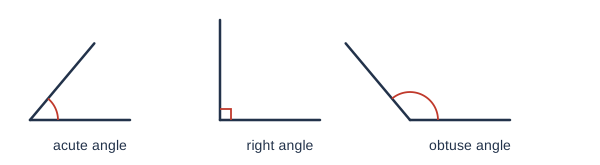
Paper folding helps. Fold a sheet of paper twice to make a right angle, then place its corner on any angle to see if that angle is smaller or bigger.
Types of triangle
We name triangles by their sides and their angles. The red marks on the sides show which sides are equal.
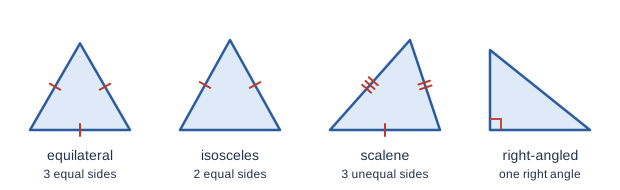
| Triangle | Sides | Angles |
|---|---|---|
| Equilateral | 3 equal sides | 3 acute angles |
| Isosceles | 2 equal sides | 3 acute angles, or 1 obtuse and 2 acute |
| Scalene | 3 unequal sides | 1 obtuse and 2 acute, or 3 acute |
| Right-angled | sides may differ | 1 right angle and 2 acute angles |
Do not say a triangle is "right" when you only see an angle that looks square. Check for the small square mark. A triangle can have only one right or obtuse angle.
A triangle has 3 sides of different lengths and one obtuse angle. What is its name?
Show answerHide answer
A scalene triangle: the three sides are unequal.
6.2Parallel lines and perpendicular lines
Parallel lines are always the same distance apart and never meet, however far they go.
Perpendicular lines cross each other at a right angle.
Perpendicular lines cross each other at a right angle.
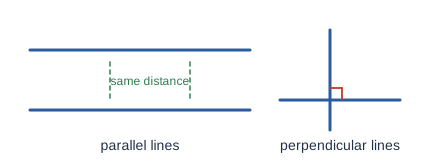
Drawing the lines
- Parallel: place a ruler, draw a line along one edge, slide the ruler along the same direction, and draw a second line along the edge again.
- Perpendicular: draw a horizontal line along a ruler. Hold a second ruler across it, or use the corner of a set square, and draw a line so that it makes a right angle.
Two lines that are not parallel may still not touch on the page. If you extend them far enough they will meet. Only parallel lines never meet. Also, crossing lines are perpendicular only when the angle is a right angle.
The top and bottom of a door are parallel. Which line is perpendicular to both?
Show answerHide answer
The side of the door (a vertical edge), because it meets the top and bottom at a right angle.
6.3Perimeter
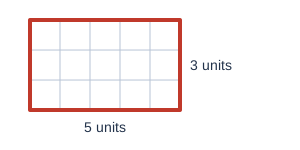
Perimeter is the total length of all the sides of a shape, the distance all the way round its outline.
| Shape | Perimeter | Example |
|---|---|---|
| Square | 4 × side | 4 × 7 cm = 28 cm |
| Rectangle | 2 × (length + width) | 2 × (18 m + 10 m) = 56 m |
| Regular polygon with n sides | n × side | regular octagon, side 6 m: 8 × 6 m = 48 m |
| Other triangles and polygons | add all the sides | 8 cm + 8 cm + 6 cm = 22 cm |
Worked example: a regular pentagon with sides of 8 cm
Step 1. A regular pentagon has 5 equal sides.Step 2. Perimeter = 5 × 8 cm = 40 cm.
The perimeter is a length, so its unit is cm or m, not cm² or m².
Find the perimeter of a rectangle 9 cm long and 4 cm wide.
Show answerHide answer
9 + 4 + 9 + 4 = 26 cm.
6.4Area
Area is the size of a surface. It is measured in square units: 1 square unit is a square with sides of 1 unit. We write it as unit², cm² or m².
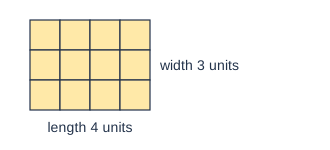
Area of a rectangle = length × width
Area of a square = side × side
Area of a triangle = ½ × base × height
Area of a square = side × side
Area of a triangle = ½ × base × height
A rectangle can be cut into two equal triangles, so a triangle is half the area of the rectangle that has the same base and height.
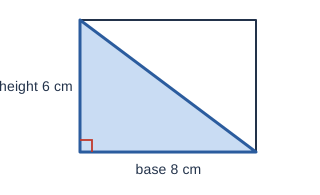
Worked example: a blue wall 6 m long and 3 m wide
Area = 6 m × 3 m = 18 m².Two ways for a triangle with base 8 cm and height 6 cm: ½ × 8 × 6 = 24 cm², or 48 cm² ÷ 2 = 24 cm².
The height of a triangle is the straight distance at a right angle to the base, not the slanted side. Use cm × cm = cm², and m × m = m².
Find the area of a triangle with base 10 cm and height 7 cm.
Show answerHide answer
½ × 10 × 7 = 70 ÷ 2 = 35 cm².
6.5Volume
Volume is the amount of space a solid takes up. It is measured in cubic units: 1 unit³ is a cube with edges of 1 unit.
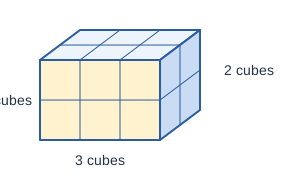
Volume of a cuboid = length × width × height
Volume of a cube = side × side × side
Volume of a cube = side × side × side
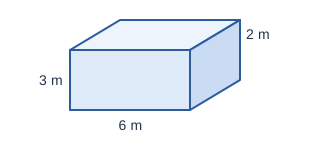
Volume = base area × height. If the base area is 12 m² and the height is 2 m, the volume is 12 × 2 = 24 m³.
Worked example: how many cubes fit in a box?
A box is 16 cm × 12 cm × 8 cm. Each cube has sides of 4 cm.Step 1. Volume of box = 16 × 12 × 8 = 1 536 cm³.
Step 2. Volume of one cube = 4 × 4 × 4 = 64 cm³.
Step 3. Number of cubes = 1 536 ÷ 64 = 24.
Volume uses three lengths multiplied together and ends in cm³ or m³. Do not confuse it with area (cm²) or perimeter (cm).
Find the volume of a cube with sides of 5 cm.
Show answerHide answer
5 × 5 × 5 = 125 cm³.
6.6Solving problems
Use the four steps: understand the problem, plan a strategy (draw a diagram), solve, then check.
Worked example: a square cow farm
Each side of a square farm is 16 m. Find the length of fence needed and the area of the farm.Perimeter = 4 × 16 m = 64 m.
Area = 16 m × 16 m = 256 m².
Check: 256 ÷ 16 = 16. Correct.
| Asked for | Think | Unit |
|---|---|---|
| Fence, ribbon, edging | perimeter: add the sides | cm, m |
| Paint, tiles, cloth | area: length × width | cm², m² |
| Space inside a box | volume: length × width × height | cm³, m³ |
The perimeter of a square card is 40 cm. Find its area.
Show answerHide answer
Side = 40 ÷ 4 = 10 cm. Area = 10 × 10 = 100 cm².
Notes follow Mathematics Year 4 (DLP), Unit 6, pp.199–214; figures redrawn.