Mathematics notes, unit 7
Coordinates, Ratio and Proportion
Textbook Mathematics Year 4 (DLP), pages 215–232
What this chapter covers
- You can name the origin, the horizontal axis (x-axis) and the vertical axis (y-axis) of a Cartesian plane (7.1.1)
- You can read and write the coordinates of a point in the first quadrant, x first and then y (7.1.1, 7.1.2)
- You can mark a point on a Cartesian plane from its coordinates (7.1.2)
- You can state the ratio of two quantities of the same kind, with the same unit (7.2.1)
- You can find the value of one item and use it in simple proportion (7.3.1)
- You can solve problems about coordinates, ratio and proportion (7.4.1)
7.1Coordinates
A map on a grid lets us say exactly where a place is. A Cartesian plane has two number lines that cross each other at right angles.
The horizontal axis is the x-axis (across). The vertical axis is the y-axis (up). They cross at the origin, O. The coordinates of a point say where it is: (x, y).
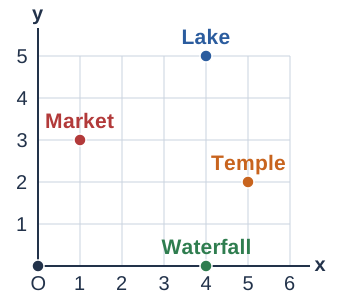
Idea from Mathematics Year 4 (DLP), p.215: places of interest on a Cartesian plane. Figure drawn for this site.
Worked example: write the coordinates of the Lake
Step 1. Start at the origin O.Step 2. Go across to the right until you are under the Lake: 4 units. This is the x-coordinate.
Step 3. Go up to the Lake: 5 units. This is the y-coordinate.
Step 4. Write the x-coordinate first, then the y-coordinate: the Lake is at (4, 5).
| Point | Across (x) | Up (y) | Coordinates |
|---|---|---|---|
| Origin | 0 | 0 | (0, 0) |
| Waterfall (on the x-axis) | 4 | 0 | (4, 0) |
| Market | 1 | 3 | (1, 3) |
Order matters. (4, 5) and (5, 4) are two different places. Always across first, then up. Also, the origin is written O (a letter), not the number 0.
A point on the x-axis has y = 0, like (4, 0). A point on the y-axis has x = 0, like (0, 5).
Look at the Cartesian plane above. What are the coordinates of the Temple? Which place is at (1, 3)?
Show answerHide answer
The Temple is at (5, 2). The place at (1, 3) is the Market.
Marking a point
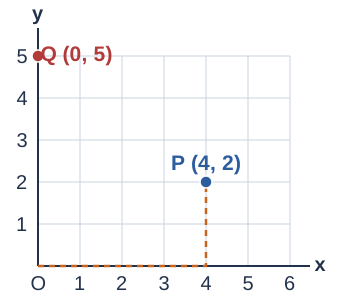
Worked example: mark P (4, 2) and Q (0, 5)
Step 1. For P: from the origin move 4 units to the right, then 2 units up. Mark the point and write P (4, 2).Step 2. For Q: do not move right at all (0 units). Move 5 units up the y-axis. Mark the point and write Q (0, 5).
A butterfly is 3 units to the right of the origin. It flies 6 units up and lands on a flower. What are the coordinates of the flower?
Show answerHide answer
(3, 6): 3 across, then 6 up.
7.2Ratio
A ratio compares two quantities of the same kind. We write it with a colon: a : b, read "a to b".
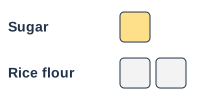
Idea from Mathematics Year 4 (DLP), p.218: ingredients of a kuih recipe. Figure drawn for this site.
Worked example: pens and books
Aina has 2 pens and 7 books.Step 1. Ratio of pens to books: 2 : 7.
Step 2. Ratio of books to pens: 7 : 2. The order follows the question.
Say the first thing in the question first. "Pens to books" is 2 : 7, not 7 : 2. Do not write the units (cm, kg, RM) in the ratio.
Same unit first
Both quantities must be in the same unit before you write the ratio.
| Compare | Change to the same unit | Ratio |
|---|---|---|
| RM1 and RM100 | already the same | 1 : 100 |
| 1 kg and 1 000 g | 1 kg = 1 000 g | 1 000 : 1 000 = 1 : 1 |
| 1 mℓ and 1 ℓ | 1 ℓ = 1 000 mℓ | 1 : 1 000 |
| 1 cm and 1 m | 1 m = 100 cm | 1 : 100 |
State the ratio of the mass of 1 g sugar to the mass of 1 kg flour.
Show answerHide answer
1 kg = 1 000 g, so the ratio is 1 : 1 000.
7.3Proportion
Things are in proportion when one item always has the same value, for example, the same price for each apple. To solve, use the unitary method: first find the value of one (divide), then find the value of the number you want (multiply).
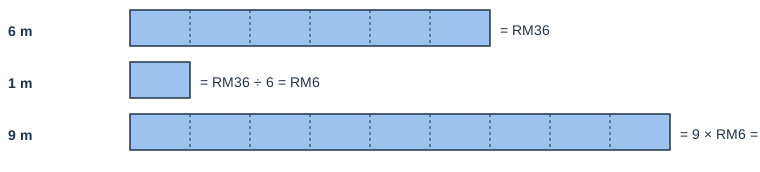
Idea from Mathematics Year 4 (DLP), p.223: price of curtain cloth. Figure drawn for this site.
Worked example: heart rate
An adult's heart beats 360 times in 5 minutes. How many times in 3 minutes?Step 1. In 1 minute: 360 ÷ 5 = 72 times.
Step 2. In 3 minutes: 3 × 72 = 216 times.
Worked example: how many metres?
RM6 buys 1 m of cloth. How long a piece can be bought with RM84?RM84 ÷ RM6 = 14 m.
Do not just double or halve without thinking. Always find the value of 1 first. Check: if 5 buys more than 3, the answer for 5 must be bigger.
A car travels 240 km in 3 hours at a steady speed. How far does it go in 5 hours?
Show answerHide answer
In 1 hour: 240 ÷ 3 = 80 km. In 5 hours: 5 × 80 = 400 km.
7.4Solving problems
Understand the problem, plan a strategy, solve, then check. Many problems join two ideas.
Worked example: which pair of items?
A shop has a television (RM1 750), a refrigerator (RM1 800) and a water heater (RM220). Ayub pays RM2 020 for two items.Step 1. Try: 1 750 + 220 = 1 970. Not 2 020.
Step 2. Try: 1 800 + 220 = 2 020. Correct, so he bought the refrigerator and the water heater.
Worked example: ratio from "more than"
Halim's durian is 1 kg. Rekha's is 5 kg heavier.Step 1. Rekha's durian: 1 + 5 = 6 kg.
Step 2. Ratio of Halim's to Rekha's: 1 : 6.
Worked example: the best buy
Shop A: 4 books for RM4.80. Shop B: 2 books for RM2.60. Shop C: 3 books for RM3.30.Step 1. One book: A RM1.20, B RM1.30, C RM1.10.
Step 2. The cheapest is shop C. For 12 books: 12 × RM1.10 = RM13.20.
A tap fills 5 buckets in 20 minutes. How many buckets does it fill in 36 minutes at the same rate?
Show answerHide answer
20 ÷ 5 = 4 min for 1 bucket. 36 ÷ 4 = 9 buckets.
Summary
- A Cartesian plane has an x-axis (across), a y-axis (up) and the origin O at (0, 0).
- Coordinates are written (x, y): across first, then up.
- A ratio a : b compares two quantities of the same kind in the same unit; the order follows the question.
- Proportion: find the value of 1 (divide), then the value you want (multiply).
- For problems: understand, plan, solve, check.