Science questions, unit 2
Nama / NameKelas / ClassTarikh / Date
Humans
41 marks. Use Practice to check each answer as you go, or Exam to answer everything first. Ask a grown-up to help you mark the written answers.
Section A: objective questions
10 marksChoose the best answer for each question.
1
Question 1
In which organ does the exchange of gases take place?
Show answerHide answer
B
Oxygen enters the lungs and carbon dioxide leaves the lungs, so the exchange of gases takes place in the lungs.
2
Question 2
Which shows the passage of air during inhalation?
Show answerHide answer
D
Air enters through the nose, passes down the trachea and reaches the lungs.
3
Question 3
How is exhaled air different from inhaled air?
Show answerHide answer
A
Exhaled air has more carbon dioxide and less oxygen than inhaled air. It still has some oxygen.
4
Question 4
A boy puts his hand on his chest and breathes slowly. What happens to his chest when he exhales?
Show answerHide answer
C
The chest moves upwards when we inhale and downwards when we exhale.
5
Question 5
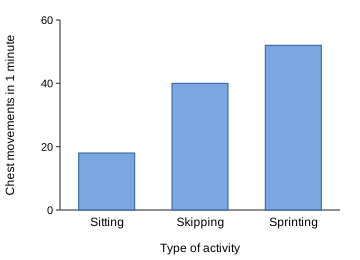
Diagram 1 shows the chest movements of a pupil in one minute. How many chest movements did the pupil make while skipping?
Show answerHide answer
B
The bar for skipping reaches 40.
6
Question 6
Which of these is a stimulus?
Show answerHide answer
A
A stimulus is a change in the surroundings. The other three are actions, which are responses.
7
Question 7
Which pair of excretory organ and product is correct?
Show answerHide answer
D
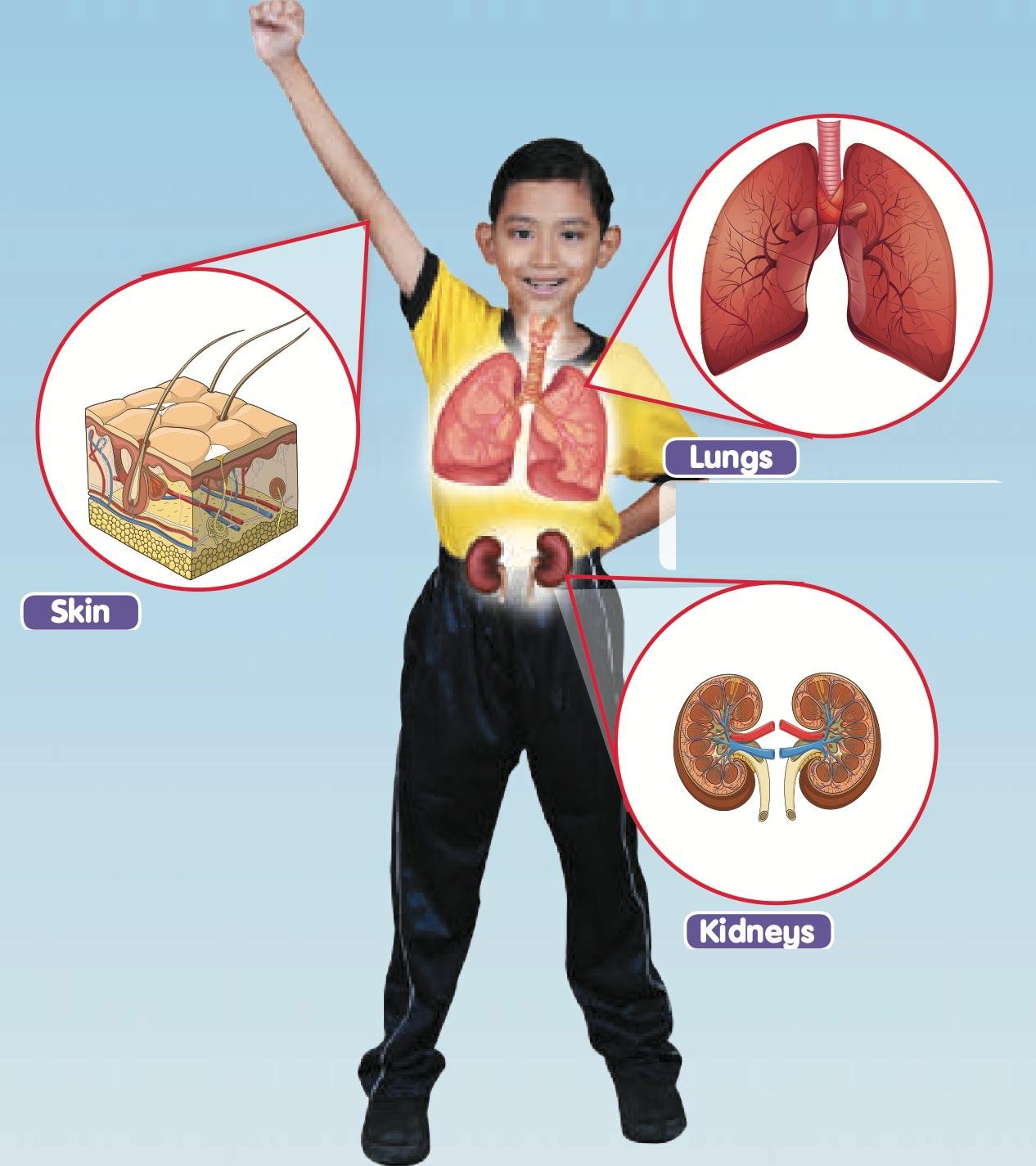
Kidneys excrete urine, the skin excretes sweat, and the lungs release carbon dioxide and water vapour.
8
Question 8
What is defecation?
Show answerHide answer
C
Defecation is the removal of faeces through the anus.
9
Question 9
Which habit can make a person respond slowly to stimuli?
Show answerHide answer
A
Glue contains chemicals that disturb the sensory organs and the brain, so response is slow.
10
Question 10
Hana smells smoke in her house, runs outside and calls for help. Why is it important for her to respond?
Show answerHide answer
B
Responding to the smell of smoke helps her to save herself from danger.
Section B: structured questions
31 marksAnswer all questions. Circle the answer or write it in the space.
11
Question 11
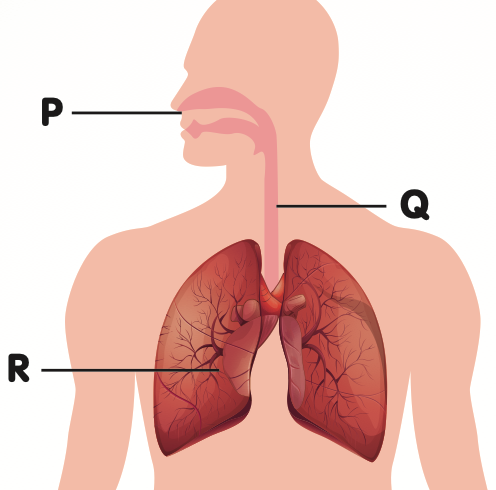
Diagram 2 shows some organs involved in human breathing.
[1 mark]
(a)Name organ P.
Show answerHide answer
Nose
[1 mark]
(b)Name organ Q.
Show answerHide answer
Trachea
[1 mark]
(c)Name organ R.
Show answerHide answer
Lung
[2 marks]
(d)Arrange P, Q and R in the correct order for the passage of air during exhalation.
Show answerHide answer
Tick each point you got.
[1 mark]
(e)What may happen to a person who is always exposed to polluted air?
Show answerHide answer
Tick each point you got.
12
Question 12
Diagram 3 shows an investigation on the effect of the type of activity on the rate of breathing of a pupil.
[1 mark]
(a)State one observation.
Show answerHide answer
Tick each point you got.
[1 mark]
(b)State one inference.
Show answerHide answer
Tick each point you got.
[1 mark]
(c)How many more chest movements does the pupil make when sprinting than when sitting?
Show answerHide answer
Tick each point you got.
[1 mark]
(d)What conclusion can be drawn from this investigation?
Show answerHide answer
Tick each point you got.
13
Question 13
Answer these questions about inhaled air and exhaled air.
[1 mark]
(a)Which gas is present in more amount in inhaled air than in exhaled air?
Show answerHide answer
Oxygen
[1 mark]
(b)Which gas is present in more amount in exhaled air?
Show answerHide answer
Carbon dioxide
[1 mark]
(c)Name the organ where the exchange of gases takes place.
Show answerHide answer
Tick each point you got.
[2 marks]
(d)State two ways to keep the lungs healthy.
Show answerHide answer
Any 2 points
Haze and smoke harm the lungs, so keep away from them and keep the air clean.
Tick each point you got.
14
Question 14
Diagram 4 shows three excretory organs: the lungs, the skin and the kidneys.
[1 mark]
(a)What is excretion?
Show answerHide answer
Tick each point you got.
[1 mark]
(b)What is defecation?
Show answerHide answer
Tick each point you got.
[1 mark]
(c)What does the skin excrete?
Show answerHide answer
Tick each point you got.
[2 marks]
(d)What do the lungs release?
Show answerHide answer
Tick each point you got.
[1 mark]
(e)Why must faeces be removed from the body?
Show answerHide answer
Tick each point you got.
15
Question 15
Diagram 5 shows a girl in a rose garden. She touches a rose stem and reacts at once.

[1 mark]
(a)Which sensory organ receives the stimulus?
Show answerHide answer
Skin
We feel touch and pain with our skin.
[2 marks]
(b)State the stimulus and the response.
Show answerHide answer
Tick each point you got.
[1 mark]
(c)Why is the response important to the girl?
Show answerHide answer
Tick each point you got.
16
Question 16
Two pupils talk about habits. Imran says: "Glue sniffing is harmless because I only do it once." Hana says: "Cough syrup is a medicine, so it is always safe to drink a lot."
[1 mark]
(a)Is Imran correct?
Show answerHide answer
No
Glue chemicals can cause hallucination and addiction and disturb the sensory organs and the brain.
[2 marks]
(b)Explain why Hana is not correct.
Show answerHide answer
Tick each point you got.
17
Question 17
Your school is making a poster to teach Year 4 pupils to protect their sensory organs and their response to stimuli.
[1 mark]
(a)Name one habit that pupils must avoid.
Show answerHide answer
Tick each point you got.
[2 marks]
(b)Write a short slogan for the poster and say why the habit must be avoided.
Show answerHide answer
Tick each point you got.