Science notes, unit 3
Animals
Textbook Science Year 4 (DLP), pages 53–68
What this chapter covers
- {'You can name the breathing organs of animals': 'lungs, gills, moist skin and spiracles (3.1.1)'}
- You can classify animals by their breathing organs (3.1.2)
- You can explain that some animals, such as frogs, have more than one breathing organ and can live in two habitats (3.1.3, 3.1.4)
- You can tell vertebrates from invertebrates and give examples of each (3.2.1, 3.2.2)
- You can classify vertebrates as mammals, reptiles, amphibians, birds and fish using their specific characteristics (3.2.3, 3.2.4)
Animals live on land, in water, and some live in both. Whatever they are and wherever they live, all animals need to breathe. In this unit you will see which body parts animals use to breathe, and how scientists sort animals into groups.
3.1Breathing organs of animals
A breathing organ is the part of an animal's body used to take in air or oxygen. Animals do not all breathe in the same way.
| Breathing organ | Found in | Examples |
|---|---|---|
| Lungs | Animals that live on land (normally) | Cow, cat, chicken |
| Gills | Animals that live in water (normally) | Fish, crab, prawn, tadpole |
| Moist skin | Soft-bodied animals | Earthworm, leech |
| Spiracles | Insects | Grasshopper, butterfly, caterpillar, ant, dragonfly |
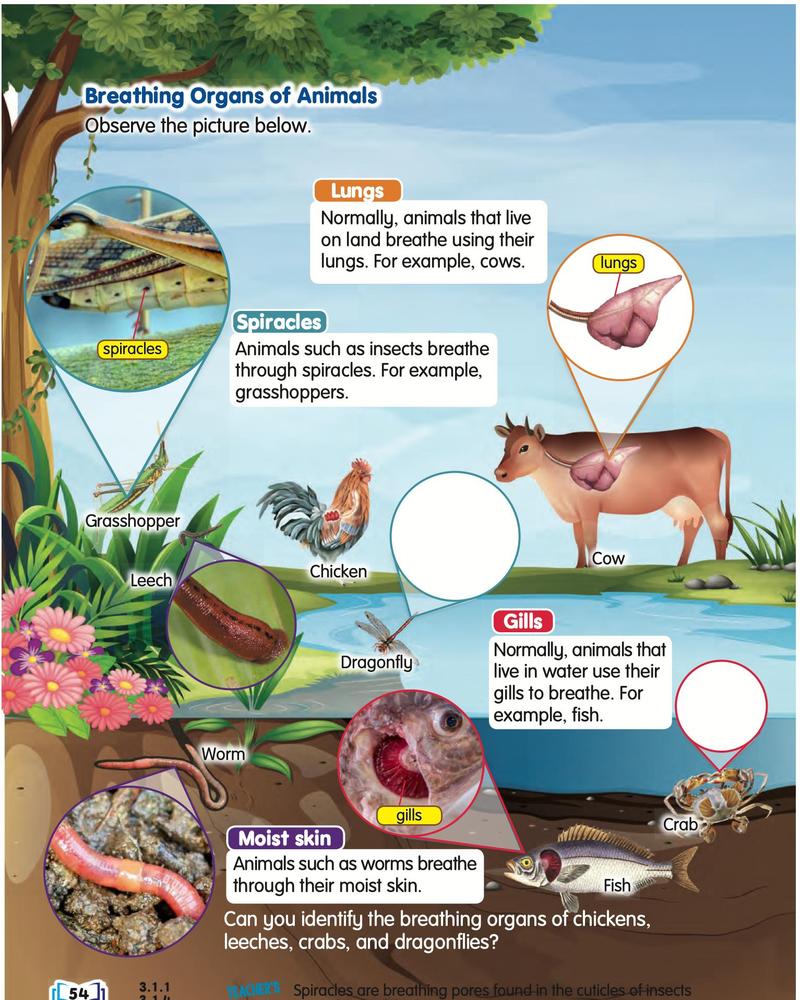
Figure: Science Year 4 (DLP), p.54.
Spiracles are tiny breathing holes in the outer layer of an insect's body. An insect breathes through its body, not through its nose.
Classifying animals by their breathing organs
We can sort animals into four groups using the organ they breathe with.
| Lungs | Gills | Moist skin | Spiracles |
|---|---|---|---|
| Cat, crocodile, goat | Tadpole, crab, prawn | Worm, leech | Caterpillar, butterfly, ant |
Animals with two breathing organs
The frog
A frog breathes with its lungs when it is on land and with its moist skin when it is in water. A fish has only one breathing organ, its gills, so it can live only in water.Caecilias and newts also breathe with both lungs and moist skin. Animals with more than one breathing organ can live in two habitats.
A tadpole is not a small frog in the way it breathes. A tadpole breathes with gills. The adult frog uses lungs and moist skin.
Why can a frog live on land and in water, but a fish cannot live on land?
Show answerHide answer
A frog has two breathing organs (lungs for land, moist skin for water). A fish has only gills.
3.2Vertebrates and invertebrates
Vertebrates are animals that have a backbone. Invertebrates are animals that have no backbone.
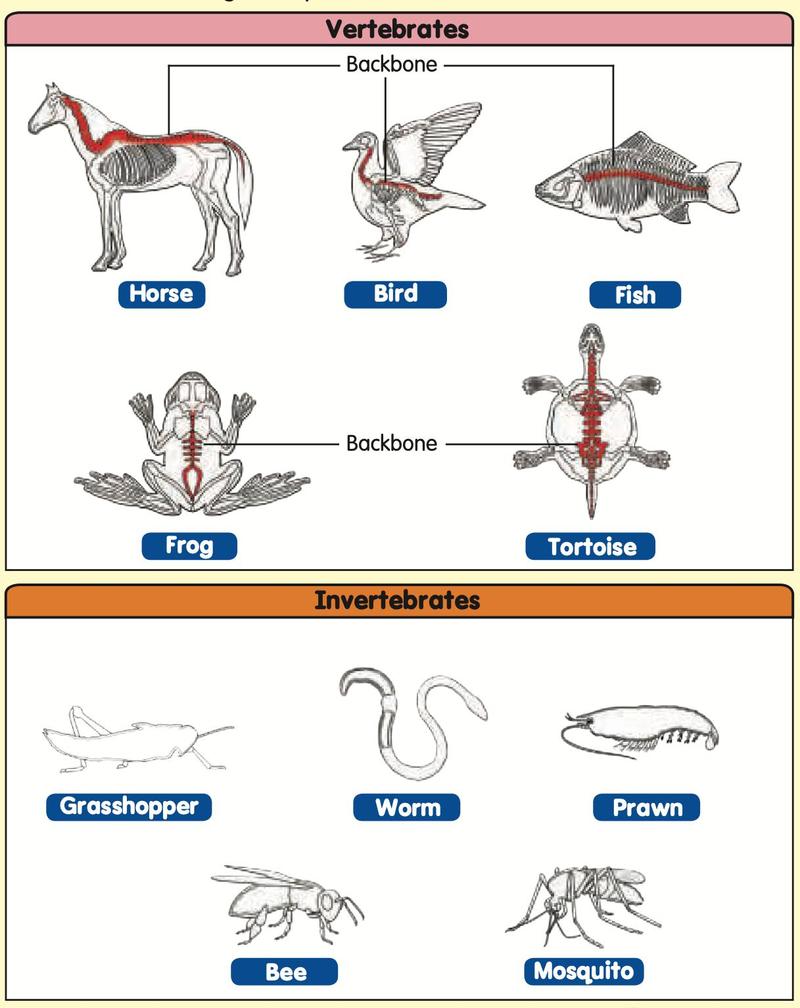
Figure: Science Year 4 (DLP), p.59.
| Vertebrates | Invertebrates |
|---|---|
| Horse, bird, fish, frog, tortoise, snake, tiger | Grasshopper, worm, prawn, bee, mosquito, centipede, starfish |
Five classes of vertebrates
Vertebrates are sorted by their breathing organ, how they reproduce, their body covering and their habitat.
| Class | Breathing organ | Reproduction | Body covering | Habitat | Examples |
|---|---|---|---|---|---|
| Mammal | Lungs | Gives birth | Fine hair | On land | Deer, cat |
| Reptile | Lungs | Lays eggs | Scales or hard shell | Mostly on land | Tortoise, crocodile |
| Amphibian | Lungs and moist skin | Lays eggs | Moist skin | On land and in water | Frog, caecilia |
| Bird | Lungs | Lays eggs | Feathers | On land | Chicken, stork |
| Fish | Gills | Lays eggs | Scales | In water | Fish |
Science info. A whale lives in the sea but is a mammal: it gives birth and breathes with lungs, so it swims up to the surface for air. A bat flies but is a mammal, not a bird. A platypus is an unusual mammal that lays eggs, yet it feeds its young with milk.
Do not sort animals only by where they live. A whale lives in water but it is not a fish.
A new animal has a backbone, lungs, feathers and lays eggs. Which class is it?
Show answerHide answer
Bird. It is a vertebrate with feathers, and birds lay eggs and use lungs.
Summary
- Animals breathe with lungs, gills, moist skin or spiracles.
- Some animals, such as frogs, have more than one breathing organ and live in two habitats.
- Vertebrates have a backbone; invertebrates do not.
- Vertebrates are mammals, reptiles, amphibians, birds or fish.