Plants
What this chapter covers
- You can say that plants respond to stimuli such as water, gravity, light and touch (4.1.1)
- You can name the parts of a plant that respond to each stimulus (4.1.2)
- You can carry out investigations on plant responses and draw conclusions (4.1.3, 4.1.4)
- You can explain what photosynthesis means (4.2.1)
- You can state the needs of photosynthesis (4.2.2)
- You can state the products of photosynthesis and write the word equation (4.2.3)
- You can explain why photosynthesis is important to living things (4.2.4, 4.2.5)
4.1How plants respond to stimuli
A plant cannot walk away, but it still reacts to the world around it. A stimulus is anything that makes a living thing react. The reaction is called a response. Plants respond to four stimuli: water, gravity, light and touch.
Response: the way a living thing reacts to a stimulus.
Gravity: a force that pulls objects towards the Earth.
| Part of plant | Stimulus | Response |
|---|---|---|
| Roots | Water | Grow towards the water |
| Roots | Gravity | Grow downwards, in the direction of the pull of gravity |
| Shoots | Light | Grow towards the light |
| Leaves of some plants | Touch | Droop and fold inwards |
The Mimosa pudica and the Venus flytrap are two plants whose leaves respond to touch.
Facts: Science Year 4 (DLP) textbook, pp. 70-71.
The investigations
The textbook uses four fair tests. In each one the aim says what we want to find out, and the hypothesis is a testable statement about what we expect to find.
| Investigation | What is done | Result and conclusion |
|---|---|---|
| Roots and water | Green bean seedlings on a petri dish. Cotton on the left and right sides (A and B). Water is added to cotton A only. | Roots grow towards cotton A. Roots respond to water. |
| Roots and gravity | Seedlings placed in different positions in a moist petri dish, held upright for a week. | All roots grow downwards. Roots respond to gravity. |
| Shoots and light | Chilli plants in boxes A and B, with a hole on the left of A and the right of B, in the sunlight. | Shoots bend towards the hole in each box. Shoots respond to light. |
| Leaves and touch | Touch the leaves, the flower and the stem of a Mimosa pudica. | Only the leaves fold inwards. Leaves of Mimosa pudica respond to touch. |
Each shoot bent towards the hole where light came in. Conclusion: shoots respond to light. The hypothesis is accepted.
Show answerHide answer
4.2Photosynthesis
People and animals can move to find food. Plants cannot, so they make their own food. This process is called photosynthesis.
What plants need
| Need | What it is and where it comes from |
|---|---|
| Sunlight | The main source of energy |
| Chlorophyll | The green substance in plants that absorbs sunlight |
| Carbon dioxide | A gas in the air that enters through the leaves |
| Water | Absorbed through the roots |
A plant that is not green, such as one with red leaves, can still carry out photosynthesis if it has chlorophyll.
What plants make
Chlorophyll absorbs sunlight. The plant changes water and carbon dioxide into glucose and oxygen. The glucose is joined together to form starch, which is stored in the leaves, stems, roots, seeds, flowers and fruits. Oxygen is released into the air through the leaves.
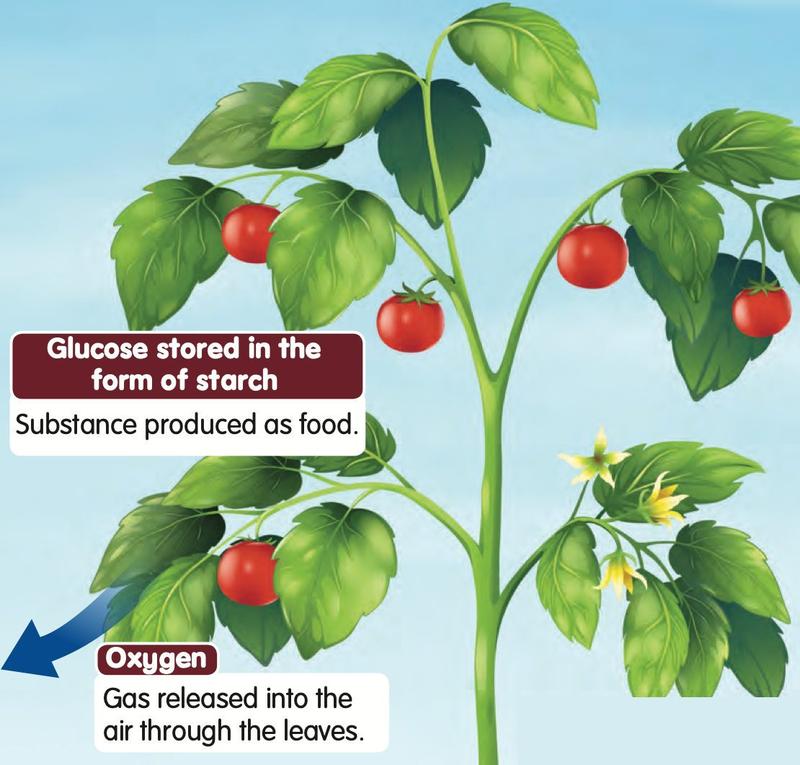
Picture: Science Year 4 (DLP) textbook, p. 78.
carbon dioxide + water → glucose + oxygen
(in the presence of sunlight and chlorophyll)
Show answerHide answer
4.3Why photosynthesis is important
- It supplies food. Plants are food for humans and animals.
- It supplies oxygen. Humans and animals breathe in the oxygen that plants release.
- It keeps the balance of gases in the air. Plants take in carbon dioxide, which humans and animals breathe out.
After some days plant X stays healthy, but plant Y turns pale and weak. Reason: plant Y gets no sunlight, so it cannot carry out photosynthesis to make food.
Show answerHide answer
Facts: Science Year 4 (DLP) textbook, pp. 76-84.