Properties of light
What this chapter covers
- You can say that light travels in a straight line and show it with an investigation (5.1.1)
- You can tell transparent, translucent and opaque objects apart by the shadows they form (5.1.2)
- You can name the factors that change the size and the shape of a shadow (5.1.3, 5.1.4)
- You can explain reflection of light and give examples of it in daily life (5.2.1, 5.2.2)
- You can draw a ray diagram to show reflection of light (5.2.3, 5.2.4)
- You can explain refraction of light and how a rainbow is formed (5.3.1, 5.3.2, 5.3.3)
- You can explain why the properties of light are important in daily life (5.3.4)
Light helps us to see. In this unit you will learn three properties of light: light travels in a straight line, light can be reflected and light can be refracted. You will also find out how shadows are formed.
5.1Light travels in a straight line
We can see this in many places around us. Sunlight shines in straight rays between the tree trunks in a forest. The light from a car's headlights makes a straight beam on a dark road.
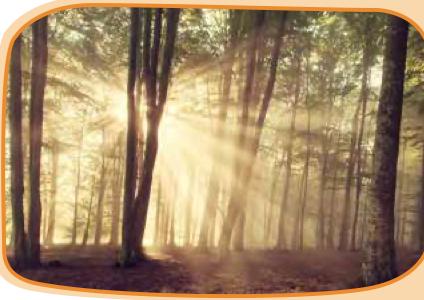
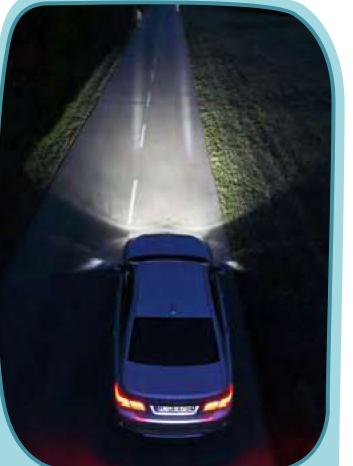
Textbook p.88.
Investigation: does light travel in a straight line?
Put a torch, three cardboards with a slit each, and a black screen in a row. Switch on the torch.
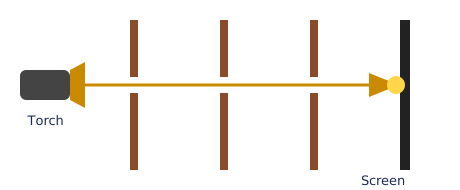
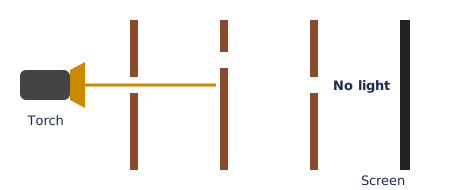
Conclusion: light forms on the screen only when the slits are in a straight line. So light travels in a straight line.
Show answerHide answer
5.2Shadows
A shadow is formed when an object blocks light. How clear the shadow is depends on the kind of object.
| Kind of object | Light that passes through | Shadow | Example |
|---|---|---|---|
| Transparent | All the light | None | Clear plastic |
| Translucent | Some of the light | Less clear | Coloured plastic |
| Opaque | No light | Clear (dark) | Manila card |
Show answerHide answer
Size of a shadow
The size of a shadow depends on two distances:
- the distance between the light source and the object;
- the distance between the object and the screen.
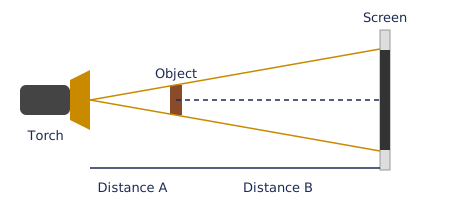
In the experiment, the manipulated variable is the distance between the torch and the object. The responding variable is the size of the shadow. The constant variable is the distance between the object and the screen.
| Torch to object | Size of shadow |
|---|---|
| 5 cm (near) | Large |
| 10 cm (further) | Smaller |
Conclusion: the further the object is from the light source, the smaller the shadow.
Shape of a shadow
The shape of a shadow changes when we change:
- the orientation of the object (how it is turned or tilted);
- the position of the light source.
For example, a cylinder gives a circle shadow when the light shines on its end and a rectangle shadow when it lies on its side.
Show answerHide answer
5.3Reflection of light
We see our image in a mirror because the mirror reflects light from our face into our eyes. Smooth and shiny surfaces reflect light well, such as water, floor tiles and metal.
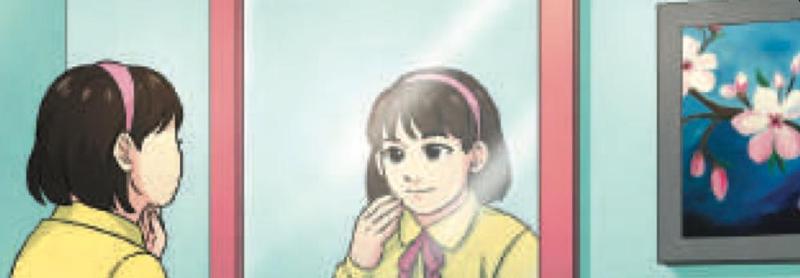
Textbook p.94.
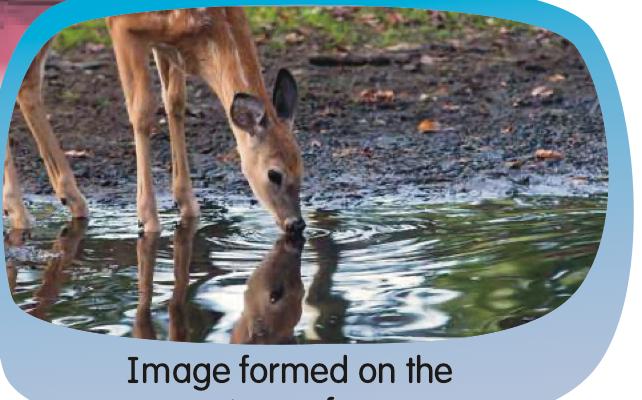
Textbook p.94.
The moon is not a source of light. It looks bright at night because it reflects sunlight towards the Earth.
Uses of reflection in daily life
| Device | How it uses reflection |
|---|---|
| Face mirror | Reflects light from our face to our eyes so we can see our image. |
| Side mirror of a car | Lets the driver see vehicles that are blocked from view. |
| Convex mirror at a bend | Lets a driver see a vehicle that is hidden round the bend, to avoid an accident. |
| Dental mirror | Lets the dentist see the teeth easily. |
| Periscope | Two mirrors reflect light from an object that is blocked from view to the observer's eyes. |
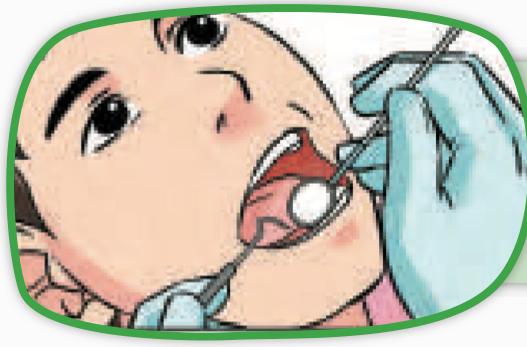
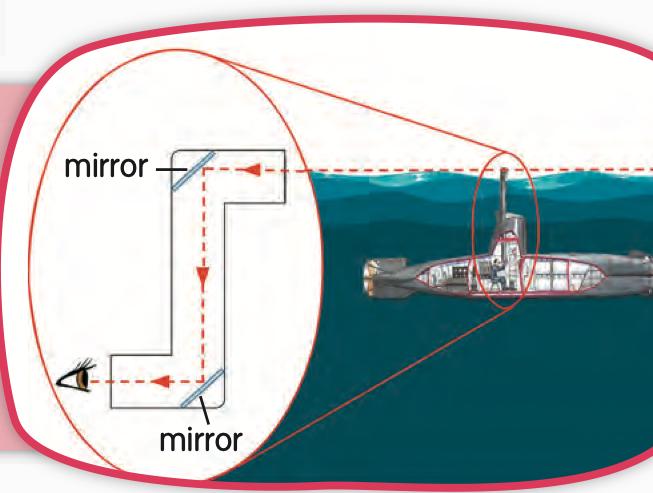
Textbook p.97.
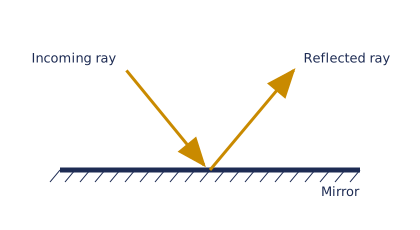
Ray diagram
A ray diagram shows how light is reflected. It has the mirror, the incoming ray and the reflected ray, each with an arrow to show the way the light goes. Draw the rays with a ruler because light travels in a straight line.
Show answerHide answer
5.4Refraction of light
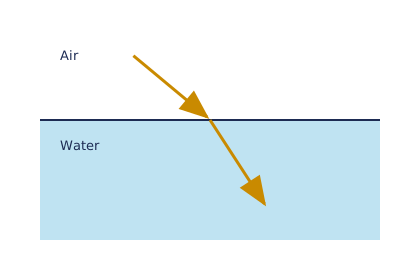
- A spoon in a glass of water looks bent because the light from the spoon is refracted when it goes from water to air.
- A hand lens magnifies things because it refracts light.
Rainbow
When the Sun shines on rain droplets, the light is refracted and a rainbow is formed. In the classroom we can model this with a mirror in a basin of water placed in sunlight: the water refracts the light and the mirror sends it onto paper on the wall.
Show answerHide answer
5.5Why the properties of light matter
| Property | What would happen without it |
|---|---|
| Travels in a straight line | A torch beam could not shine straight onto the thing we look for. |
| Reflected | We could not see our face in a mirror. |
| Refracted | A hand lens could not magnify an object. |
Reflected: mirror, periscope, dental mirror, convex mirror.
Refracted: bent spoon, rainbow, hand lens.