You can explain what energy means and name the sources of energy (7.1.1, 7.1.2)
You can state the forms of energy and give examples of each (7.1.3)
You can describe how energy changes from one form to another in daily life (7.1.4)
You can explain that energy cannot be created or destroyed, but can be transformed (7.1.5, 7.1.6)
You can classify energy sources as renewable or non-renewable and give reasons (7.2.1)
You can explain why we must use energy wisely and how to do it (7.2.2, 7.2.3)
Everything that moves, glows, gets hot or makes a sound needs energy. In this unit you will find out where energy comes from, what forms it takes and how it changes from one form to another.
7.1Energy and its sources
Energy is the ability to do work. Energy can come from many sources.
Source
How we get energy from it
Sun
The main source of energy. Solar panels use sunlight to generate electricity.
Water
Flowing water turns a turbine in a hydroelectric dam to generate electricity.
Wind
Blowing wind turns a windmill to generate electricity.
Waves
Ocean waves turn a turbine to generate electricity.
Biomass
Waste from firewood, plants and animal faeces is used as fuel and to generate electricity.
Fossil fuels
Petroleum, natural gas and coal are burned to generate electricity.
Nuclear substances
Uranium is used at nuclear power stations to generate electricity.
Geothermal
Heat from hot rocks under the Earth's surface turns a turbine.
Did you know? Many of these sources work by turning a turbine. The turning turbine is used to generate electricity.
Name three energy sources that turn a turbine to generate electricity.
Show answerHide answer
Any three: water (hydroelectric dam), wind (windmill), waves, geothermal heat.
Forms of energy
Energy is found in nine forms.
Form
What it is
Example
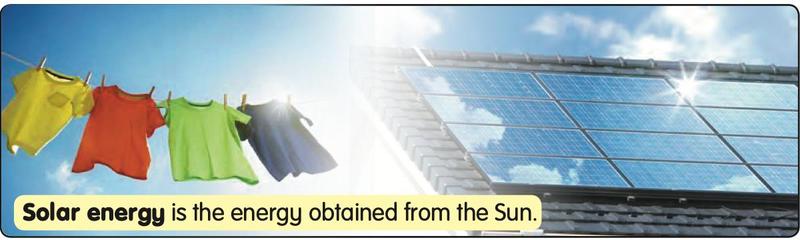
Solar energy
Energy obtained from the Sun
Sunlight on a solar panel
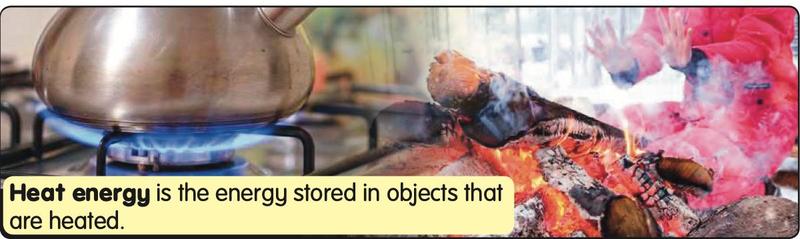
Heat energy
Energy stored in objects that are heated
A pot on a hot stove
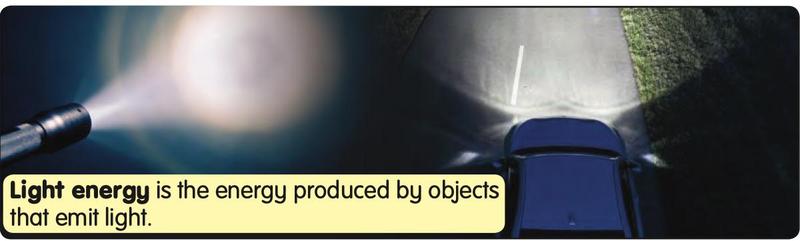
Light energy
Energy produced by objects that give out light
A torch, a lit bulb
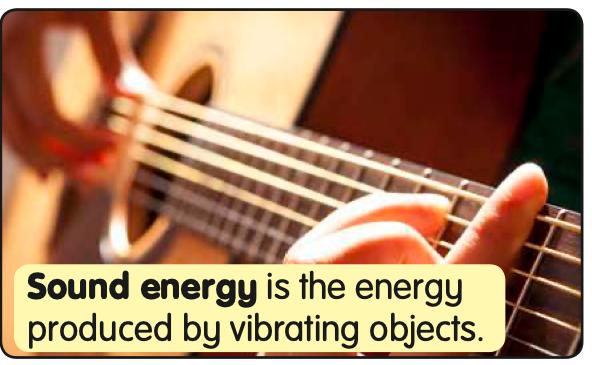
Sound energy
Energy produced by vibrating objects
A guitar string
Electrical energy
Energy flowing in a complete electrical circuit
Current in a lamp circuit
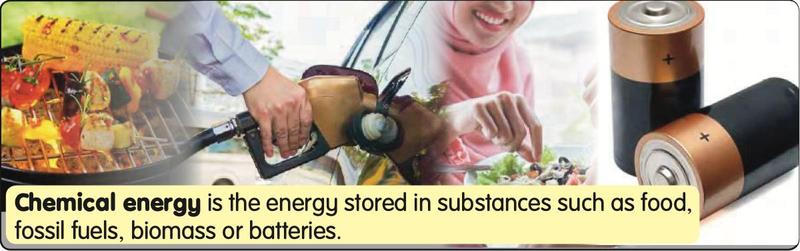
Chemical energy
Energy stored in food, fossil fuels, biomass and batteries
Rice, petrol, a dry cell
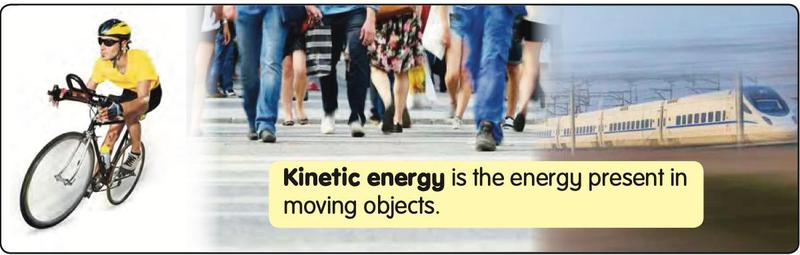
Kinetic energy
Energy of moving objects
A cyclist, a running child
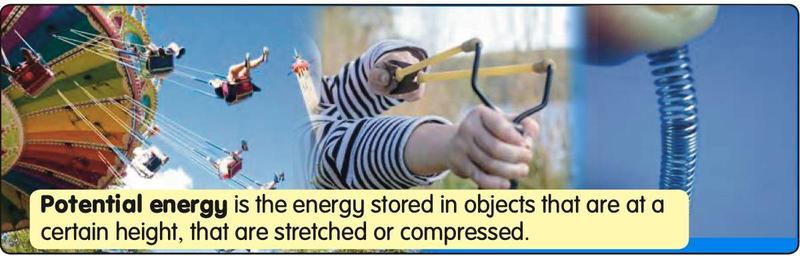
Potential energy
Energy stored in objects that are high up, stretched or compressed
A catapult pulled back
Nuclear energy
Energy inside nuclear substances
Uranium
Solar energy comes from the Sun.Heat energy is stored in a heated pot.Light energy is produced by objects that give out light.A vibrating guitar string makes sound energy.Chemical energy is stored in food, fossil fuels and batteries.Moving things have kinetic energy.Potential energy: high up, stretched or squashed.
Do not mix up the two stored forms. Chemical energy is stored in substances (food, petrol, batteries). Potential energy is stored because of position or shape (height, stretched, compressed).
Name the form of energy in (a) a rolling ball, (b) a stretched rubber band, (c) a plate of nasi lemak.
Show answerHide answer
(a) Kinetic energy (b) Potential energy (c) Chemical energy
Transformation of energy
Energy can change from one form to another. This is called transformation of energy. In a chain, an arrow → means "changes to" and + means "and".
Situation
Energy chain
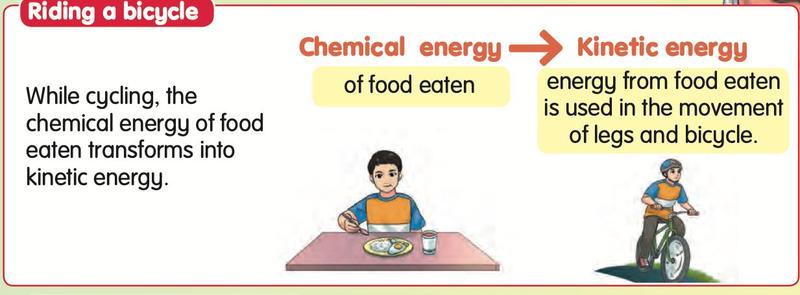
Riding a bicycle
Chemical energy (food) → kinetic energy
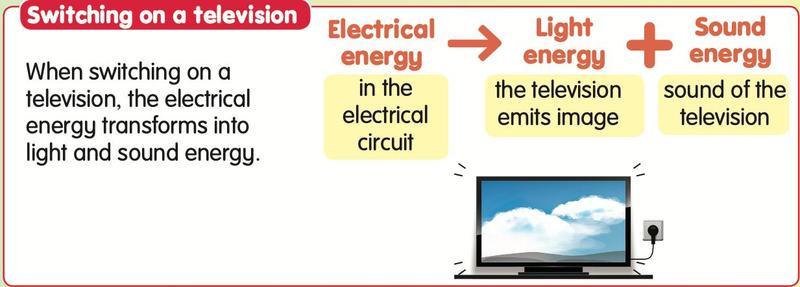
Switching on a television
Electrical energy → light energy + sound energy
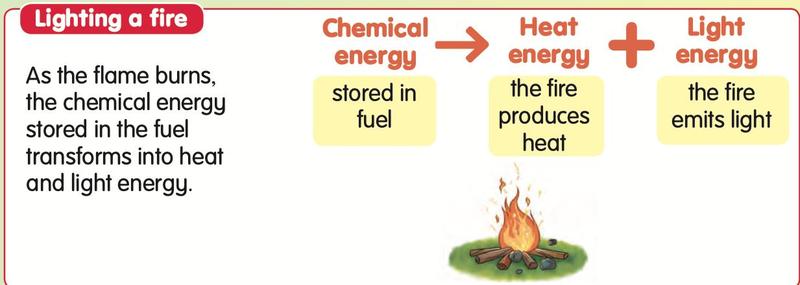
Lighting a fire
Chemical energy (fuel) → heat energy + light energy
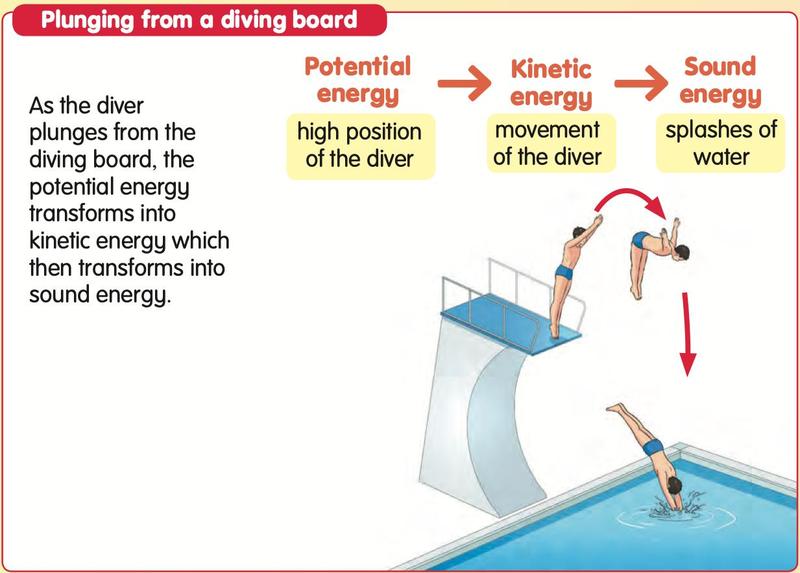
Diving from a diving board
Potential energy → kinetic energy → sound energy
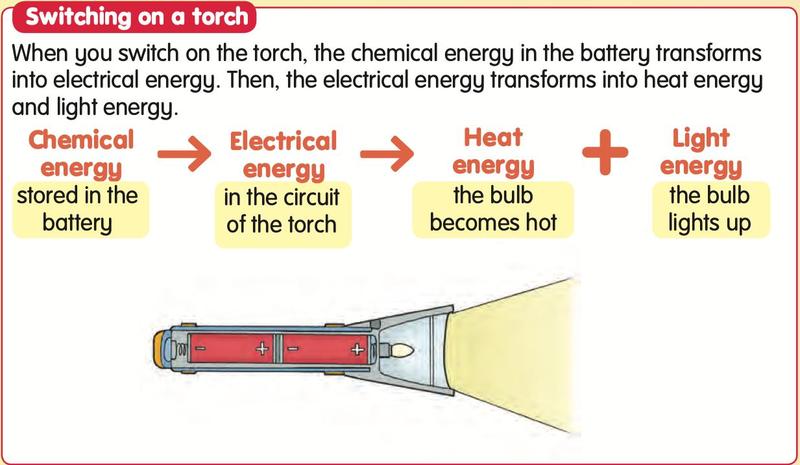
Switching on a torch
Chemical energy (battery) → electrical energy → heat energy + light energy
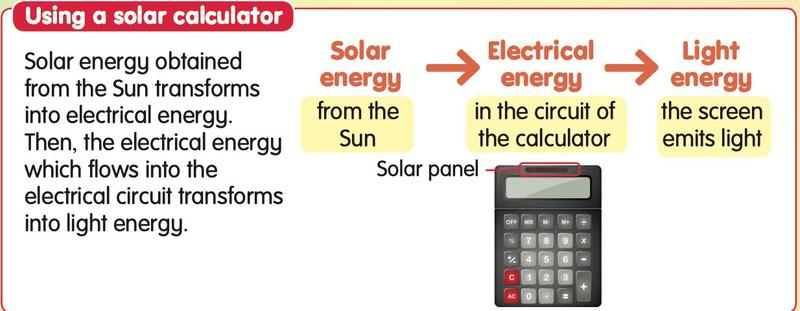
Using a solar calculator
Solar energy → electrical energy → light energy
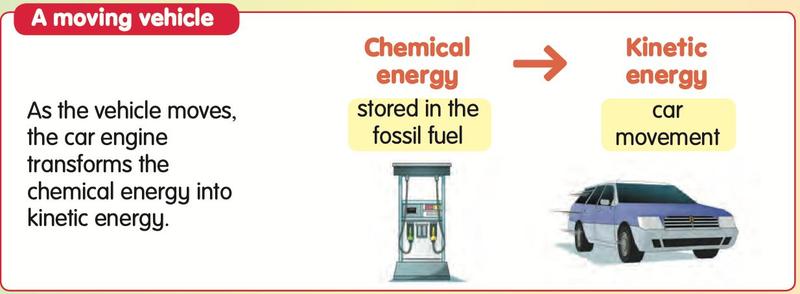
A moving car
Chemical energy (fossil fuel) → kinetic energy
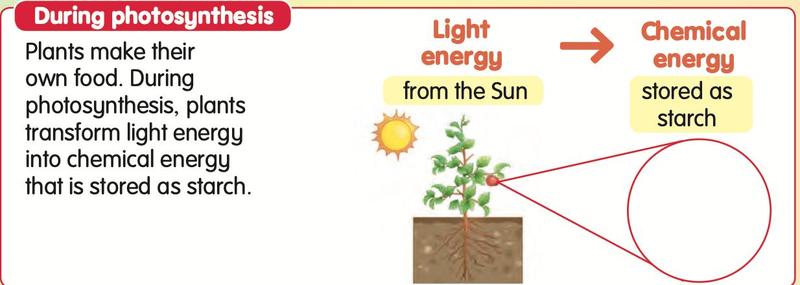
Photosynthesis
Light energy (Sun) → chemical energy (starch)
Food gives chemical energy. Cycling changes it into kinetic energy.A television: electrical energy → light energy + sound energy.A fire: chemical energy in the fuel → heat energy + light energy.The higher the diver, the more potential energy. It changes to kinetic energy as the diver falls.A torch: battery (chemical) → circuit (electrical) → bulb (heat and light).A solar calculator needs no battery. Its solar panel changes sunlight to electrical energy.A moving car: chemical energy in the fuel → kinetic energy.Photosynthesis changes light energy to chemical energy stored as starch.
Did you know? A bulb gives out heat as well as light. That is why a lit bulb feels warm.
Example: a mobile phone
While you call, the phone's battery changes chemical energy to electrical energy. Then the electrical energy becomes light (screen) and sound energy (speaker).
Write the energy chain for a radio that is plugged in and playing.
Show answerHide answer
Electrical energy → sound energy.
Energy cannot be created or destroyed
Energy cannot be created and cannot be destroyed. It can only be transformed from one form to another.
Think of a motorcycle. It does not make its own kinetic energy. The engine changes the chemical energy in petrol into kinetic energy. While it moves, some energy also changes to sound and heat. When the petrol is finished, the motorcycle stops. The kinetic energy has not been destroyed. All the chemical energy has been changed into other forms.
Chemical energy (petrol)
→
Kinetic energy + heat energy + sound energy
"The energy is used up" is not correct. Energy is never lost. It changes into other forms, often heat and sound that we do not use.
A girl rides a bicycle, then stops pedalling and the bicycle slowly stops. Has the kinetic energy been destroyed?
Show answerHide answer
No. Energy cannot be destroyed. The kinetic energy changed into other forms such as heat and sound.
7.2Renewable and non-renewable energy sources
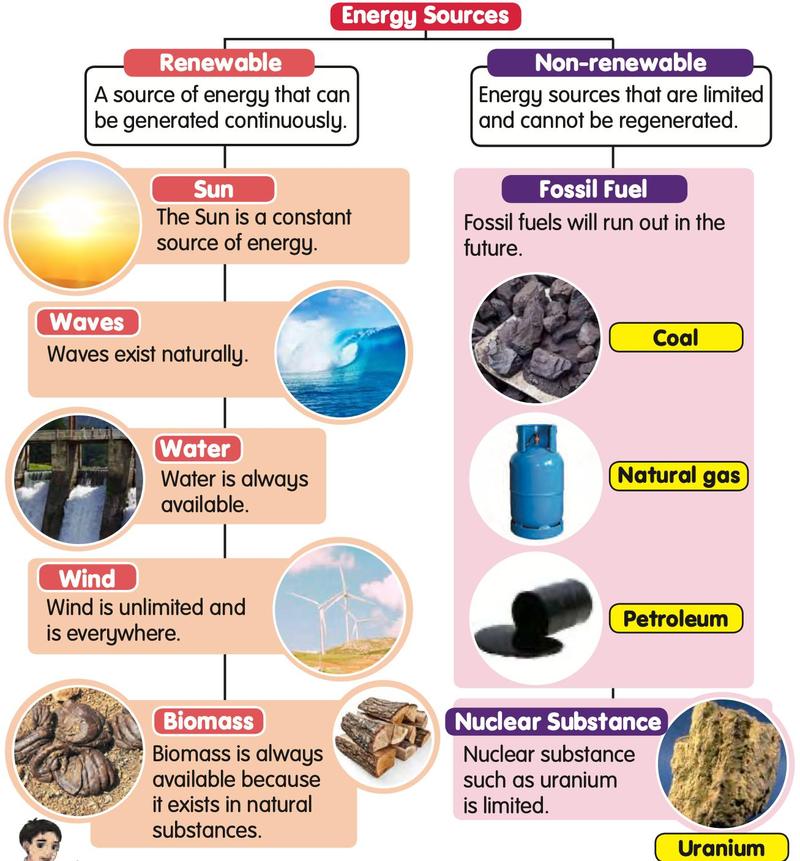
Renewable
Non-renewable
Meaning
Can be generated continuously. It does not run out.
Limited and cannot be regenerated. It will run out.
Examples
Sun, waves, water, wind, biomass
Fossil fuels (coal, natural gas, petroleum) and nuclear substances (uranium)
Why
The Sun is constant; waves, water and wind are always there; biomass comes from natural substances.
Fossil fuels will run out in the future. Uranium is limited.
Energy sources: renewable on the left, non-renewable on the right.
Did you know? Biodiesel is made from vegetable oil or animal fat. Since February 2019, petrol stations in Malaysia sell diesel mixed with palm oil biodiesel.
Biomass is renewable but it is not the same as a fossil fuel. Fossil fuels take millions of years to form, so we cannot make more in our lifetime.
Is natural gas renewable or non-renewable? Give a reason.
Show answerHide answer
Non-renewable. It is a fossil fuel, it is limited and will run out.
Using energy wisely
Most energy we use today comes from non-renewable sources. To make sure there is enough energy in the future, we must use energy wisely.
Why it is important
How we can do it
To prevent wastage of energy, so sources last longer and bills are lower
Switch off lights and fans when you leave a room. Use a fan instead of an air conditioner when possible.
To reduce pollution of the environment (burning fuels gives smoke)
Walk, cycle or share a car. Use public transport. Use renewable energy, such as solar energy.
Example: the electricity bill
Ali's family leaves the air conditioner on all day. The bill is high. Next month they use a fan and switch off the lights when not needed. The bill falls because less electrical energy is used.
Give one way to use energy wisely at school.
Show answerHide answer
Any: switch off lights, fans and computers when not in use; walk or cycle to school; share a ride.
Pictures: Science Year 4 (DLP) textbook, pp. 123–140 (forms of energy pp. 126–127, transformations pp. 128–130, renewable chart p. 134).