Science notes, unit 8
Materials
Textbook Science Year 4 (DLP), pages 141–154
What this chapter covers
- {'You can name the four basic sources of materials': 'plants, animals, petroleum and rocks (8.1.1)'}
- You can classify objects by the basic source of the material they are made from (8.1.2, 8.1.3)
- You can investigate properties of materials, such as water absorbency, floating and sinking, conducting electricity and heat, letting light through, and elasticity (8.2.1)
- You can use the properties of materials to design and make an object (8.2.2)
- You can explain why a material is chosen for an object, based on its properties (8.2.3, 8.2.4)
Look at the things around you: a chair, a shirt, a bottle, a spoon. Each one is made from a material. A material is chosen because of what it is like. In this unit you will find out where materials come from and why each one is used for a certain job.
8.1Basic sources of materials
A basic source is the place where a material first comes from. The four basic sources are plants, animals, petroleum and rocks.
| Basic source | Materials | Examples of objects |
|---|---|---|
| Plants | Rubber, wood, cotton | Tyres, rubber gloves, wooden chair, shirts, towels |
| Animals | Wool, cow skin (leather), silk | Woollen cap, sweater, leather shoes, leather sofa, silk tie |
| Petroleum | Plastic, synthetic cloth | Plastic bag, plastic bottle, raincoat, tent |
| Rocks | Metal (gold, copper), clay, soil, sand | Necklace, coins, bricks, ceramic bowl, mirror, glass bottle |
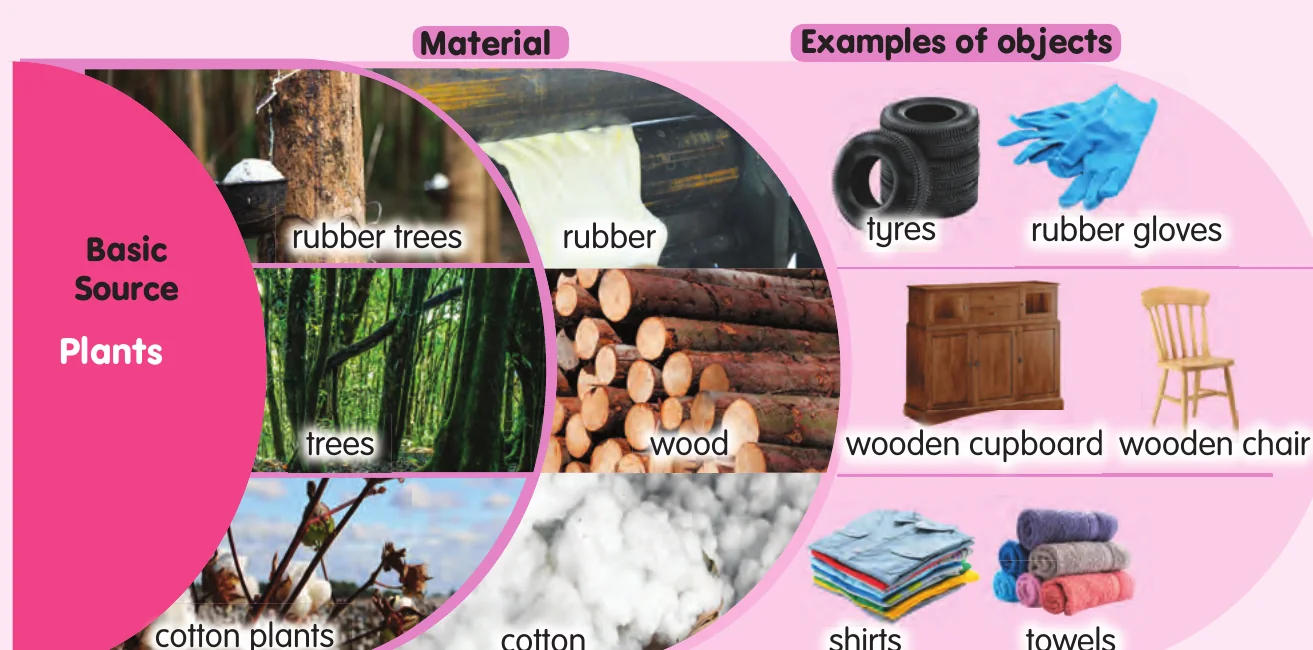
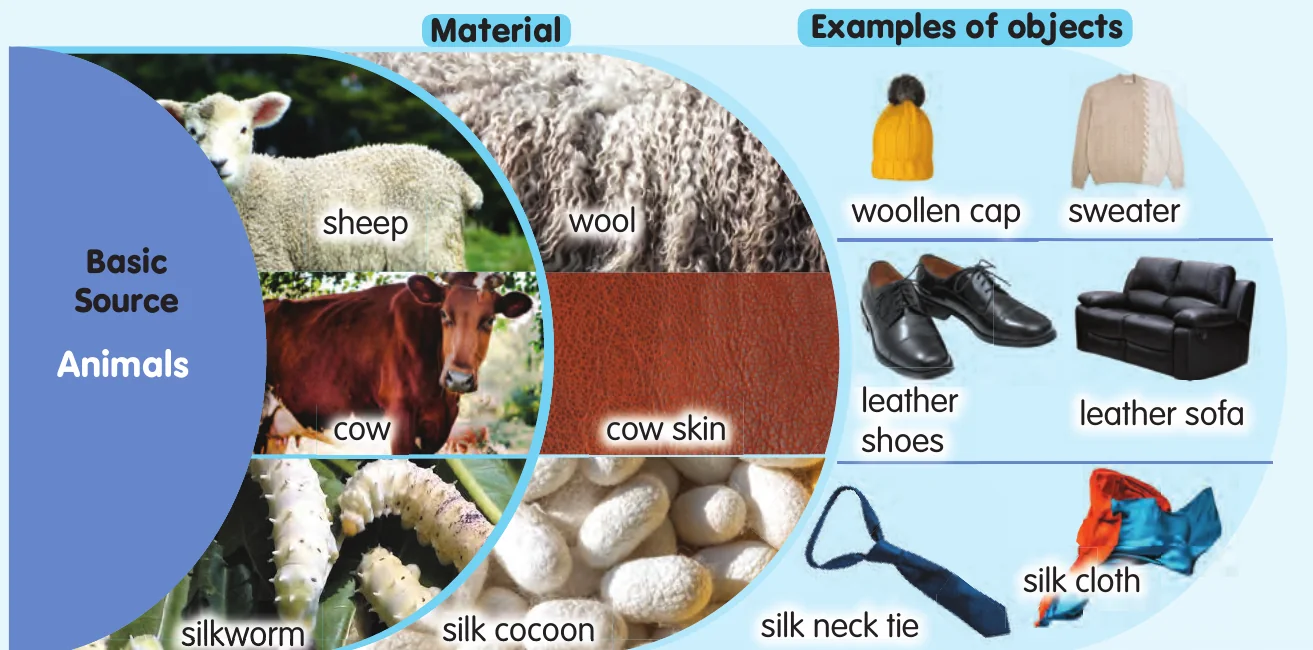
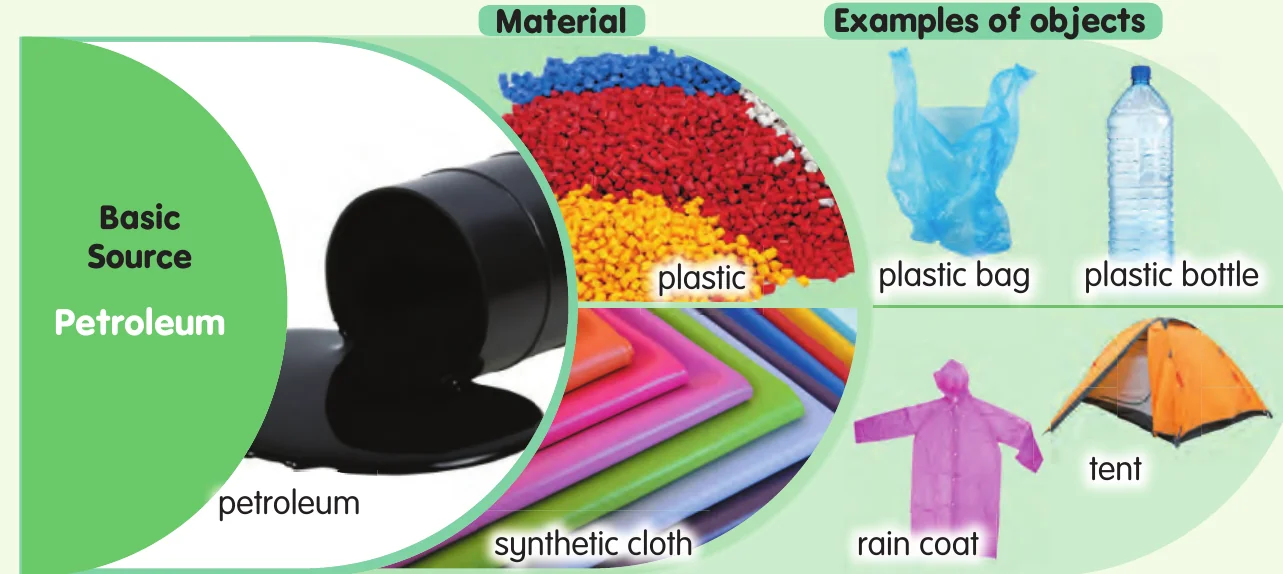
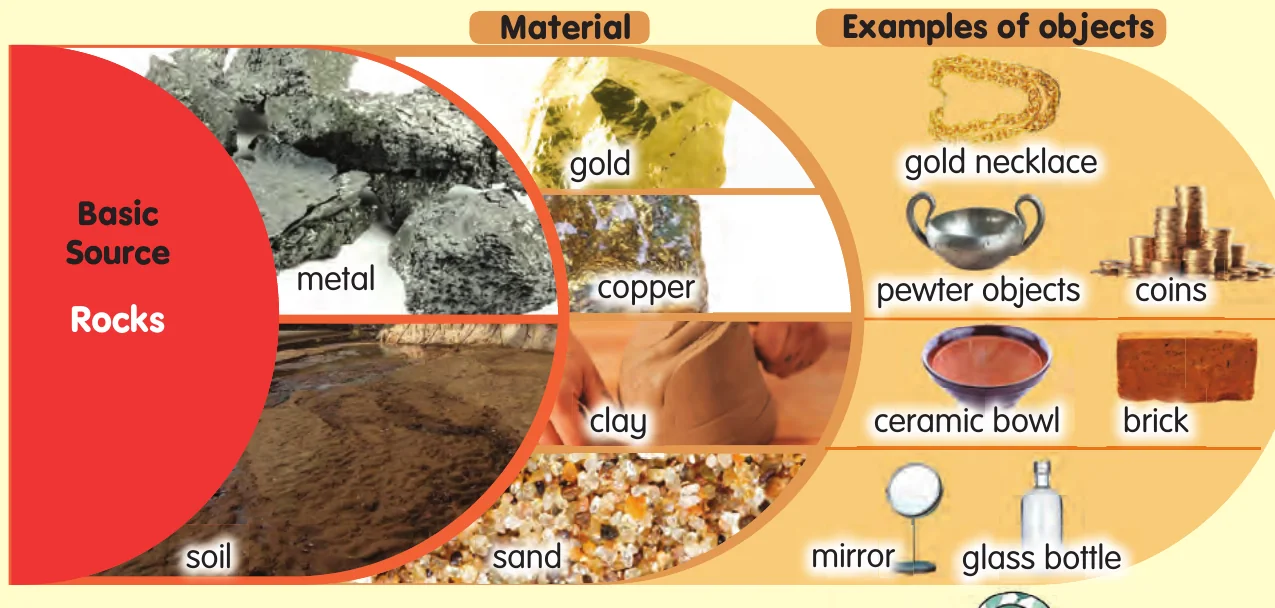
Did you know? Petroleum is a black oil from under the ground. It formed from living things that died millions of years ago. Silk comes from the cocoon that a silkworm makes to protect itself.
Glass, mirrors and bricks come from rocks (sand and clay), not from plants. Plastic comes from petroleum, not from plants.
Example: classifying objects
A towel (cotton, from a plant). A sweater (wool, from an animal). A raincoat (synthetic cloth, from petroleum). A coin (metal, from rocks).A leather bag and a wooden ruler. Name the basic source of each.
Show answerHide answer
Leather bag: animals (cow skin). Wooden ruler: plants (wood).
8.2Properties of materials
Materials have different properties. We investigate them with fair tests, using stations. We observe, record in a table and then make an inference.
| Property | How we test it | What we find |
|---|---|---|
| Absorbs water (not waterproof) | Drop water on the object and look after two minutes. | Tissue paper and cotton absorb water. Plastic and glass do not (waterproof). |
| Floats or sinks | Put the object in a half-full container of water. Look after one minute. | Popsicle sticks and polystyrene float. A rock and a key sink. |
| Conducts electricity | Put the object in a complete circuit in place of the switch. See if the bulb lights up. | Metals such as coins and aluminium foil, and pencil lead, conduct. Plastic ruler and leather string do not. |
| Lets light through | Look through the object. | Clear plastic and glass slide: clear. Tracing paper: not clear. Coloured paper: cannot be seen through. |
| Conducts heat | Soak the objects in hot water for two minutes. Touch the ends. | Aluminium foil feels warm quickly. Polystyrene stays the same. |
| Elastic | Stretch or pull the object, then release it. | Balloon, rubber band and spring return to their shape. A pencil or nail cannot be stretched. |
Elasticity is the ability of a material to return to its original shape after it is pulled, pressed or stretched.
Always read the question: if the test is "does the bulb light up?", then lighting up means the object conducts electricity. A bulb that stays off means the object does not conduct electricity.
Be careful with a glass slide: handle it safely. Take care with hot water too. Ask your teacher to help.
In a circuit, the bulb lights up when an aluminium foil strip is joined in. It stays off with a plastic ruler. What do you infer?
Show answerHide answer
Aluminium foil conducts electricity. The plastic ruler does not conduct electricity.
8.3Using properties to choose materials
When people invent an object, they choose the material by its properties so that the object works well.
| Object | Material | Reason |
|---|---|---|
| Cooking pot | Metal | It conducts heat well, so food cooks quickly. |
| Rice cooker, iron | Metal base | It conducts heat to the food or clothes. |
| Cloth for wiping spills | Cotton | It absorbs water well. |
| Raincoat | Synthetic cloth | It is waterproof. |
| Balloon, rubber band | Rubber | It is elastic. |
| Window | Glass | Light passes through it. |
| Float for a fishing net | Foam | It floats on water. |
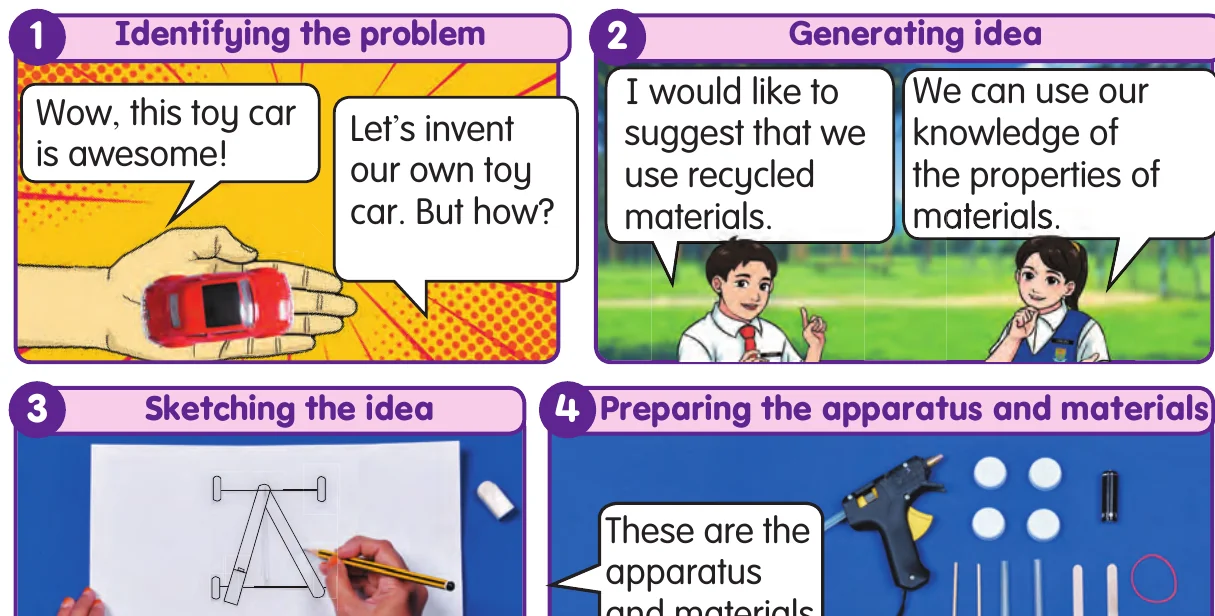
The toy car in the textbook shows steps for making an object:
- Identify the problem.
- Generate ideas using the properties of materials.
- Sketch the idea.
- Prepare the apparatus and materials.
- Build the toy car.
Why use rubber for tyres?
Rubber is elastic and strong, and it is waterproof. It grips the road and lets a vehicle roll smoothly.Why are electrical wires covered with plastic?
Show answerHide answer
Plastic does not conduct electricity, so it keeps us safe.
Choosing the right material makes sure the object works properly and is suitable for its use. Use what you know about basic sources and properties of materials. For example, you can make a lamp shade from used materials.
Pictures: Science Year 4 (DLP) textbook, pp. 141–154 (plants and animals p. 142, petroleum and rocks p. 143, toy car p. 151).
Summary
| Idea | Key point |
|---|---|
| Basic sources | Plants, animals, petroleum, rocks |
| Properties | Absorbs water, floats or sinks, conducts electricity, lets light through, conducts heat, elastic |
| Choosing materials | Pick the material whose properties suit the job |