myUASARevision for UASA
Science notes, unit 9

Earth

Textbook Science Year 4 (DLP), pages 155–168

What this chapter covers

  • You can explain what gravitational pull on Earth is (9.1.1)
  • You can describe the effects of gravitational pull on Earth (9.1.2)
  • You can explain why gravitational pull on Earth is important (9.1.3)
  • You can say that Earth rotates on its axis and revolves around the Sun at the same time (9.2.1)
  • You can state the direction and the duration of the rotation and revolution of Earth (9.2.2, 9.2.4)
  • You can describe the effects of the rotation of Earth on its axis (9.2.3)

Why does a ball you throw up always come back down? Why do day and night follow each other? In this unit you will find out how Earth pulls things towards itself and how it moves in space.

9.1Gravitational pull on Earth
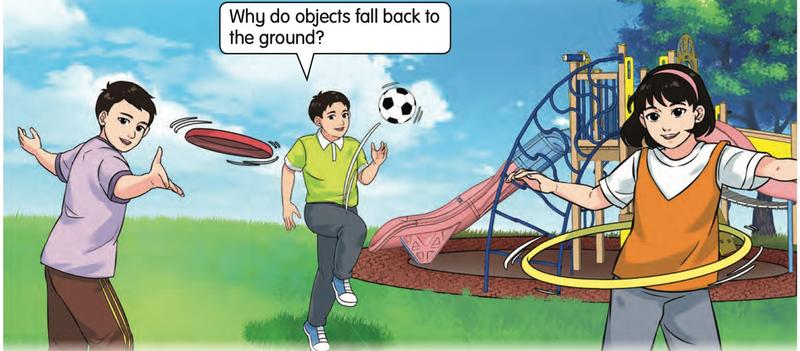
Three children playing in a park with a flying disc, a football and a hoop
Toss anything up and it falls back to the ground. Why?

Figure: Science Year 4 (DLP), p.156

Gravitational pull (gravity) is the force that pulls all objects towards the centre of Earth.

The ball, the flying disc and you are all pulled the same way, down towards the middle of Earth. The word gravity comes from the Latin gravitas, meaning weight.

What gravity does
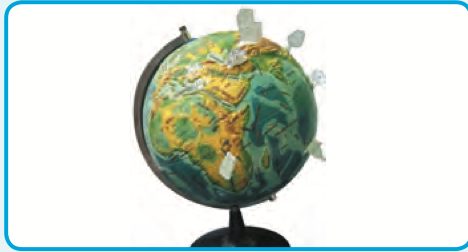
1. Objects fall freely. A ball dropped from a chair, thrown up or tossed to the side always ends up downward.
2. Objects stay in position. A book on a table, or a model stuck on a globe, does not drift off into the air.
A globe with small paper models of objects stuck on it
Models stuck on a globe stay in place as it turns, like objects on Earth.

Figure: Science Year 4 (DLP), p.158

Why gravity matters

Without gravitational pull, everything that is not fixed down would float in the air: books, chairs, water, even people. Because of gravity, objects remain in their positions on Earth.

Explain: an astronaut in space
Far from Earth there is hardly any gravitational pull from Earth. An astronaut has to be strapped down or he floats, just as things would float if Earth had no gravity.
Gravity is a pull towards the centre of Earth, not "downwards" in space. Say "towards the centre of Earth".
Give two effects of the gravitational pull on Earth.
Show answerHide answer
Objects fall freely (towards the ground) and objects remain in their positions.

9.2Rotation and revolution of Earth

Earth is a planet. It makes two movements at the same time.

Rotation is the movement of Earth spinning on its axis. Revolution is the movement of Earth going around the Sun in its orbit.

The axis is an imaginary line through the centre of Earth joining the North Pole and the South Pole. The orbit is the path Earth follows around the Sun.
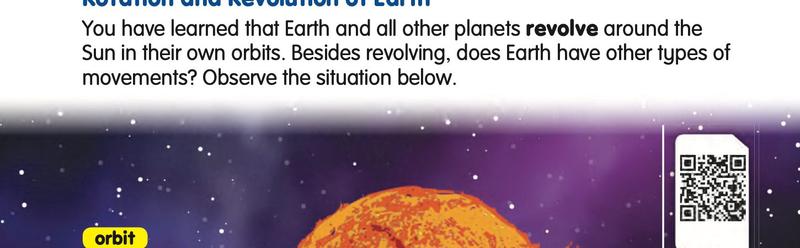
Earth in its orbit around the Sun with the orbit and the axis labelled
Earth spins on its axis and at the same time moves around the Sun in its orbit.

Figure: Science Year 4 (DLP), p.160

Direction and duration
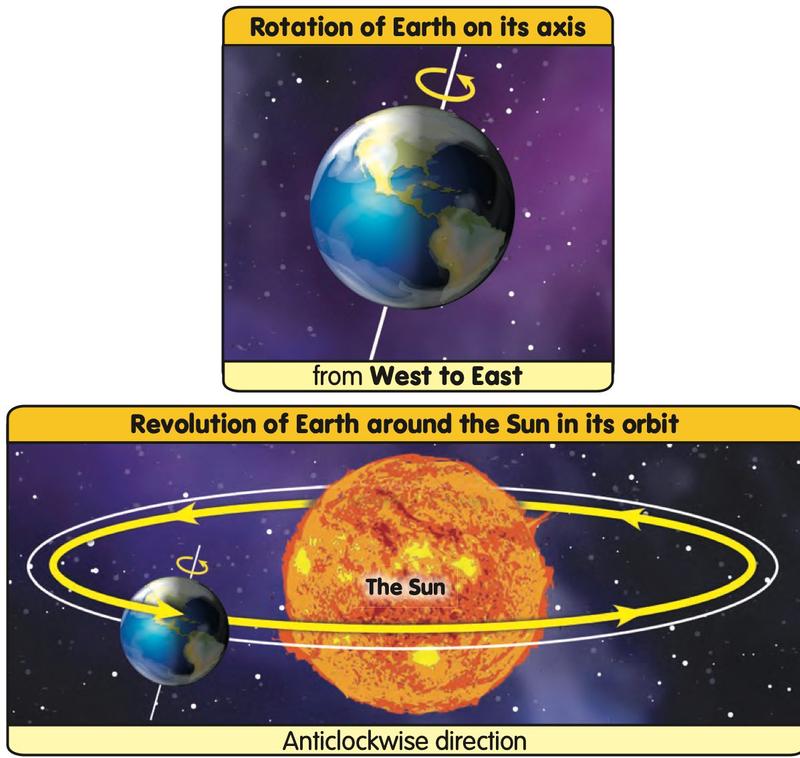
Earth rotating from west to east on its axis, and Earth revolving anticlockwise around the Sun
Rotation: west to east. Revolution: anticlockwise around the Sun.

Figure: Science Year 4 (DLP), p.161

Rotation on its axisRevolution around the Sun
DirectionFrom West to East (anticlockwise)Anticlockwise
One complete turn takes24 hours = 1 day1 year = 365¼ days
Remember: a day is one rotation; a year is one revolution. That is why the clock goes round 24 hours in a day.
Do not mix the two words. The Sun does not go around Earth. It only seems to move because Earth rotates.

Effects of the rotation of Earth

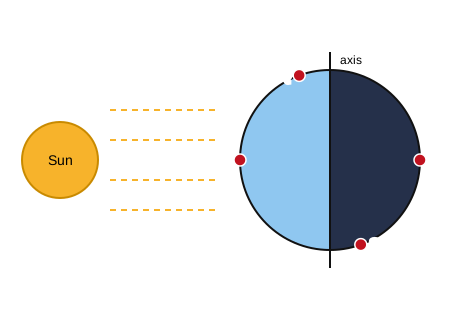
1. Day and night. The half of Earth that faces the Sun has day time. The half facing away has night time. As Earth rotates, a place moves from day into night and back again every 24 hours.
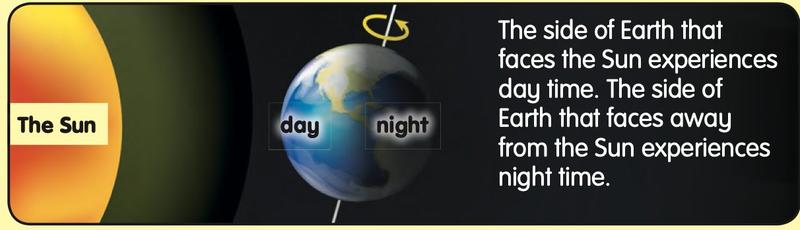
Earth next to the Sun; the side facing the Sun is day and the far side is night
Day on the side facing the Sun, night on the side facing away.

Figure: Science Year 4 (DLP), p.163

Earth with places P and Q on the side facing the Sun, and R and S on the far side
Places P and Q face the Sun (day). R and S face away (night).

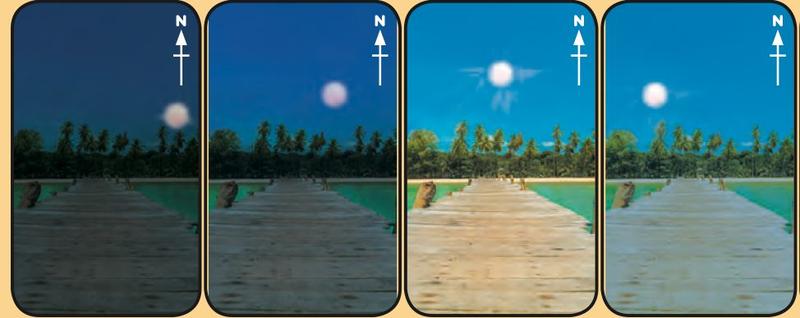
2. The Sun seems to change its position. In the morning the Sun is low in the east. At noon it is high. In the evening it is low in the west. The Sun is not really moving; Earth is rotating from west to east.

Four pictures of a jetty and sea with the Sun in different positions in the sky
The Sun seems to change its position through the day.

Figure: Science Year 4 (DLP), p.163

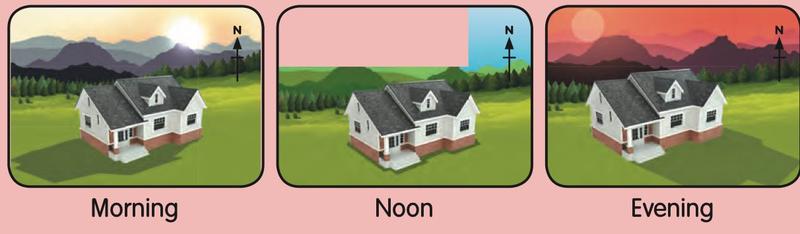
3. The length and direction of the shadow change. The shadow of a house or pole is long in the morning, short at noon and long again in the evening. It also points to a different direction as the Sun seems to move.

A house with its shadow in the morning, at noon and in the evening
Morning, noon and evening shadows.

Figure: Science Year 4 (DLP), p.163
TimeSunShadow
MorningLow, in the eastLong, points west
NoonHigh aboveShortest
EveningLow, in the westLong, points east
How do we know Earth rotates from west to east?
The Sun seems to rise in the east and set in the west. This happens when Earth turns from west to east.
Try it: Shine a torch on a globe in a dark room and turn the globe anticlockwise. Malaysia moves into the light, then out of it. That is day and night.
Earth makes one complete rotation. How long does it take, and what do we call it?
Show answerHide answer
24 hours, which is one day.
At 12 noon a stick has the shortest shadow. Why?
Show answerHide answer
The Sun is highest in the sky at noon, so the shadow is shortest.