Machines
What this chapter covers
- You can name the three parts of a lever, the load, the fulcrum and the force, and find them in everyday tools (10.1.1, 10.1.2)
- You can explain how the distance of the load from the fulcrum changes the force needed to lift it (10.1.3)
- You can name the seven simple machines and say what each one is used for (10.2.1)
- You can choose simple machines to solve a problem and explain why (10.2.2)
- You can say what a complex machine is and name the simple machines inside one (10.2.3)
- You can describe the characteristics of a sustainable machine (10.2.4)
Machines make our work easier and faster. In this unit you will meet the lever, learn how it works, and then learn about the seven simple machines and the complex machines that are made from them.
10.1Lever
| Part | What it is | Opening a paint can with a screwdriver |
|---|---|---|
| Load | The weight of the object we want to move | The lid of the can |
| Fulcrum | The point that supports and balances the rod | The tip of the screwdriver touching the can |
| Force | The push or pull we use | The hand pushing the screwdriver down |
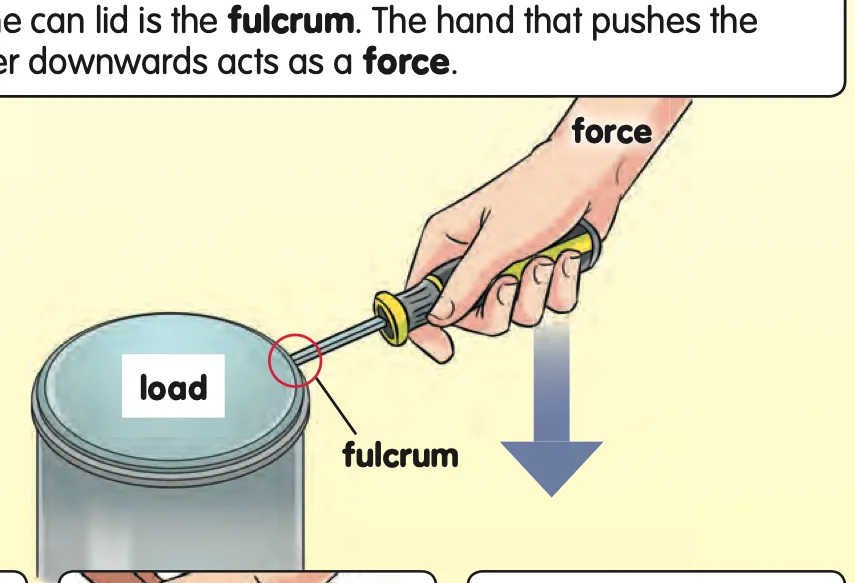
Figure after Science Year 4 (DLP), p.170.
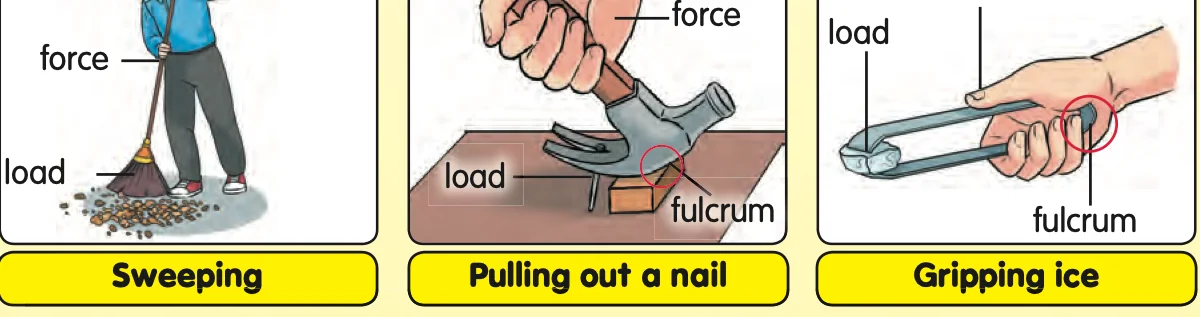
Figure after Science Year 4 (DLP), p.170.
Distance of the load from the fulcrum
Two men want to move a big rock with a stick. When they push the small rock (the fulcrum) closer to the big rock, the rock lifts more easily.
Investigation: lift a wooden block with a 50 cm ruler, placing the fulcrum triangle 25 cm, 20 cm and then 15 cm from the block.
| Variable | What it is in this investigation |
|---|---|
| Manipulated (changed) | Distance of the fulcrum triangle from the block (25, 20, 15 cm) |
| Responding (measured) | Force needed to lift the block |
| Constant (kept the same) | The block, the ruler, the way you press |
At 25 cm the block is hardest to lift. At 15 cm it is easiest.
Show answerHide answer
10.2Simple machines and complex machines
| Simple machine | What it is | Example |
|---|---|---|
| Wheel and axle | A wheel fixed on a rod called an axle | Door knob |
| Lever | A rod resting on a fulcrum, to lift or pry up a load | Broom |
| Screw | A grooved cylinder turned into an object to join or tighten two parts | Bottle and its cap |
| Gear | Wheels with teeth (jagged edges) | Gears in a clock |
| Pulley | A grooved wheel that a rope passes through, to lift or lower a load | Pulley on window blinds |
| Inclined plane | A tilted flat surface with ends at different heights | Stairs |
| Wedge | A tool with one pointed end, to cut, hold or stop an object | Knife, doorstop |
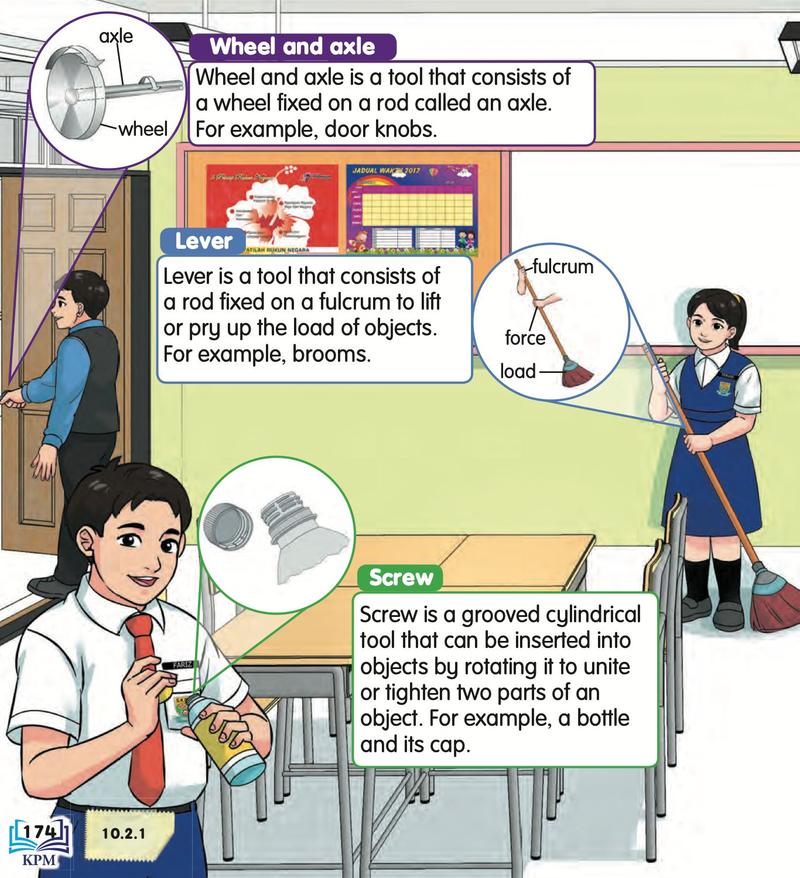
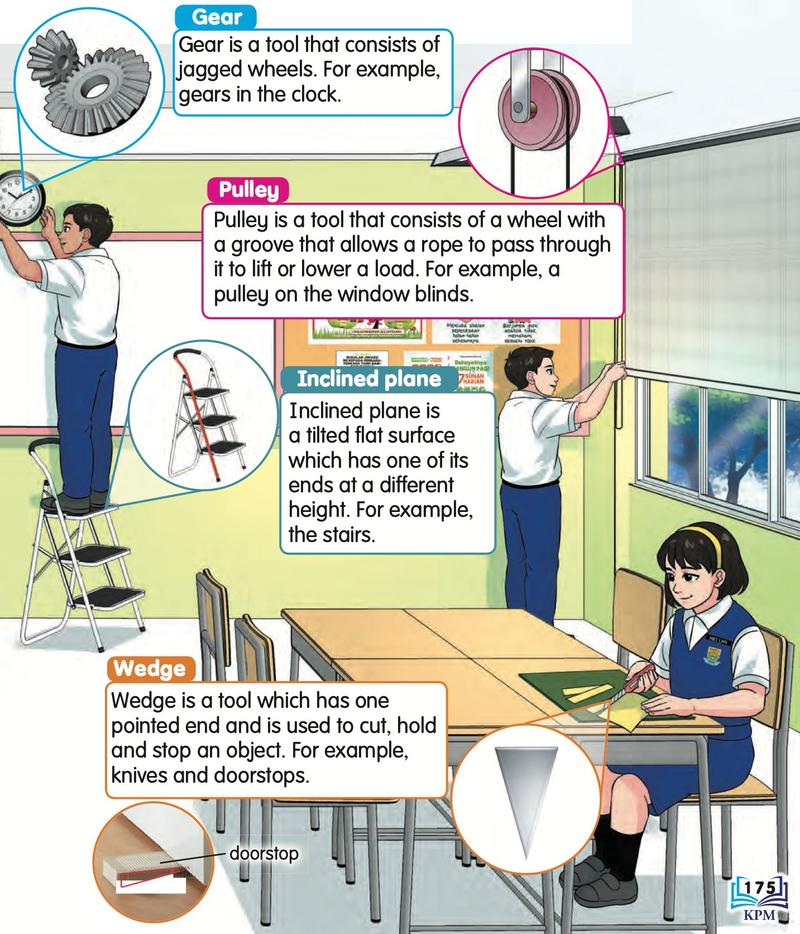
Figures after Science Year 4 (DLP), pp.174-175.
Show answerHide answer
Using simple machines to solve problems
Teruni's father cannot lift heavy boxes into a lorry. A tilted board (an inclined plane) makes loading easier. A trolley (wheel and axle) makes it faster. The more simple machines we use, the easier and faster the work becomes.
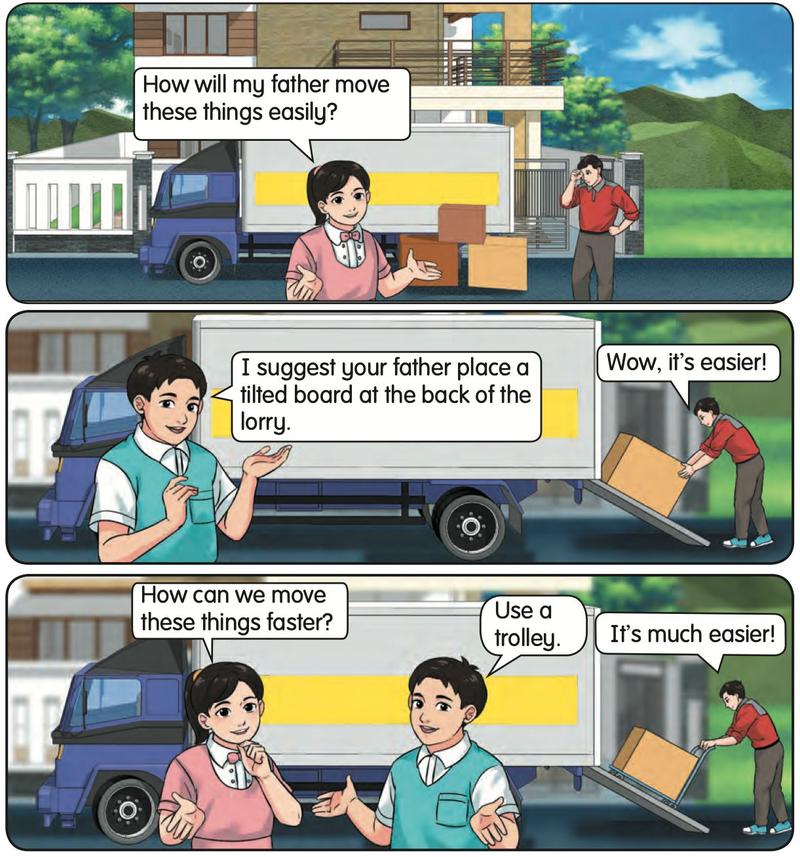
Figure after Science Year 4 (DLP), p.177.
Complex machines
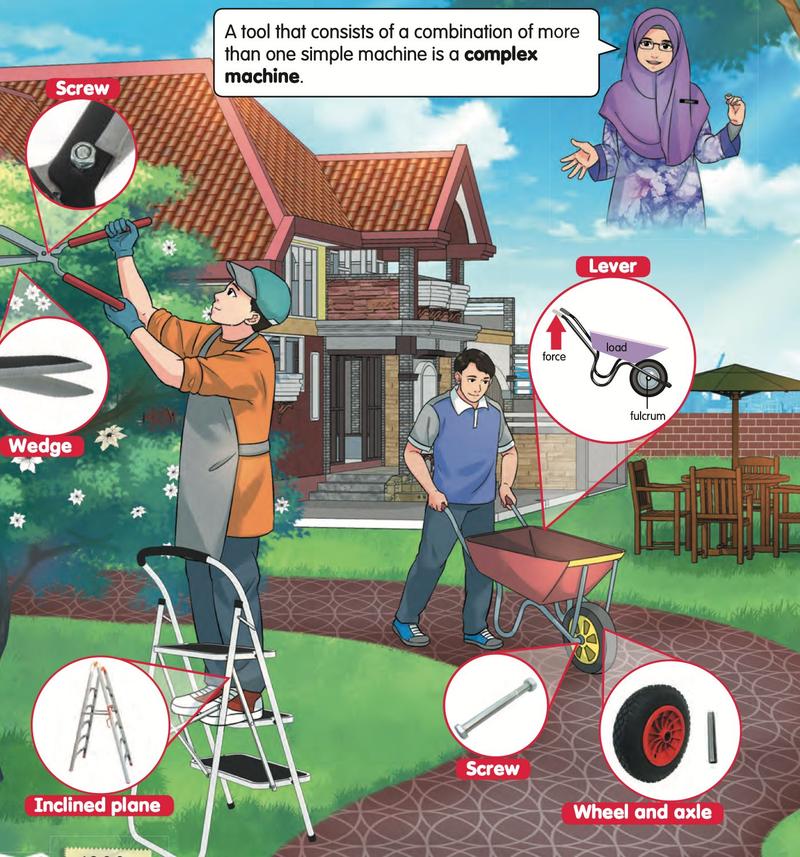
Figure after Science Year 4 (DLP), p.180.
A bicycle (gear, screw, wheel and axle) and a mechanical pencil sharpener are also complex machines.
A bicycle is a good example: it is easy to use, needs no fossil fuel and does not pollute the air.