Days
What this chapter covers
- I can talk about my daily routine using verbs for the start and end of the day, eating, travel, free time, and work and study (3.1)
- I can use adverbs of frequency (never, sometimes, often, usually, always) and put them in the right place in a sentence (3.2)
- I can read a text about a busy family and understand the general idea and the details (3.3)
- I can use the present simple affirmative and negative for facts and routines, with -s, -es and -ies endings and don't / doesn't (3.4)
- I can name things people do on special days, such as celebrate, wear, give, visit and invite (3.5)
- I can ask and answer present simple questions with do and does and with question words (3.6)
- I can make plans and suggestions, for example "What about the concert?" and "Let's go to the party." (3.7)
- I can write a short description of a celebration, using present simple and also (3.8)
Welcome to Days (Unit 2 in the textbook, Unit 3 on this site)! This unit is about days: what we do every day, how often we do things, and what happens on special days. You will use the present simple to talk about facts and routines.
3.1Daily routines
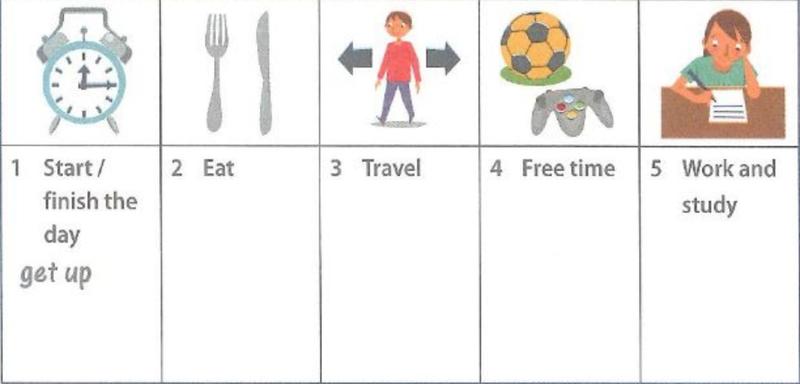
A routine is what you do again and again, every day or every week. The textbook sorts daily routine verbs into five groups.
English Plus 1 Year 5, p. 22.
| Group | Verbs and phrases |
|---|---|
| Start or finish the day | get up, brush your teeth, wash your face, go to bed |
| Eat | have breakfast, have lunch, have dinner |
| Travel | go to school (by bus, by bike, on foot), get home |
| Free time | watch TV, play video games, chat online, relax |
| Work and study | start work, do your homework, have classes, help with the housework |
Show answerHide answer
3.2Adverbs of frequency
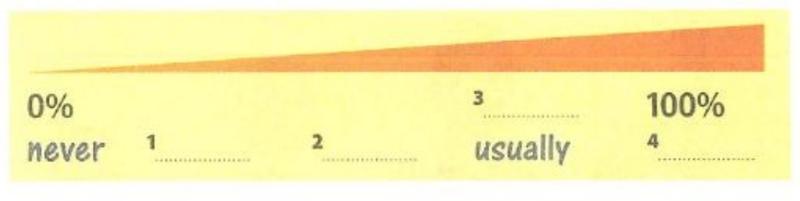
Adverbs of frequency tell us how often something happens. Think of a scale from 0% to 100%.
English Plus 1 Year 5, p. 23.
| Scale | Adverb | Example |
|---|---|---|
| 0% | never | I never go to bed before 8 p.m. |
| low | sometimes | She sometimes helps with the housework. |
| middle | often | It is often noisy at home. |
| high | usually, normally | We usually have dinner at 7 p.m. |
| 100% | always | I am always on time for school. |
Where does the adverb go?
- After the verb be: She is often tired. I am never late.
- Before other verbs: He usually walks to school. They always have lunch at home.
English Plus 1 Year 5, p. 23.
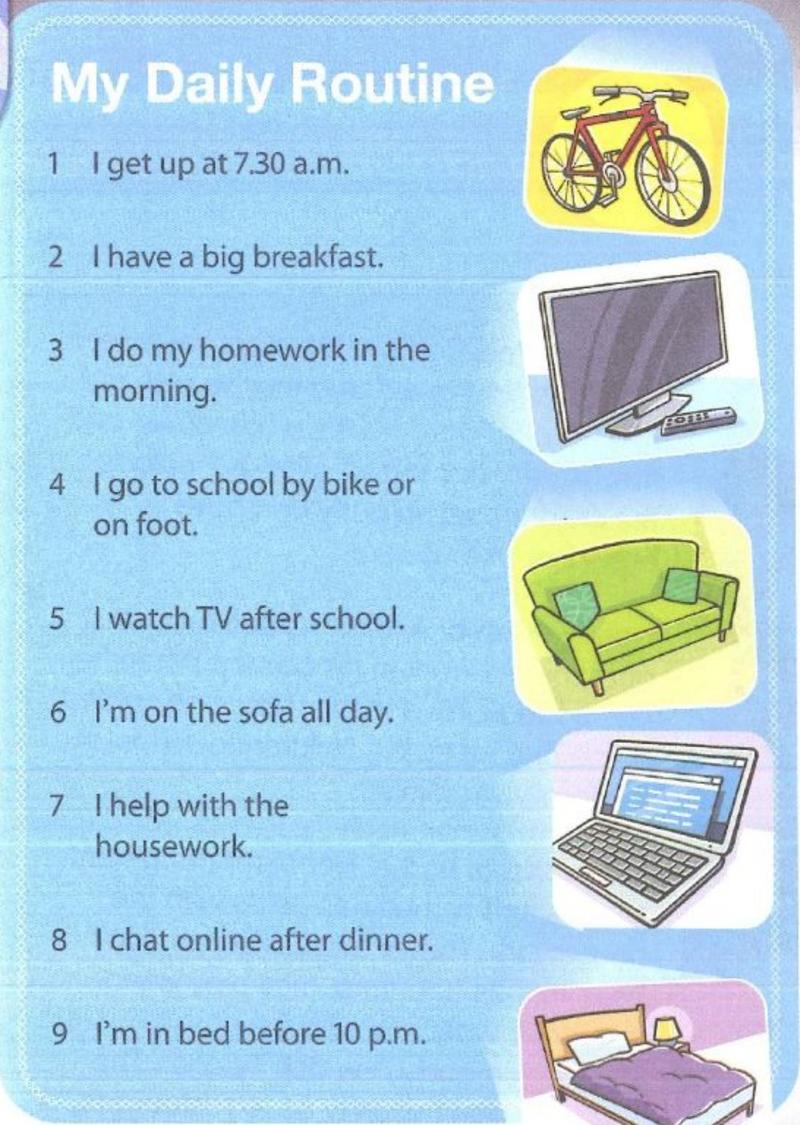
"I'm in bed before 10 p.m." becomes "I'm always in bed before 10 p.m."
Show answerHide answer
3.3Reading: a busy day
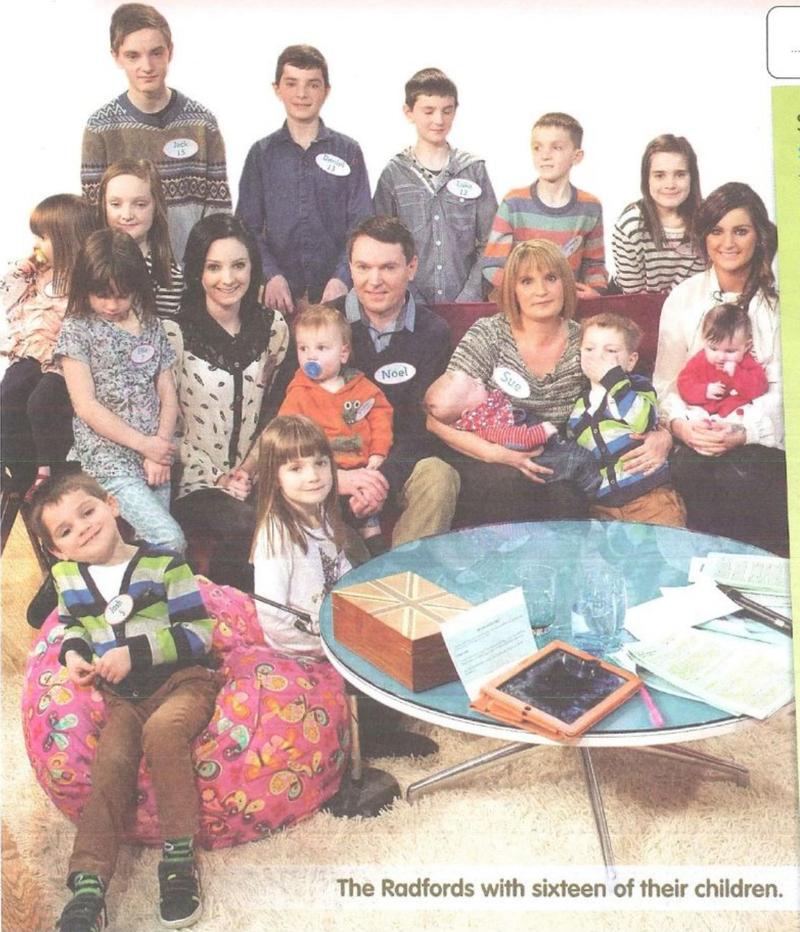
The text is about the Radford family, who have a very big family. When you read, first look at the photo and title to find the general idea, then read again for the details.
English Plus 1 Year 5, p. 24.
| Who | What they do |
|---|---|
| Noel | Gets up at 4.45 a.m., has breakfast, works in his bakery. In his break he takes the children to school in the minibus. |
| Sue | Works at home. She doesn't watch TV a lot. |
| The children | Get up early and have breakfast at 6.45 a.m. on schooldays. The young ones go to bed at 7 p.m., the older ones at 8 or 9 p.m. |
| The whole family | Don't usually go to restaurants or the cinema because it is expensive. |
Show answerHide answer
3.4Present simple: affirmative and negative
We use the present simple for facts and routines. With he, she and it the verb ends in -s.
| Rule | Example |
|---|---|
| Most verbs: add -s | play, plays; get up, gets up |
| Verbs ending in -o, -sh, -ch, -x: add -es | go, goes; wash, washes; watch, watches; relax, relaxes |
| Consonant + y: change y to -ies | study, studies |
| have changes to has | He has breakfast at 7 a.m. |
The negative uses don't or doesn't and the base verb.
| Who | Negative | Example |
|---|---|---|
| I, you, we, they | don't + verb | I don't play football. |
| He, she, it | doesn't + verb | Sue doesn't watch TV a lot. |
Show answerHide answer
3.5Special days
These verbs go with special days and celebrations.
Show answerHide answer
3.6Present simple: questions
| Pattern | Example | Short answer |
|---|---|---|
| Do + I / you / we / they + verb? | Do you like fireworks? | Yes, I do. / No, I don't. |
| Does + he / she / it + verb? | Does the lion stop at all the restaurants? | Yes, it does. / No, it doesn't. |
| Question word + do / does + subject + verb | Where do you eat? Who does she invite? | At my grandmother's house. All the family. |
- Question words go at the beginning: What, Where, Who, When, How, What time, How often.
- After does the main verb does not take -s: What does he have for breakfast?
Time expressions: in the morning / the evening / the holidays / the summer, at 6 a.m. / the weekend / New Year, on weekdays / Monday.
Show answerHide answer
3.7Speaking: making plans and suggestions
Daisy and Gareth look at a programme for a school event and choose what to do. Use these phrases.
| What you want to say | Key phrase |
|---|---|
| Ask what is happening | What's on? |
| Ask about plans | What do you want to do / see? |
| Say you do not like something | I'm not really interested in the ... |
| Say you like something | I like the sound of the ... |
| Make a suggestion | What about the ...? |
| Agree on a plan | Let's go to the ... |
B: I like the sound of the mini zoo.
A: Right, and what about the fireworks?
B: OK. Let's go to the mini zoo and the fireworks.
Show answerHide answer
3.8Writing: a special day
The model text describes the Notting Hill Carnival in London. It has three short paragraphs.
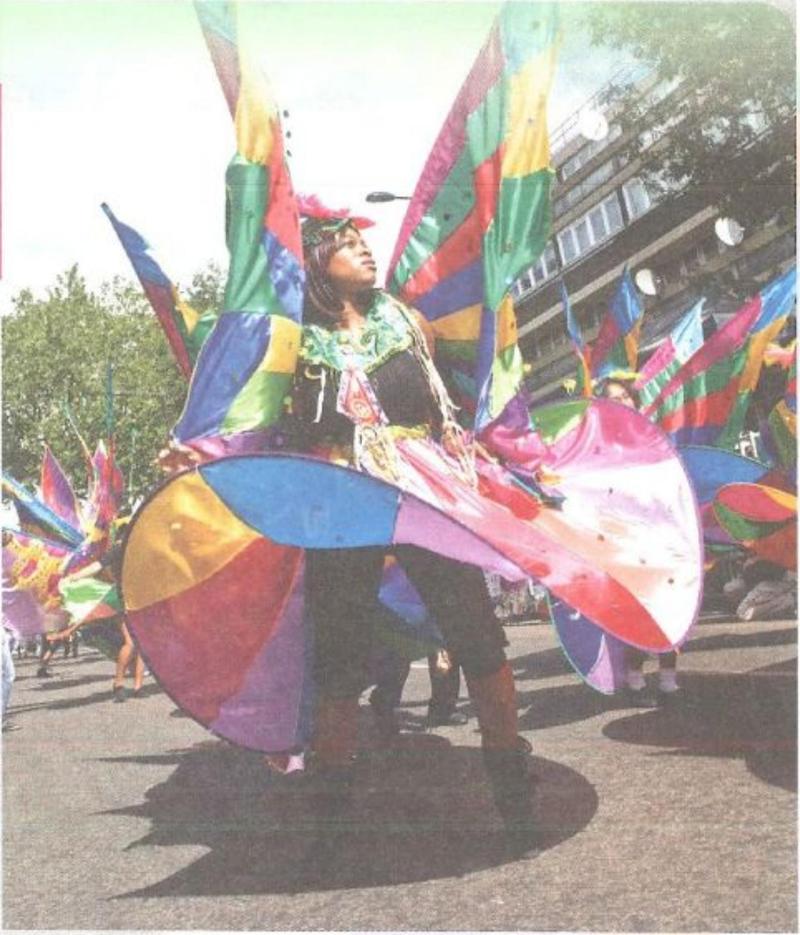
English Plus 1 Year 5, p. 29.
| Paragraph | What to write | Useful phrase |
|---|---|---|
| 1 | General information: what, where, when | Every year there's a celebration called ... in ... |
| 2 | What do people do? | People celebrate ... There are ... in the street. It's a lot of fun. |
| 3 | What do you do? | I usually ... / I don't usually ... |
The word also
- Before the main verb: We also have a family meal.
- After the verb be: There is also a concert. My sister's birthday is also in April.