Sport
What this chapter covers
- I can name different sports and talk about the sports I do and like, with phrases like "I'm in the school team." and "I want to try climbing." (7.1)
- I can read a timeline about the Olympic Games and find specific information (7.2)
- I can use there was, there wasn't, there were and there weren't to talk about the past (7.3)
- I can use was, wasn't, were and weren't to say what things and people were like in the past (7.3)
- I can understand a short programme about the X Games and match verbs with their past simple forms (7.4)
- I can use regular and irregular past simple verbs in affirmative sentences, like "She won an X Games medal." (7.5)
- I can use past time expressions such as last weekend, on Friday, when I was ten and two years ago (7.5)
- I can say the -ed endings /t/, /d/ and /id/ correctly (7.5)
- I can ask and answer about my weekend, like "How was your weekend? It was great. I went to a football match." (7.6)
- I can write a profile of a sports star in three paragraphs using the past simple (7.7)
Welcome to Sport (Unit 6 in the textbook, Unit 7 on this site)! You will learn the names of sports, read about the Olympic Games, and talk and write about the past. The most important grammar is there was / there were, was / were and the past simple.
7.1Sports
Here are sixteen sports. Match each picture with a word in the table below, then say which sports you like.
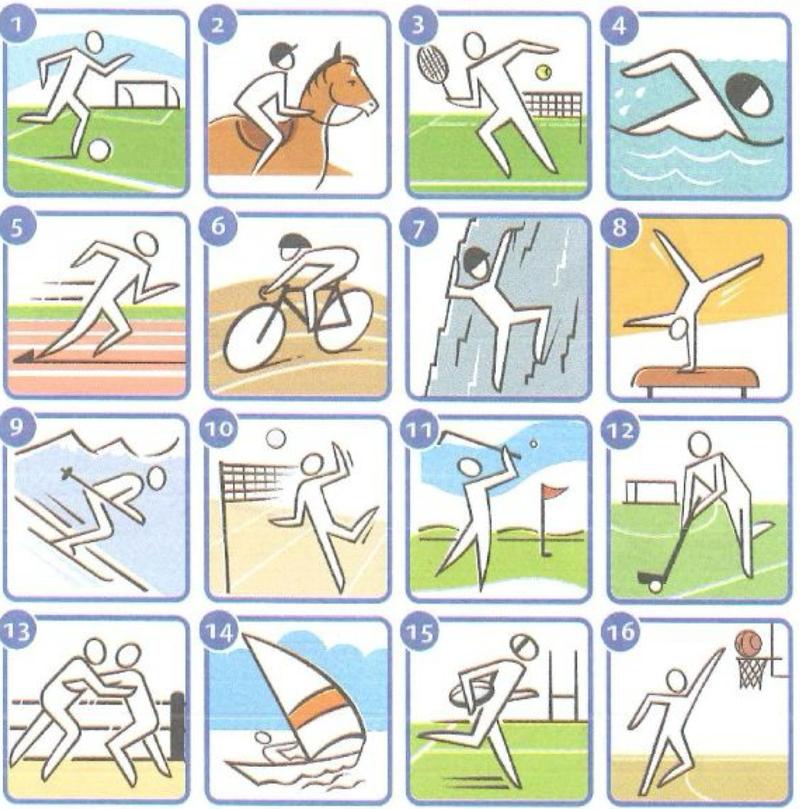
English Plus 1 Year 5, p. 62.
| Picture | Sport | Picture | Sport |
|---|---|---|---|
| 1 | football | 9 | skiing |
| 2 | horse-riding | 10 | volleyball |
| 3 | tennis | 11 | golf |
| 4 | swimming | 12 | hockey |
| 5 | athletics | 13 | wrestling |
| 6 | cycling | 14 | sailing |
| 7 | climbing | 15 | rugby |
| 8 | gymnastics | 16 | basketball |
Talking about sports
Do you do any sports? Yes, I enjoy playing basketball.
I'm in a ... club. I'm in the school team. I'm a ... fan. I want to try ...
Ben: Yes, I enjoy playing basketball. I'm in the school team. And you?
Aina: I don't do many sports, but I'm a football fan. I want to try climbing.
Show answerHide answer
7.2Reading: The Olympics then and now
The Olympics timeline tells us what happened in different years. Notice the verbs: they are all in the past.
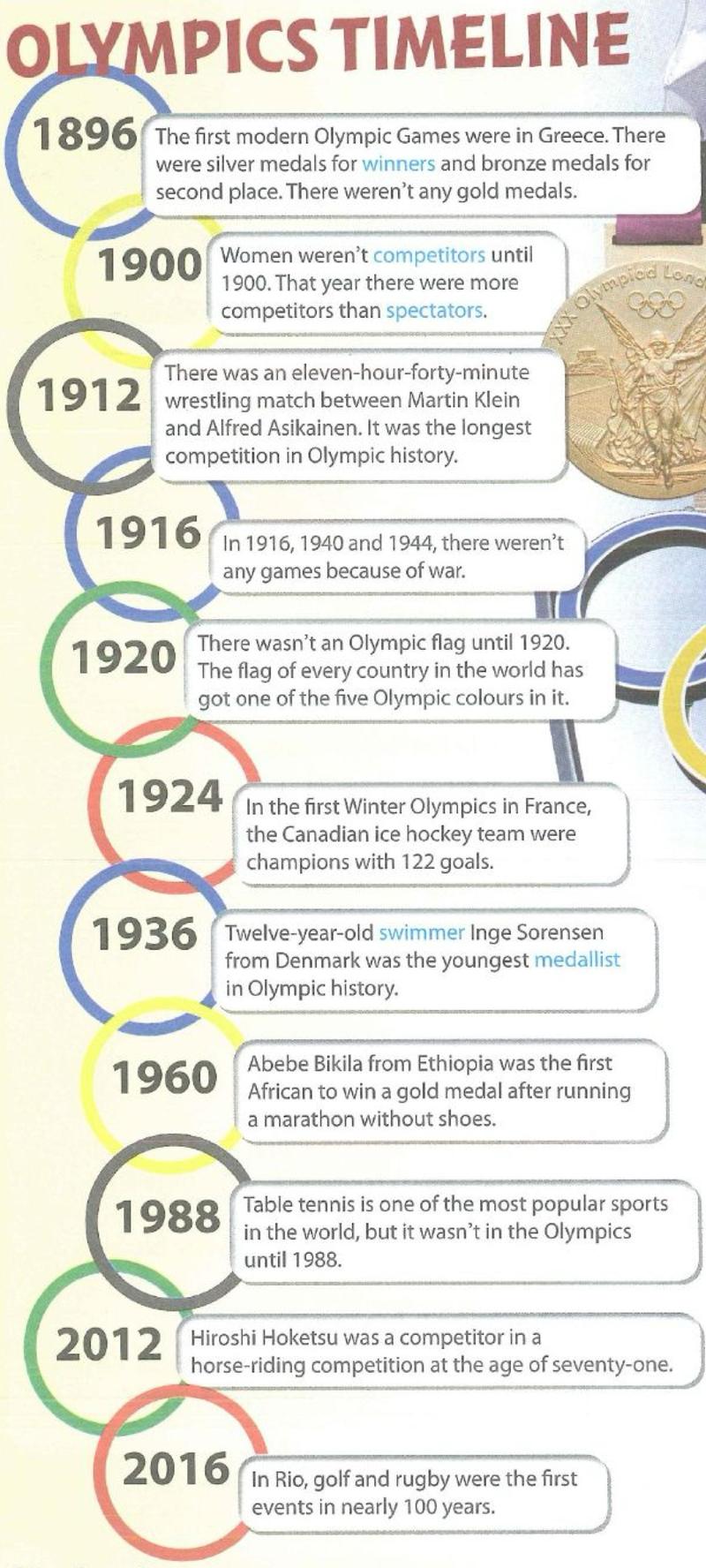
English Plus 1 Year 5, p. 64.
| Year | What happened |
|---|---|
| 1896 | The first modern Olympic Games were in Greece. Winners got silver medals and second place got bronze. There were no gold medals. |
| 1900 | Women were competitors for the first time. There were more competitors than spectators. |
| 1912 | A wrestling match lasted eleven hours and forty minutes, the longest in Olympic history. |
| 1916, 1940, 1944 | There were no games because of war. |
| 1920 | The Olympic flag appeared for the first time. |
| 1924 | First Winter Olympics, in France. The Canadian ice hockey team won with 122 goals. |
| 1936 | Inge Sorensen from Denmark, a twelve-year-old swimmer, was the youngest medallist. |
| 1960 | Abebe Bikila from Ethiopia ran a marathon without shoes and was the first African to win gold. |
| 1988 | Table tennis joined the Olympics. |
| 2012 | Hiroshi Hoketsu competed in horse-riding at the age of seventy-one. |
| 2016 | Golf and rugby were the first new events in nearly 100 years (Rio). |
Show answerHide answer
Show answerHide answer
7.3There was, there were, was and were
There was / There were
We use there were / there weren't with more than one thing (plural).
| Singular | Plural |
|---|---|
| There was a wrestling match in 1912. | There were more competitors than spectators. |
| There wasn't an Olympic flag until 1920. | There weren't any gold medals. |
Was / Were
Was and were are the past forms of am / is and are.
| Now | In the past | Negative |
|---|---|---|
| I am / He is / She is / It is | I / he / she / it was | wasn't |
| You are / We are / They are | you / we / they were | weren't |
Show answerHide answer
Show answerHide answer
7.4The X Games: regular and irregular verbs
The X Games are exciting and often dangerous sports competitions. They started in 1995, when 500,000 fans travelled to Newport in the USA to watch BMX, skateboarding and motocross. Two skateboarders became stars when they were very young: Tom Schaar was the youngest gold medallist and Alana Smith was the youngest silver medallist in the history of the games.
| Verb | Past simple | Type |
|---|---|---|
| learn | learned | regular |
| start | started | regular |
| travel | travelled | regular |
| watch | watched | regular |
| compete (in) | competed | regular |
| decide | decided | regular |
| go | went | irregular |
| win | won | irregular |
| become | became | irregular |
| do | did | irregular |
Show answerHide answer
7.5Past simple: affirmative
Regular verbs end in -ed: compete → competed, play → played.
Irregular verbs do not end in -ed: win → won, go → went.
The past simple is the same for I, you, he, she, it, we and they.
She won an X Games medal. We won at the X Games.
Past time expressions
| Words | Example |
|---|---|
| last Tuesday / weekend / week / year / August | She last competed in 1981. |
| in August / in 2014 | He won in 2014. |
| on Friday / on Sunday | I played football on Friday. |
| when I was ten | He first competed when he was twelve. |
| ten minutes / two weeks / a month ago | He was on this programme two years ago. |
Pronunciation: -ed endings
| Sound | Comes after | Words |
|---|---|---|
| /t/ | p, ch, k, s, x and similar sounds | practised, watched |
| /d/ | most other sounds | travelled, played |
| /id/ | t or d | started, decided |
Young talent: two sports stars
- Abdul Latif Romly from Malaysia went to the Rio Paralympic Games in 2016. He won the gold medal for the long jump in September 2016 and broke the world record three times in one day. He won Malaysia's 2016 Sportsman of the Year award.
- Martin Odegaard from Norway became a professional footballer at fifteen and played international football before he was sixteen. Real Madrid gave him a contract in 2015.
English Plus 1 Year 5, p. 67.
Show answerHide answer
Show answerHide answer
7.6Speaking: Last weekend
Alfie: It was great, thanks. I went to a football match on Saturday.
Lois: Really? Was it good?
Alfie: Yes, it was brilliant. There were a lot of goals. United won 3-2 in the end.
Lois: That's good news! Who were you with?
Alfie: My brother. Why don't you come next time?
Lois: Sure. Why not? Text me when you're going, OK?
| Use | Phrases |
|---|---|
| Ask about the weekend | How was your weekend? Who were you with? |
| Say what you did | I went to a concert / on a trip / to a tennis match / to the cinema / to a restaurant with my parents. |
| Give an opinion | It was brilliant / cool / great / OK. It wasn't bad. The food was amazing. The players were really good. |
| React and invite | That's good news! That's bad news! Why don't you come next time? Sure. Why not? Text me when you're going. |
Show answerHide answer
7.7Writing: A sports star
A profile of a sports star has three paragraphs. The model text is about the athlete Usain Bolt from Jamaica.
| Paragraph | Topic | What the model says |
|---|---|---|
| 1 | Basic information | His full name, that he is an athlete from Jamaica, his birth date and town, and where he lives now. |
| 2 | Early career | He first competed in sprint races at school. At sixteen he was the youngest ever world junior champion for 200 metres. He turned professional in 2004. |
| 3 | Greatest moments | He first broke a world record in May 2008 and won gold medals at the Olympics in Beijing and London. |
His / Her full name is ... He / She was born on ... At the age of ... he / she ...
He / She first competed / played in ... He / She continued to ...
He's / She's one of the most successful ... in the history of ...
Show answerHide answer
Extra: Paralympic story
Dr Ludwig Guttmann was a German doctor who worked in a hospital in England in the Second World War. His patients had serious back problems, so he used sport to help them and began a sports competition at the hospital. In September 1960 the hospital games became the Paralympics, and the first competition took place in Rome. Athletes from twenty-three countries competed and Italy won eighty medals.
English Plus 1 Year 5, p. 70 (Review, exercise 5).
Summary
| Topic | Remember |
|---|---|
| Sports | football, basketball, tennis, swimming, athletics, cycling, climbing, gymnastics, skiing, volleyball, golf, hockey, wrestling, sailing, rugby, horse-riding |
| There was / were | There was + one thing. There were + more than one. Negatives: wasn't, weren't (with any / many). |
| Was / were | I, he, she, it was. You, we, they were. |
| Past simple | Regular: verb + -ed. Irregular: win → won, go → went, become → became, do → did. |
| Past time words | last week, in 2014, on Friday, when I was ten, two years ago |
| -ed sounds | /t/ watched, /d/ played, /id/ started |
| Speaking | How was your weekend? It was great. I went to ... Who were you with? Sure. Why not? |
| Writing | Profile: basic information, early career, greatest moments |