Going away
What this chapter covers
- I can name things to take on holiday, such as a rucksack, sleeping bag, torch, sun cream and waterproofs (9.1)
- I can read for detailed information in a short text about summer plans (9.2)
- I can talk about plans and intentions with be going to in statements, negatives, questions and short answers (9.3)
- I can talk about the weather with words like sunny, rainy, foggy, windy and icy, and read facts about extreme weather (9.4)
- I can make predictions with will and won't, and ask Will ...? with a short answer (9.5)
- I can make offers and promises, such as "I can bring some pizza" and "I won't be late, I promise" (9.6)
- I can write an email about a friend's visit and join sentences with because (9.7)
Welcome to Going away (Unit 8 in the textbook, Unit 9 on this site)! You will learn the names of things to take on holiday, talk about plans with be going to, describe the weather, make predictions with will and won't, make offers and promises, and write an email about a friend's visit.
9.1Vocabulary: things for a holiday
The unit opens with twenty photos for a Travel Quiz. These are the words you must know.
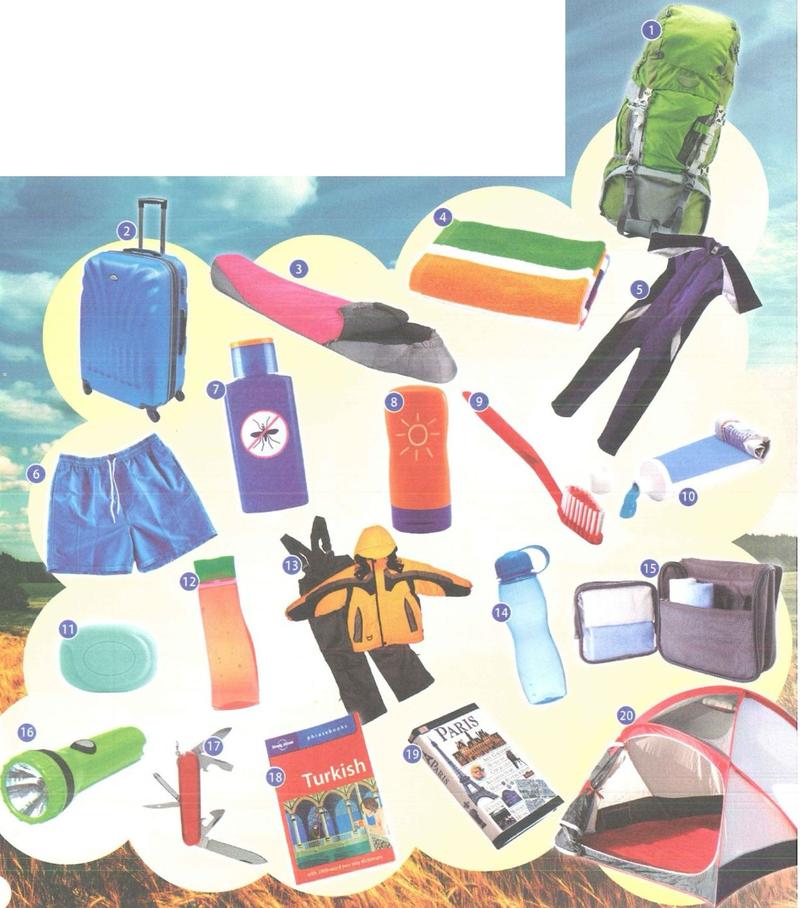
English Plus 1 Year 5, p. 82.
| Group | Words | What they are for |
|---|---|---|
| Bags and camping | rucksack, suitcase, sleeping bag, tent, torch, penknife | carry your clothes, sleep and see at night |
| Washing | washbag, toothbrush, toothpaste, soap, shampoo, towel | keep clean |
| Sun, water and weather | sun cream, swimming costume, trunks, water bottle, waterproofs, insect spray | stay safe in the sun, in the water and in the rain |
| Finding your way | guidebook, phrasebook | learn about a place, speak another language |
The Travel Quiz asks sensible questions. For example: a rucksack is best for carrying clothes when you are camping and walking; you need waterproofs in a rainforest; mosquitoes like wet places; and you probably do not need a swimming costume or sun cream in the Arctic.
Show answerHide answer
9.2Reading: Summer holidays
Three students in Class 10A write about their summer plans. Read for detailed information: look for the exact fact, not just the topic.
| Student | Plan | Details |
|---|---|---|
| Ciara | A week in Paris with her family in July, by train | bought a guidebook last week; Paris looks cool but very expensive; going to climb the Eiffel Tower (324 metres) |
| Martin | Not going away | his parents want to stay at home and do jobs; going to do a tennis course; friends are going to stay one weekend and sleep in his new tent in the garden |
| Bethany | Stay with her cousins in Cornwall | they have got a huge house near the beach; going to swim in the sea every day and learn to surf |
English Plus 1 Year 5, p. 84.
Show answerHide answer
9.3Language focus: be going to
We use be going to to talk about future plans and intentions: things we have decided to do.
| Form | Example |
|---|---|
| Affirmative | We're going to climb the Eiffel Tower. I'm going to go away. |
| Negative | I'm not going to go away. They aren't going to go to school tomorrow. |
| Question | What are you going to do this summer? Is she going to stay in London? |
| Short answer | Yes, I am. / No, I'm not. Yes, she is. / No, she isn't. |
- The question starts with be (am, is, are), then the person, then going to and the verb.
- After going to we use the plain verb: going to buy, going to stay.
- In questions and short answers the verb be matches the person: I am, she is, they are.
Question stress: in a question we stress the important words. In "Where are you going to stay?" the words Where and stay are strong.
Show answerHide answer
9.4Vocabulary and listening: weather

English Plus 1 Year 5, p. 86.
Most weather words are the noun + y: sun + ny = sunny, rain + y = rainy, fog + gy = foggy (double the g). Say "It's hot and sunny." or "What's the weather like today?"
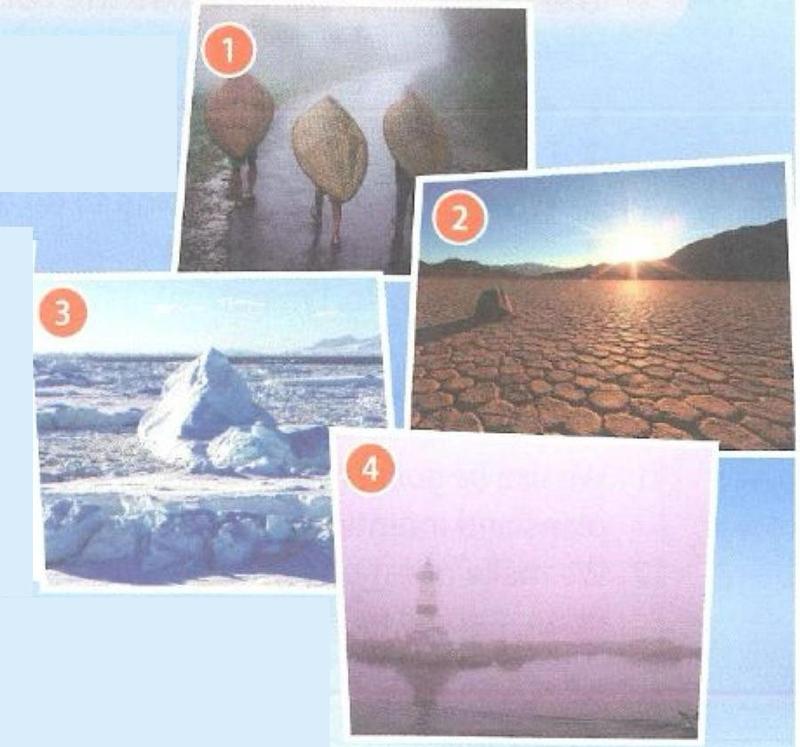
English Plus 1 Year 5, p. 86.
| Place | Record | Weather facts |
|---|---|---|
| Mawsynram, India | one of the wettest places | about twelve metres of rain every year |
| Death Valley, California | the hottest place in the USA | 56.7°C in 1913; can be very cold at night, below 0°C |
| Vostok Station, Antarctica | probably the coldest place on Earth | -89.2°C in 1983; strongest wind 327 kilometres an hour in 1972 |
| Argentia, Canada | the foggiest place | about 200 foggy days every year; thunder and lightning |
Show answerHide answer
9.5Language focus: will and won't
We use will to make predictions about the future: what we think will happen.
| Form | Example |
|---|---|
| Affirmative: will / 'll | It'll be hot and sunny. Lydia will feel tired and happy. |
| Negative: will not / won't | I won't be very hungry. |
| Question: Will + subject + verb | Will there be many cyclists? What will the weather be like? |
| Short answer | Yes, there will. / No, there won't. |
- The form of will is the same for every person: I will, he will, they will.
- After will and won't use the plain verb: it won't rain.
| Use | Example |
|---|---|
| be going to: a plan or intention | I'm going to take a sleeping bag. (I have decided.) |
| will: a prediction | It'll be cold, so you'll need a sleeping bag. (I think this will happen.) |
Show answerHide answer
9.6Speaking: offers and promises
Zoe and Aaron decide to go to the beach because the weather will be hot and sunny. They make offers and promises.
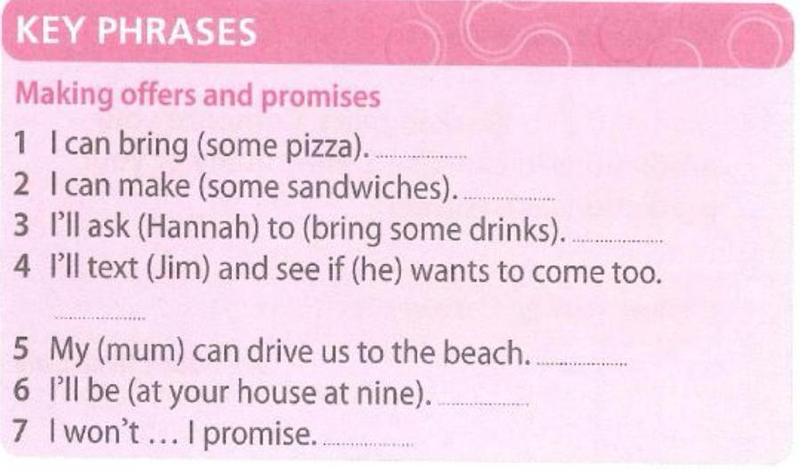
English Plus 1 Year 5, p. 88.
| Function | Phrases | Example |
|---|---|---|
| Offer: you will do something to help | I can bring ... / I can make ... / I'll ask ... to ... / I'll text ... and see if ... / My mum can drive us ... | I can make some sandwiches. |
| Promise: you say you will, or won't, do it | I'll be ... / I won't ... I promise. | I'll be at your house at nine. I won't be late, I promise. |
Show answerHide answer
9.7Writing: an email
Natalie writes to Gemma, who is going to stay with her family. Plan the email in three paragraphs.
| Paragraph | Job | Key phrase |
|---|---|---|
| 1 | Say why you are writing | I'm very excited that you're going to stay with us. I'm emailing you because ... |
| 2 | Where and what time you will meet | On Friday evening, I'm going to meet you at ... because ... |
| 3 | Plans for the weekend | On Saturday, we're going to ... On Sunday, the weather will be ..., so we can ... I can't wait to see you! |
English Plus 1 Year 5, p. 89.
Language point: because
Because gives the reason. Put the result first, then because, then the reason: "I'm emailing you because I want to tell you about our plans." (Natalie's email) or "We're going to take our umbrellas because it will rain on Sunday."
- Use be going to for plans and will for the weather.
- Check spelling and punctuation: capital letters, full stops, commas after the greeting and the closing.
Show answerHide answer
Summary
| Topic | Remember |
|---|---|
| Holiday things | rucksack, suitcase, sleeping bag, tent, torch, penknife, washbag, toothbrush, toothpaste, soap, shampoo, towel, sun cream, swimming costume, trunks, waterproofs, insect spray, water bottle, guidebook, phrasebook. |
| be going to | plans and intentions: I'm going to ... / She isn't going to ... / Are you going to ...? Yes, I am. / No, I'm not. |
| Weather | sunny, cloudy, rainy, windy, foggy, stormy, icy, snowy, hot, cold. What's the weather like? |
| will / won't | predictions: It'll be sunny. It won't rain. Will it be cold? Yes, it will. / No, it won't. |
| Offers and promises | I can bring ... I'll ask ... I'll be there at nine. I won't be late, I promise. |
| Writing an email | I'm very excited that ... I'm emailing you because ... On Saturday, we're going to ... I can't wait to see you! |