Mathematics notes, unit 2
Fractions, Decimals and Percentages
Textbook Mathematics Year 5 (DLP), Part 1 and Part 2, pages Part 1, 65–90
What this chapter covers
- You can multiply a whole number, a fraction and a mixed number by a fraction, and give the answer in the simplest form (2.1.1)
- You can round off decimals to one, two and three decimal places (2.2.1)
- You can add and subtract decimals with up to three decimal places, including mixed operations (2.2.2)
- You can multiply decimals by whole numbers, and by 10, 100 and 1 000 (2.2.3)
- You can divide decimals by whole numbers, and by 10, 100 and 1 000 (2.2.4)
- You can convert between mixed numbers and percentages more than 100% (2.3.1)
- You can find a percentage of a quantity, and one quantity as a percentage of another (2.3.2)
- You can solve problems involving fractions, decimals and percentages (2.4.1)
Fractions, decimals and percentages are three ways of writing parts of a whole. In Year 5 you multiply fractions, round off decimals, calculate with decimals up to three decimal places, and change between mixed numbers and percentages. Always check that your answer is in the simplest form and has the right unit.
2.1Multiplying fractions
To multiply fractions, multiply the numerators together and multiply the denominators together. Then write the answer in the simplest form. A whole number can be written as a fraction with denominator 1, so 2 = 21.
Whole number times fraction
Worked example: the cake recipe needs 34 cup of sugar per batch. How much for 2 batches?
Step 1. 2 × 34 = 21 × 34.Step 2. Multiply: 64. Simplify by dividing top and bottom by 2: 32.
Step 3. Change the improper fraction to a mixed number: 32 = 112 cups.
Cancellation saves work. Before you multiply, divide a numerator and a denominator by the same number. In 2 × 34, divide 2 and 4 by 2 to get 1 × 32 = 112.
Worked example: mixed number times whole number
312 × 26 kg. Step 1. 312 = 72. Step 2. 72 × 26 = 7 × 13 (cancel 26 by 2) = 91 kg.Check by partitioning: 3 × 26 = 78 and 12 × 26 = 13, and 78 + 13 = 91.
Fraction times fraction
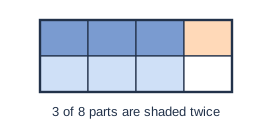
Worked example
25 × 23 = (2 × 2) / (5 × 3) = 415.13 × 114: change 114 to 54, then 13 × 54 = 512.
213 × 47: change to 73 × 47. Cancel the 7s: 13 × 41 = 43 = 113.
Do not multiply only the fraction part of a mixed number and forget the whole-number part. Change a mixed number to an improper fraction first (or partition it and add both parts). And never find a common denominator when multiplying: that is only for adding and subtracting.
Calculate (a) 8 × 23 (b) 34 × 29 (c) 112 × 25.
Show answerHide answer
(a) 163 = 513. (b) 636 = 16. (c) 32 × 25 = 35.
2.2Rounding off decimals
To round off a decimal, find the digit at the place you need. Look at the digit to its right: if it is 5 to 9, add 1 to the place digit; if it is 0 to 4, keep the place digit. Then drop all the digits after it.

| Number | One decimal place | Two decimal places | Three decimal places |
|---|---|---|---|
| 2.468 | 2.5 | 2.47 | 2.468 |
| 9.85 | 9.9 | 9.85 | 9.850 |
| 740.5692 | 740.6 | 740.57 | 740.569 |
Rounding a decimal works the same way as rounding a whole number. Only the places have different names: tenths, hundredths, thousandths.
Round in one step from the original number. To round 740.5692 to one decimal place, look only at the hundredths digit (6), not at the later digits one after another.
Round off 29.615 to one decimal place and to two decimal places.
Show answerHide answer
One decimal place: hundredths digit is 1, so keep: 29.6. Two decimal places: thousandths digit is 5, add 1: 29.62.
2.3Adding and subtracting decimals
Line up the decimal points so that tenths are under tenths and hundredths under hundredths. Write extra zeros so every number has the same number of decimal places. In a mixed sum, work from left to right.
Worked example: 28.9 km + 22.302 km − 17.45 km
Step 1. Add first: 28.900 + 22.302 = 51.202.Step 2. Subtract: 51.202 − 17.450 = 33.752 km.
Worked example: 80 − 63.819 + 4.57
Write 80 as 80.000. 80.000 − 63.819 = 16.181. Then 16.181 + 4.570 = 20.751.Put the zeros in! In 80 − 63.819, write 80.000 so the places line up. Also keep the order: 2.86 − 1.874 + 0.279 is done from left to right, 2.860 − 1.874 = 0.986, then 0.986 + 0.279 = 1.265. Adding 1.874 and 0.279 first and subtracting from 2.86 would give a wrong answer.
To find a missing number, think of a simple example: if 8 − □ = 6 then □ = 8 − 6 = 2. In 90.09 + 76.185 − □ = 63.575, first 90.09 + 76.185 = 166.275, then □ = 166.275 − 63.575 = 102.7.
Calculate 74.285 + 9.607 − 18.043.
Show answerHide answer
74.285 + 9.607 = 83.892. 83.892 − 18.043 = 65.849.
2.4Multiplying decimals
To multiply decimals, multiply as if they were whole numbers. Then put the decimal point so the answer has the same number of decimal places as the decimal in the question.
Worked example: Aidil cycles 1.046 km to school and back, 24 times in a month
1 046 × 24 = 25 104. 1.046 has 3 decimal places, so the answer has 3 decimal places: 25.104 km.Multiplying by 10, 100 and 1 000
Shift the decimal point to the right: 10 × 0.33 = 3.3, 100 × 0.16 = 16, 1 000 × 6.045 = 6 045.| Multiply by | Shift the point | Example |
|---|---|---|
| 10 | 1 place to the right | 9.873 × 10 = 98.73 |
| 100 | 2 places to the right | 9.873 × 100 = 987.3 |
| 1 000 | 3 places to the right | 9.873 × 1 000 = 9 873 |
If there are not enough digits, write zeros: 0.45 × 1 000 = 450, not 45.
Calculate 12 × 0.33 and 100 × 92.851.
Show answerHide answer
12 × 33 = 396, two decimal places: 3.96. 100 × 92.851 = 9 285.1.
2.5Dividing decimals
To divide a decimal by a whole number, keep the decimal point in the same place in the answer and divide as usual. Add zeros after the last digit if you need to.
Worked example: 0.6 kg of biscuits in 12 packets
0.6 ÷ 12: 0.60 ÷ 12 = 0.05 kg. Check: 12 × 0.05 = 0.60.22.5 ÷ 60 = 0.375 (write 22.500 and divide).
Dividing by 10, 100 and 1 000
| Divide by | Shift the point | Example |
|---|---|---|
| 10 | 1 place to the left | 54.9 ÷ 10 = 5.49 |
| 100 | 2 places to the left | 54.9 ÷ 100 = 0.549 |
| 1 000 | 3 places to the left | 8 973 ÷ 1 000 = 8.973 |
Multiply right, divide left. Check any division with multiplication: 0.375 × 60 = 22.5.
Calculate 9.25 ÷ 10 and 46 ÷ 1 000.
Show answerHide answer
0.925 and 0.046 (46 = 46.000, shift 3 places left).
2.6Mixed numbers and percentages
A percentage is a fraction with denominator 100. 1 whole = 100100 = 100%. So a percentage more than 100% is a number more than 1, which is a mixed number or improper fraction.
| Mixed number | Working | Percentage |
|---|---|---|
| 114 | 14 = 25100 = 25%, so 100% + 25% | 125% |
| 2310 | 2.3 × 100% | 230% |
| 112 | 12 = 50%, so 100% + 50% | 150% |
Worked example: change 208% to a mixed number
208% = 208100 = 200100 + 8100 = 2 + 225 = 2225. (Divide 8 and 100 by 4.)Learn the pairs that make 100: 2 × 50, 4 × 25, 5 × 20 and 10 × 10. They help you change 12, 14, 15 and 110 to percentages quickly.
Change 1910 to a percentage and 304% to a mixed number.
Show answerHide answer
1910 = 1.9 × 100% = 190%. 304% = 304100 = 3 + 4100 = 3125.
2.7Finding quantities and percentages
Percentage of a quantity
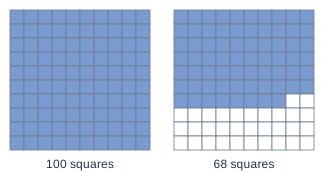
Worked example: Box B has 125% of the bottles in Box A, and Box A has 24
125% of 24 = 125100 × 24. Partition: 100% of 24 = 24 and 25% of 24 = 6. So 24 + 6 = 30 bottles.One quantity as a percentage of another
Write the two quantities as a fraction (the quantity you are asked about over the quantity you compare it to, in the same unit), then multiply by 100%. The answer can be more than 100%.
Worked example: savings of RM140 compared with a goal of RM70
14070 × 100% = 2 × 100% = 200%.Orders of 180 boxes compared with 80 boxes: 18080 × 100% = 94 × 100% = 225%.
The quantity you compare to (the goal, the first amount) goes at the bottom of the fraction. Both quantities must be in the same unit.
What is 130% of 30 eggs? What percentage is 108 packages of a target of 90 packages?
Show answerHide answer
130% × 30 = 30 + 9 = 39 eggs. 10890 × 100% = 120%.
2.8Solving problems
Use four steps: understand the problem, plan a strategy, solve and check. Draw a diagram or make a table if it helps.
Worked example: a fraction of a fraction
45 of the pupils love football, and 13 of them also love hockey. Fraction who love hockey = 13 × 45 = 415.Worked example: percentage increase
600 visitors came on day 1. On day 2 the number went up by 70%. Day 2 is 100% + 70% = 170% of day 1.170% × 600 = 1 020 visitors. Check: 600 + 0.7 × 600 = 600 + 420 = 1 020.
Worked example: round the answer
A bus travels 682.03 km one way. There and back: 2 × 682.03 = 1 364.06 km. To one decimal place: 1 364.1 km.Does the answer make sense? Each laptop has a mass of 1.26 kg. Round 1.26 kg to 1.3 kg: 12 × 1.3 = 15.6 kg, so the exact answer 15.12 kg is a sensible size. It is more than 14 kg, so a box that can carry only 14 kg cannot hold all 12 laptops.