Money
What this chapter covers
- You can add money with values up to RM1 000 000, with ringgit and sen (3.1.1)
- You can subtract money, and find a missing amount in an addition or a subtraction (3.1.2)
- You can multiply money by a 2-digit number, 10, 100 and 1 000 (3.1.3)
- You can divide money by a 2-digit number, 10, 100 and 1 000 (3.1.4)
- You can solve mixed operations with money, doing the brackets first and then multiplication or division before addition or subtraction (3.2.1)
- You can tell a savings account from an investment account, and simple interest from compound interest (3.3.1, 3.3.2)
- You can explain credit and debt, and compare buying with cash and buying on credit (3.4.1, 3.4.2)
- You can solve money problems with the four steps: understand, plan, solve and check (3.5.1)
In Year 5 the amounts of money get big: a family loan for a house, the sales of a motorcycle shop, a bonus shared by a whole company. In this unit you will work with money up to RM1 000 000, mix the four operations in one number sentence, and learn how banks, interest and credit work.
3.1The four operations with money
Adding money
The family needs a loan of RM250 000 and another RM100 000. The total loan is RM250 000 + RM100 000 = RM350 000. When there is sen, add the sen first, then the ringgit, and carry as usual.
Example 1: adding three amounts (textbook p. 92)
RM43 026.70 + RM150 130.45 + RM387 060.20 = ?
- Line up the decimal points.
- Add the sen: 70 + 45 + 20 = 135 sen. Write 35 and carry 1 to the ringgit.
- Add the ringgit, carrying when a column makes 10 or more.
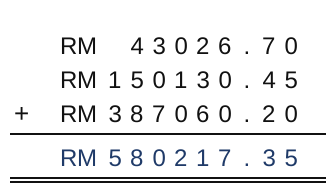
The answer is RM580 217.35.
Subtracting money
A car costs RM108 800 and the mother pays RM11 500 as down payment. The bank loan is RM108 800 − RM11 500 = RM97 300. Subtract the sen first and regroup when you need to.
Example 2: ringgit and sen (textbook p. 93)
RM250 230 − RM31 879.50 = ?
- RM250 230 has no sen, so write it as RM250 230.00.
- Subtract the sen first: 00 − 50 needs regrouping, so 100 − 50 = 50.
- Then subtract the ringgit.
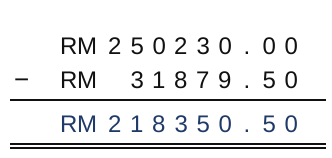
The answer is RM218 350.50.
Show answerHide answer
Multiplying money
A shop sold 20 motorcycles at RM42 970 each. The sales are 20 × RM42 970. There are two good methods.
Example 3: 20 × RM42 970 (textbook p. 95)
Method 1: long multiplication gives RM859 400.
Method 2: 20 = 10 × 2, so 20 × RM42 970 = 10 × RM42 970 × 2 = RM429 700 × 2 = RM859 400.
Example 4: 79 × RM1 499.80 (textbook p. 96)
79 is 1 less than 80, so 79 × RM1 499.80 = (80 × RM1 499.80) − RM1 499.80 = RM119 984.00 − RM1 499.80. Or multiply directly in columns:
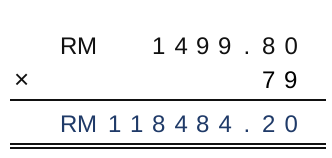
The answer is RM118 484.20 either way.
Multiplying and dividing by 10, 100 and 1 000
The digits shift to the left when you multiply and to the right when you divide. The decimal point moves 1, 2 or 3 places.
| Number sentence | Answer | Decimal point moves |
|---|---|---|
| 100 × RM6 240.70 | RM624 070 | 2 places right |
| 1 000 × RM284.15 | RM284 150 | 3 places right |
| RM317 659 ÷ 10 | RM31 765.90 | 1 place left |
| RM648 321 ÷ 100 | RM6 483.21 | 2 places left |
| RM550 200 ÷ 1 000 | RM550.20 | 3 places left |
Dividing money
Divide from the left, one digit at a time. Money is divided until there is no remainder: add a decimal point and zeros if you need them.
Example 5: sharing a donation (textbook p. 97)
RM650 000 is shared equally by 4 charities.
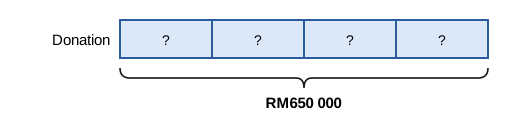
RM650 000 ÷ 4 = RM162 500 for each charity.
Example 6: dividing by 2-digit numbers (textbook p. 98)
RM578 404.20 ÷ 30 = RM19 280.14.
RM396 810 ÷ 25 = RM15 872.40. The ringgit does not divide exactly, so we carry on into the sen.
Show answerHide answer
3.2Mixed operations with money
Some problems need more than one operation. The order of working is:
- Brackets ( ) first.
- Then multiplication and division, from left to right.
- Then addition and subtraction, from left to right.
| Number sentence | Working | Answer |
|---|---|---|
| RM6 800 + 3 × RM150 | 3 × RM150 = RM450, then RM6 800 + RM450 | RM7 250 |
| 24 × RM1.60 − RM27 | RM38.40 − RM27 | RM11.40 |
| (RM750 + RM56.80) × 15 | RM806.80 × 15 | RM12 102 |
| RM2 500 ÷ 4 − RM89.90 | RM625 − RM89.90 | RM535.10 |
| (RM250 000 + RM125 500) ÷ 40 | RM375 500 ÷ 40 | RM9 387.50 |
Example 7: a bank statement (textbook p. 99)
A bank statement starts with RM6 800. Three deposits of RM150 are made. The balance is RM6 800 + 3 × RM150 = RM6 800 + RM450 = RM7 250.
Example 8: wholesale and retail (textbook p. 99)
24 boxes of milk cost RM1.60 each at retail, or RM27 for all 24 at wholesale. The saving is 24 × RM1.60 − RM27 = RM38.40 − RM27 = RM11.40.
Show answerHide answer
3.3Saving and investing
Investment is money used for a certain business that gives a profit in the future.
| Savings account | Investment account |
|---|---|
| Money can be saved or deposited, and withdrawn at any time | Money cannot be withdrawn at any time because there is a maturity date |
| The starting amount is low | The starting amount depends on the type of investment |
| Entitled to interest, about 1% to 2% a year | Profit is given as dividend or bonus, usually above 2% a year |
Simple interest and compound interest
Compound interest is interest paid on the savings and the interest already collected, so it grows each year.
Table of RM2 000 saved at 1.8% a year, with nothing withdrawn (textbook p. 106):
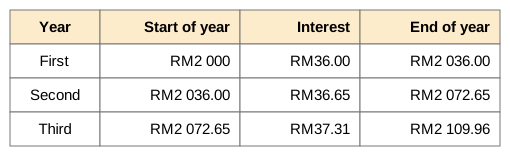
The interest rises each year because the balance at the start of the year is bigger. If money is withdrawn, the balance falls and so does the interest.
Show answerHide answer
3.4Credit and debt
Debt is a loan that someone must pay back.
With a credit card the bank pays the shop first. Then you owe the bank, and you must pay back within the time given. If you pay late, the bank charges you a late payment charge.
| Buying with cash | Buying on credit |
|---|---|
| Not in debt | In debt |
| No interest | Interest is charged |
| You pay the actual price | You pay more than the actual price |
| Paid in full, in cash or by debit card | Paid by credit card or monthly instalments |
Example 9: cash or credit? (textbook p. 108)
Andrew's family pays RM1 290 cash for a television. Carol's family pays RM120.90 a month for 12 months. Carol's family pays 12 × RM120.90 = RM1 450.80. That is RM1 450.80 − RM1 290 = RM160.80 more.
3.5Solving money problems
Use four steps every time: Understand the problem (underline the numbers and what is asked), Plan the strategy (a diagram or a number sentence), Solve, and Check your answer (use the opposite operation or estimate).
Example 10: instalment price (textbook p. 110)
Ramesh pays RM120 a month for 24 months. Price = 24 × RM120 = RM2 880. Check: RM2 880 ÷ 24 = RM120. Kok Keong pays RM180 for 15 months: 15 × RM180 = RM2 700, so Ramesh's bicycle is more expensive.
Example 11: two steps (textbook p. 111)
Two sets of sports attire at RM238.90 each are paid with RM500. Balance = RM500 − 2 × RM238.90 = RM500 − RM477.80 = RM22.20. Check: RM238.90 + RM238.90 + RM22.20 = RM500.
Example 12: will the target be reached? (textbook p. 112)
Hani saves RM3.50 a week and her mother adds RM2.50. In 40 weeks: (RM3.50 + RM2.50) × 40 = RM6 × 40 = RM240. The watch costs RM300, and RM240 is less than RM300, so the target is not reached by the 40th week. RM300 ÷ RM6 = 50, so it is reached in the 50th week.
Example 13: sharing equally (textbook p. 113)
A school fund has RM5 004 and gets RM5 500 more. It is shared equally by 26 pupils. Each pupil gets (RM5 004 + RM5 500) ÷ 26 = RM10 504 ÷ 26 = RM404. Check: 26 × RM404 = RM10 504.