Time
What this chapter covers
- You can find a duration in days and hours, and in days between two dates, using the number of days in each month and leap years (4.1.1)
- You can convert hours, days, years, decades and centuries to smaller units, when the amount is a whole number, a fraction or a decimal (4.2.1, 4.2.2)
- You can add time given in fractions, decimals and two units, and regroup the answer (4.3.1, 4.3.2)
- You can subtract time given in fractions, decimals and two units, and borrow when you need to (4.3.1, 4.3.2)
- You can solve problems about time, such as shelf life and ages, by understanding, planning, solving and checking (4.4.1)
4.1Duration of time
The duration is how long something takes: from the time it starts to the time it ends. In Year 5 the duration can be in days and hours, in days between two dates, or even across more than one year.
Days and hours
A study tour starts at 10:50 a.m. on 25 July 2021 and ends at 12:50 p.m. on 27 July 2021. Count whole days first, then the extra hours.
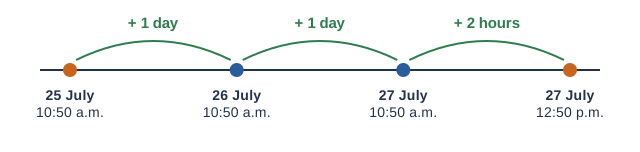
Situation based on Mathematics Year 5 (DLP), p.123.
Step 1. Monday 1650 hours to Friday 1650 hours is 4 days.
Step 2. But the end time is 0550 hours, which is 11 hours earlier than 1650 hours (1650 − 0550 = 11 hours).
Step 3. 4 days − 11 hours = 3 days 24 hours − 11 hours = 3 days 13 hours.
Months and days
To find the duration in days between two dates, you must know how many days each month has.
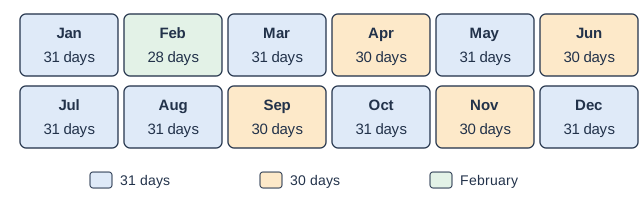
| Months | Days |
|---|---|
| January, March, May, July, August, October, December | 31 |
| April, June, September, November | 30 |
| February in a regular year | 28 |
| February in a leap year | 29 |
Step 2. 1 March to 8 March = 8 days.
Step 3. Total = 29 + 8 = 37 days.
The same dates in 2019 (not a leap year) give 28 + 8 = 36 days.
Step 2. All of June = 30 days.
Step 3. 1 July to 5 July = 5 − 1 + 1 = 5 days.
Step 4. Total = 3 + 30 + 5 = 38 days.
Years, months and days
Step 2. The whole of 2020 (a leap year) = 366 days.
Step 3. 1 January 2021 to 19 January 2021 = 19 days.
Step 4. Total = 31 + 366 + 19 = 416 days.
Show answerHide answer
4.2Converting units of time
To change a bigger unit to a smaller unit, multiply. Use the same multipliers for whole numbers, fractions and decimals.
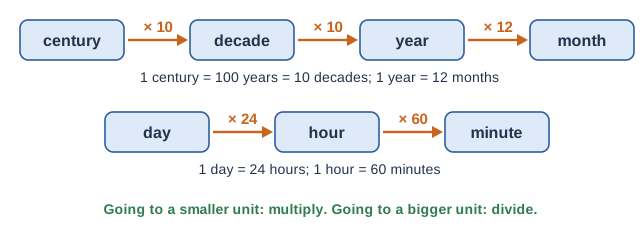
| Convert | Rule |
|---|---|
| hours to minutes | hours × 60 |
| days to hours | days × 24 |
| years to months | years × 12 |
| decades to years | decades × 10 |
| centuries to decades | centuries × 10 |
| centuries to years | centuries × 100 |
Fractions of a unit
1 34 hours = (74 × 60) minutes = 105 minutes.
13 day = (13 × 24) hours = 8 hours.
5 18 days = 5 × 24 + 18 × 24 = 120 + 3 = 123 hours.
9 16 years = 9 × 12 + 16 × 12 = 108 + 2 = 110 months.
1 12 decades = (32 × 10) years = 15 years.
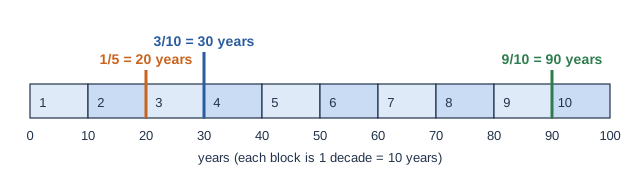
25 century = (25 × 10) decades = 4 decades. 910 century = (910 × 100) years = 90 years.
The strip below shows 1 century as 10 decades of 10 years each. You can see why 15 century is 20 years and 910 century is 90 years.
Decimals
0.25 day = (0.25 × 24) hours = 6 hours. 1.75 days = 42 hours.
29.5 years = (29.5 × 12) months = 354 months.
1.3 decades = 13 years (move the decimal point one place to the right).
5.1 centuries = (5.1 × 10) decades = 51 decades. 0.67 century = 67 years.
Show answerHide answer
4.3Adding and subtracting time
Time can be given in fractions, in decimals or in two units together (such as 2 days 9 hours). Use the same ideas you know from fractions and decimals.
Adding
- Fractions of the same unit: make the denominators the same first, then add.
- Decimals of the same unit: line up the decimal points, then add as for whole numbers.
- Two units: add each unit separately. If the smaller unit reaches its limit (60 minutes, 24 hours, 12 months, 10 years), regroup it into one of the bigger unit.
1.5 hours + 0.75 hour = 2.25 hours.
4.75 days + 9 days 18 hours: 4.75 days = 4 days 18 hours (0.75 × 24 = 18). Days: 4 + 9 = 13. Hours: 18 + 18 = 36 = 1 day 12 hours. Total = 14 days 12 hours.
2 12 years + 5 years 9 months = 2 years 6 months + 5 years 9 months = 7 years 15 months = 8 years 3 months.
Subtracting
- Convert to the same unit first. For example, change hours to minutes.
- If you cannot take away, borrow one of the bigger unit: 1 day = 24 hours, 1 year = 12 months, 1 century = 10 decades.
3.45 hours − 1 hour 40 minutes: 3.45 hours = 3 hours 27 minutes. 3 hours 27 minutes − 1 hour 40 minutes = 2 hours 87 minutes − 1 hour 40 minutes = 1 hour 47 minutes.
9.75 days − 3 days 5 hours: 9 days 18 hours − 3 days 5 hours = 6 days 13 hours.
14.5 years − 7 34 years: 14.5 − 7.75 = 6.75 years = 6 years 9 months.
0.23 century − 0.06 century = 0.17 century.
14.2 centuries − 3 centuries 9 decades: 14 centuries 2 decades = 13 centuries 12 decades. So 13 centuries 12 decades − 3 centuries 9 decades = 10 centuries 3 decades.
Show answerHide answer
4.4Solving problems about time
Use four steps: understand the problem, plan a strategy, solve, then check. Useful strategies are drawing a diagram, trial and error, and working backwards.
Step 1. 9.12.2019 to 31.12.2019 = 31 − 9 + 1 = 23 days.
Step 2. The whole of 2020 (leap year) = 366 days.
Step 3. 1.1.2021 to 31.1.2021 = 31 days. 1.2.2021 to 8.2.2021 = 8 days.
Step 4. Total = 23 + 366 + 31 + 8 = 428 days. Check by counting on a calendar.
Step 1. 1.15 centuries = 1.15 × 100 = 115 years.
Step 2. 318 − 115 = 203 years.
Step 3. 203 years = 2 centuries 3 years. Check: 2 centuries 3 years + 1.15 centuries = 203 + 115 = 318 years.
2021: 0.5 × 3 = 1.5 decades, but the other is 2.1. Too small.
2022: 0.6 × 3 = 1.8, other 2.2. 2023: 0.7 × 3 = 2.1, other 2.3.
2024: 0.8 × 3 = 2.4 and the other is 2.4. Equal, so the answer is the year 2024.
Show answerHide answer
Summary
- Duration = end − start. Count the first day too when you count days between dates (+ 1).
- 31 days: Jan, Mar, May, Jul, Aug, Oct, Dec. 30 days: Apr, Jun, Sep, Nov. February has 28 days, or 29 in a leap year (year ÷ 4 with no remainder).
- 1 hour = 60 minutes; 1 day = 24 hours; 1 year = 12 months; 1 decade = 10 years; 1 century = 10 decades = 100 years.
- Bigger to smaller unit: multiply, for fractions and decimals alike. 0.35 hour = 21 minutes.
- Add and subtract fractions with the same denominator and decimals with the points lined up; for two units, regroup.
- Solve problems in four steps: understand, plan, solve, check.