Length, Mass and Volume of Liquid
What this chapter covers
- You can change between mm, cm, m and km, using decimals and fractions (5.1.1, 5.1.2)
- You can add, subtract, multiply and divide lengths, including mixed forms and units (5.1.3–5.1.6)
- You can change between g and kg, using decimals and fractions (5.2.1)
- You can add, subtract, multiply and divide masses (5.2.2–5.2.5)
- You can change between mℓ and ℓ, using decimals and fractions (5.3.1)
- You can add, subtract, multiply and divide volumes of liquid (5.3.2–5.3.5)
- You can solve problems about length, mass and volume of liquid in daily life (5.4.1)
In Year 5 you measure length, mass and volume of liquid using fractions and decimals as well as whole numbers. You change between units, then add, subtract, multiply and divide. The big idea is the same every time: make the units the same, and write the numbers in the same form (all decimals or all fractions), before you calculate.
5.1Length
Converting units of length
1 cm = 10 mm 1 m = 100 cm 1 km = 1 000 m
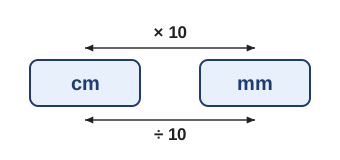
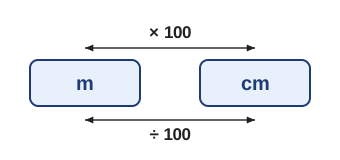
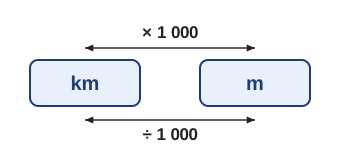
Conversion rules after textbook pp. 177 to 179.
The answer can be written as a decimal or as a fraction. Do whichever the question asks for.
| Change | Working | Answer |
|---|---|---|
| 9.2 cm to mm | 9.2 × 10 | 92 mm |
| 3612 cm to mm | 36.5 × 10 | 365 mm |
| 47 mm to cm | 47 ÷ 10 | 4.7 cm or 4710 cm |
| 1.37 m to cm | 1.37 × 100 | 137 cm |
| 114 m to cm | 1 m + (14 × 100) cm = 100 cm + 25 cm | 125 cm |
| 39 cm to m | 39 ÷ 100 | 0.39 m |
| 42.195 km to m | 42.195 × 1 000 | 42 195 m |
| 10 300 m to km | 10 300 ÷ 1 000 | 10.3 km or 10310 km |
Step 1: 6 mm = 6 ÷ 10 = 0.6 cm.
Step 2: 20 cm + 0.6 cm = 20.6 cm (or 2035 cm).
b) 5 m 80 cm = ? m
Step 1: 80 cm = 80 ÷ 100 = 0.8 m.
Step 2: 5 m + 0.8 m = 5.8 m (or 545 m).
c) 68 km 4 m = ? km
Step 1: 4 m = 4 ÷ 1 000 = 0.004 km.
Step 2: 68 km + 0.004 km = 68.004 km.

Show answerHide answer
b) 5 ÷ 100 = 0.05, so 2 m + 0.05 m = 2.05 m
c) 6 × 1 000 + 40 = 6 040 m
Adding and subtracting length
Check that all the lengths are in the same unit and the same form. Then line up the decimal points and calculate.
Step 1: 3012 cm = 30.5 cm.
Step 2: 26.3 + 18.4 + 30.5 = 75.2 cm.
Step 3: change to mm: 75.2 × 10 = 752 mm.
Step 1: 74 cm = 0.74 m and 234 m = 2.75 m.
Step 2: 0.74 + 1.08 + 2.75 = 4.57 m.
Step 1: 638 m = 0.638 km.
Step 2: 13.500 − 0.638 = 12.862 km.
Show answerHide answer
62.7 − 54.9 = 7.8 cm.
Multiplying and dividing length
b) 14 cards, each 1.9 cm long, in mm: 14 × 1.9 = 26.6 cm = 266 mm.
c) 100 × 4812 m: change 12 to 0.5 so the number is 48.5 m. 100 × 48.5 = 4 850 m = 4.85 km.
d) A stack of 8 ten-sen coins is 12 mm high. One coin: 12 mm ÷ 8 = 1.5 mm thick.
e) 315 m ÷ 16 in cm: 315 m = 320 cm, and 320 ÷ 16 = 20 cm.
Show answerHide answer
7.5 ÷ 5 = 1.5 cm = 15 mm.
5.2Mass
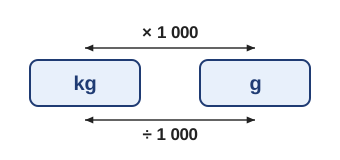
1 kg = 1 000 g
| Change | Working | Answer |
|---|---|---|
| 1.8 kg to g | 1.8 × 1 000 | 1 800 g |
| 234 kg to g | 2 000 g + (34 × 1 000) g = 2 000 g + 750 g | 2 750 g |
| 3.07 kg to g | 3.07 × 1 000 | 3 070 g |
| 6 900 g to kg | 6 900 ÷ 1 000 | 6.9 kg or 6910 kg |
| 5 kg 800 g to kg | 5 kg + 0.8 kg | 5.8 kg |
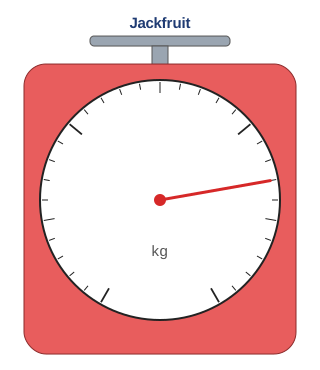
b) 318 kg + 270 g in kg: 318 = 3.125 kg and 270 g = 0.27 kg. 3.125 + 0.27 = 3.395 kg.
c) Khairul is 34.9 kg and Divesh is 41.2 kg. Difference = 41.2 − 34.9 = 6.3 kg.
d) How much more is 14 kg than 0.1 kg, in g? 14 kg = 250 g and 0.1 kg = 100 g, so 250 − 100 = 150 g.
e) 6 042 g − 1.07 kg − 980 g in kg: 6.042 − 1.070 − 0.980 = 3.992 kg.
f) 7 packets of 0.25 kg each: 7 × 0.25 = 1.75 kg.
g) 1 000 tins of 0.85 kg: 1 000 × 0.85 = 850 kg = 850 000 g.
h) One chocolate bar if 7 bars are 0.35 kg: 0.35 ÷ 7 = 0.05 kg.
i) 100 macaroons weigh 112 kg. One macaroon: 1 500 g ÷ 100 = 15 g.
d) 5 kg − 2 350 g = ___ g e) 12 × 0.75 kg = ___ kg f) 4.8 kg ÷ 6 = ___ g
Show answerHide answer
b) 7.25 kg
c) 1.6 + 0.45 = 2.05 kg
d) 5 000 − 2 350 = 2 650 g
e) 9 kg
f) 0.8 kg = 800 g
5.3Volume of liquid
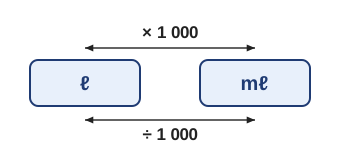
1 ℓ = 1 000 mℓ
| Change | Working | Answer |
|---|---|---|
| 0.3 ℓ to mℓ | 0.3 × 1 000 | 300 mℓ |
| 12 ℓ to mℓ | 12 × 1 000 | 500 mℓ |
| 2 750 mℓ to ℓ | 2 750 ÷ 1 000 | 2.75 ℓ or 234 ℓ |
| 42 ℓ 9 mℓ to ℓ | 42 ℓ + (9 ÷ 1 000) ℓ | 42.009 ℓ |
| 6 025 mℓ to ℓ | 6 025 ÷ 1 000 | 6.025 ℓ or 6140 ℓ |
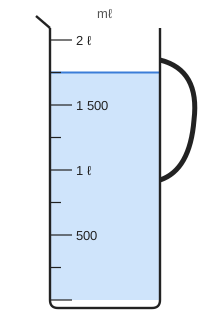
b) 1.875 ℓ + 125 mℓ in mℓ: 1.875 ℓ = 1 875 mℓ, so 1 875 + 125 = 2 000 mℓ.
c) 5 ℓ − 3.3 ℓ = 1.7 ℓ.
d) 1014 ℓ − 2.5 ℓ = 10.25 − 2.50 = 7.75 ℓ.
e) 12.09 ℓ − 780 mℓ in mℓ: 12 090 − 780 = 11 310 mℓ.
f) 5 × 0.08 ℓ = 0.4 ℓ.
g) 100 bottles of 0.4 ℓ in mℓ: 100 × 0.4 = 40 ℓ = 40 000 mℓ.
h) 2.5 ℓ of soup into 4 bowls: 2.5 ÷ 4 = 0.625 ℓ each.
i) 2.5 ℓ of honey into 100 mini bottles, in mℓ: 2 500 mℓ ÷ 100 = 25 mℓ each.
d) 9 ℓ − 234 ℓ = ___ ℓ e) 8 × 0.45 ℓ = ___ ℓ f) 3.6 ℓ ÷ 8 = ___ mℓ
Show answerHide answer
b) 3 750 ÷ 1 000 = 3.75 = 334 ℓ
c) 4.2 + 0.85 = 5.05 ℓ
d) 9 − 2.75 = 6.25 ℓ
e) 3.6 ℓ
f) 0.45 ℓ = 450 mℓ
5.4Solving problems
Use the four steps (textbook p. 210): understand the problem, plan the strategy, solve, then check. Underline the important information, change all measurements to the same unit and form, and draw a bar model when it helps.
Step 1: change all to cm: 12 cm, 0.16 m = 16 cm, 15 m = 20 cm.
Step 2: (a) 12 + 16 + 20 = 48 cm.
Step 3: (b) longest 20 cm, shortest 12 cm. 20 − 12 = 8 cm = 0.08 m.
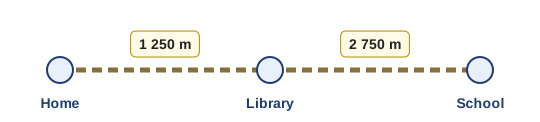
Step 1: 814 km = 8 250 m.
Step 2: the distance for Jeera = 8 250 ÷ 3 = 2 750 m.
Step 3: check: 3 × 2 750 = 8 250. Correct!
4.67 kg = 4 670 g. 12 × 4 670 = 56 040 g.