Textbook Mathematics Year 5 (DLP), Part 1 and Part 2, pages Part 2, 217–234
What this chapter covers
You can name regular polygons and state their characteristics, including sides, corners, interior angles, symmetrical axes and diagonals (6.1.1)
You can measure the interior angles of regular polygons with a protractor (6.2.1)
You can find the perimeter of composite shapes made from two regular polygons (6.3.1)
You can find the area of composite shapes made from squares, rectangles and triangles (6.3.2)
You can find the volume of composite shapes made from cubes and cuboids (6.4.1)
You can solve everyday problems about the perimeter, area and volume of composite shapes (6.5.1)
Space is about shapes. In this unit you study regular polygons, measure their interior angles with a protractor, and then find the perimeter, area and volume of shapes that are made by joining two simpler shapes together (composite shapes).
Plan for a composite shape. Split it into shapes you already know (rectangle, square, triangle, cuboid, cube). Work out each part. Then add the parts together, or subtract the piece that was taken away.
6.1Regular polygons
A polygon is a closed shape made of straight sides. A regular polygon has all sides equal in length and all interior angles equal in size.
A corner (also called a vertex) is where two sides meet. An interior angle is the angle inside the shape at a corner. A diagonal is a straight line drawn from one corner to another corner that is not next to it.
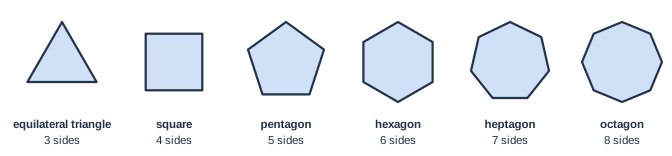
Six regular polygons. The number of sides always equals the number of corners and the number of interior angles.
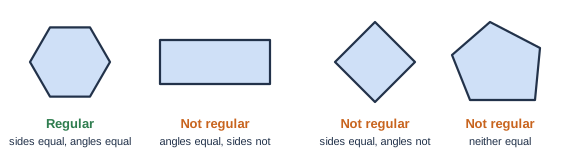
Regular or not regular?
Both conditions must be true. A rectangle that is not a square has equal angles but its sides are not all equal. A rhombus that is not a square has equal sides but its angles are not all equal. So neither is a regular polygon.
Only the hexagon has equal sides and equal angles.
A shape with equal sides is not always regular. Check the angles too. A square is regular, but a rectangle or a rhombus that is not a square is not.
Characteristics of regular polygons
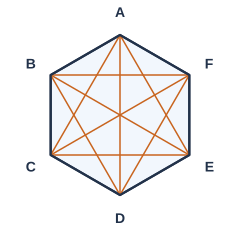
A hexagon has 6 corners and 9 diagonals.
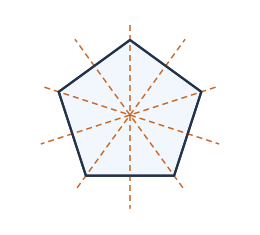
A pentagon has 5 symmetrical axes (lines of symmetry).
Regular polygon
Sides
Corners
Interior angles
Symmetrical axes
Diagonals
Equilateral triangle
3
3
3
3
0
Square
4
4
4
4
2
Pentagon
5
5
5
5
5
Hexagon
6
6
6
6
9
Heptagon
7
7
7
7
14
Octagon
8
8
8
8
20
Patterns to remember. Sides = corners = interior angles = symmetrical axes. The diagonals go up by 2, 3, 4, 5, 6 as the polygon gets one more side: 0, 2, 5, 9, 14, 20. To check a number of diagonals, each corner joins to (sides − 3) other corners, so diagonals = sides × (sides − 3) ÷ 2. For a hexagon: 6 × 3 ÷ 2 = 9.
Worked example: name the polygon
A regular polygon has 7 corners and 14 diagonals.
7 corners means 7 sides, so it is a regular heptagon. Check: 7 × 4 ÷ 2 = 14 diagonals.
a) How many symmetrical axes does a regular octagon have? b) A regular polygon has 5 diagonals. Name it. c) Is a rhombus that is not a square a regular polygon? Why?
Show answerHide answer
a) 8 (same as its number of sides). b) Pentagon (5 sides, 5 diagonals). c) No. Its sides are equal but its interior angles are not all equal.
6.2Measuring interior angles
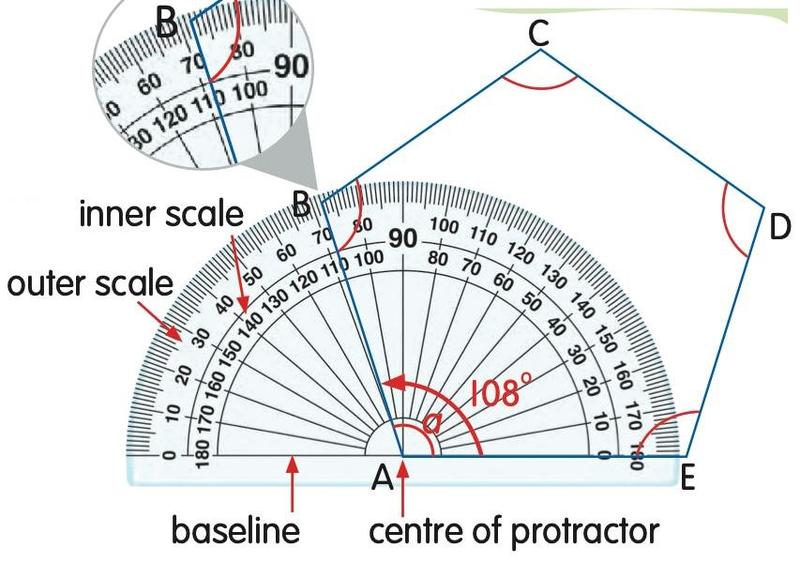
A protractor measures angles in degrees (°). It has an inner scale and an outer scale, a baseline and a centre.
Measuring angle a of the regular pentagon: centre on corner A, baseline along AE. The reading is 108°.
Figure: Mathematics Year 5 (DLP) textbook, p. 219.
Place the centre of the protractor on the corner of the angle.
Line up the baseline with one arm of the angle, so that arm points to a 0° mark.
Start reading from 0° on the scale that begins at that arm, and follow the same scale to the other arm.
Write the value with the degree sign.
Two scales. The two scales give two numbers that add up to 180°. Decide first if the angle is smaller or larger than a right angle (90°), then choose the reading that fits. The angle a in the pentagon is more than 90°, so the correct reading is 108°, not 72°.
Types of angle
Type
Size
Acute angle
more than 0° and less than 90°
Right angle
exactly 90°
Obtuse angle
more than 90° and less than 180°
Every interior angle of a regular polygon is the same size. Measure just one:
Regular polygon
Each interior angle
Type
Equilateral triangle
60°
acute
Square
90°
right angle
Pentagon
108°
obtuse
Hexagon
120°
obtuse
Octagon
135°
obtuse
The more sides a regular polygon has, the larger each interior angle becomes. Your own measurement may be 1° or 2° away from these values. That is fine.
The protractor reading on the outer scale for one arm of an angle is 40°, and the other arm is on the baseline at 0°. What is the angle, and what type is it?
Show answerHide answer
The angle is 40°. It is less than 90°, so it is an acute angle.
6.3Perimeter and area of composite shapes
A composite shape is a shape made by joining two or more simpler shapes. Its perimeter is the distance round the outside of the shape. Its area is the space inside, measured in square units (cm², m²).
Perimeter
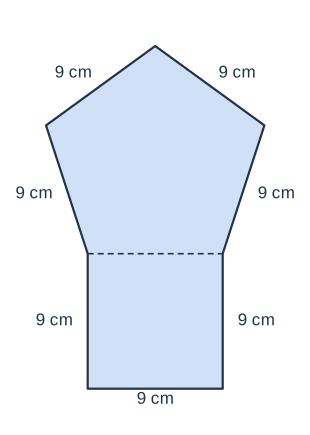
A square and a regular pentagon share one side (dashed). Only the outer sides are counted.
Worked example
The square has 4 sides and the pentagon has 5 sides. They share one side, which is inside the shape.
Outer sides = 4 + 5 − 2 = 7 sides (the shared side is removed from each polygon).
Perimeter = 7 × 9 cm = 63 cm
Do not count the joining side. Counting all 9 sides gives 81 cm, which is wrong. Only the outside edges are part of the perimeter.
For a shape with sides of different lengths, label every outer side, then add them one by one starting from a corner. Tick each side as you add it so none is missed or counted twice.
Area
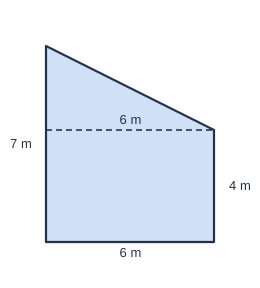
Rectangle 6 m by 4 m, with a right-angled triangle on top. The dashed line separates the two parts.
Shape
Area
Rectangle
length × breadth
Square
side × side
Triangle
½ × base × height
Worked example: add the parts
Rectangle: 6 m × 4 m = 24 m²
Triangle: ½ × 6 m × 3 m = 9 m²
Total area = 24 m² + 9 m² = 33 m²
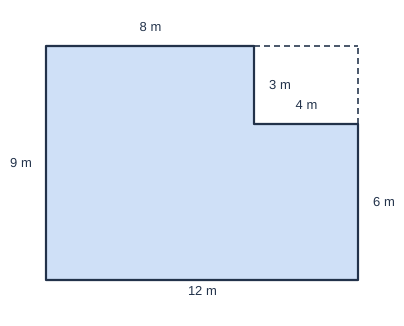
A 12 m by 9 m rectangle with a 4 m by 3 m corner cut away (dashed).
Worked example: subtract the missing piece
Whole rectangle: 12 m × 9 m = 108 m²
Piece removed: 4 m × 3 m = 12 m²
Shaded area = 108 m² − 12 m² = 96 m²
Height of a triangle. The height is the straight-up distance from the base, at a right angle to it. It is not the slanted side.
A square of side 5 cm has a right-angled triangle of base 5 cm and height 4 cm joined to one side. Find the area of the composite shape.
Show answerHide answer
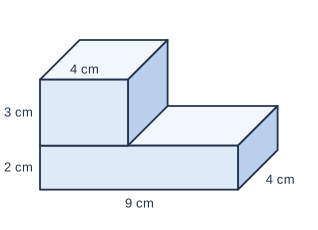
Volume is the amount of space a solid takes up. It is measured in cubic units (cm³, m³). Volume of a cuboid = length × breadth × height. A cube is a cuboid with all edges equal, so its volume is side × side × side.
Two cuboids joined together.
Worked example: add the parts
Lower cuboid: 9 cm × 4 cm × 2 cm = 72 cm³
Upper cuboid: 4 cm × 4 cm × 3 cm = 48 cm³
Volume of the composite shape = 72 cm³ + 48 cm³ = 120 cm³
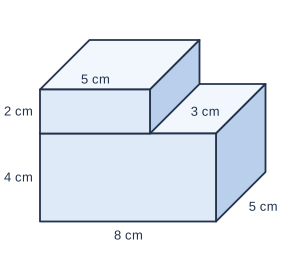
An 8 cm by 5 cm by 6 cm block with a piece cut away. The piece that was cut away was 3 cm long and 2 cm high.
Worked example: subtract the piece removed
Whole block: 8 × 5 × 6 = 240 cm³
Piece cut away: 3 × 5 × 2 = 30 cm³
Remaining volume = 240 cm³ − 30 cm³ = 210 cm³
Check by adding the two parts that are left: 8 × 5 × 4 = 160 cm³ and 5 × 5 × 2 = 50 cm³; 160 + 50 = 210 cm³.
The volume of a composite shape stays the same however the parts are arranged, as long as no part is added or taken away.
Units. Perimeter is in cm or m. Area is in cm² or m². Volume is in cm³ or m³. Check the unit before you write the answer.
A cuboid measures 10 cm × 8 cm × 4 cm. A cube of side 4 cm is cut out of it. What is the volume left?
Show answerHide answer
The textbook uses four steps. Understand the problem, plan the strategy, solve, then check.
Worked example: fence round a pond
A pond is made of a regular octagon with sides of 6 m joined to a rectangle 15 m long and 6 m wide. One 6 m side of the rectangle is also a side of the octagon. A fence goes round the outside of the pond. How long is the fence? (The textbook, p. 228, solves a similar problem.)
Understand: we need the length round the outside of the pond. Plan: outer sides of the octagon + outer sides of the rectangle, leaving out the shared side. Solve: octagon: 8 sides, 1 shared, so 7 × 6 m = 42 m. Rectangle: 15 m + 15 m + 6 m = 36 m (the other 6 m side is shared).
Fence = 42 m + 36 m = 78 m Check: octagon 8 × 6 = 48 m, rectangle 2 × (15 + 6) = 42 m. 48 + 42 − (2 × 6) = 78 m. ✓
Worked example: is the money enough?
A rectangular path 7 m by 3 m and another rectangular path 5 m by 2 m are to be tiled. One square metre costs RM80. Mak has RM2 000.
Area = 7 × 3 + 5 × 2 = 21 + 10 = 31 m²
Cost = 31 × RM80 = RM2 480
RM2 480 is more than RM2 000, so the money is not enough. She needs RM480 more.
In a cost problem, always do three things: find the area (or length), multiply by the price for each unit, then compare with the money and write a sentence.
A garden 10 m by 6 m has a pond 3 m by 2 m inside it. Grass costs RM12 for each m². How much does the grass cost for the part without the pond?
Show answerHide answer
Garden: 10 × 6 = 60 m² Pond: 3 × 2 = 6 m² Grass area: 60 − 6 = 54 m² Cost: 54 × RM12 = RM648
Notes follow Mathematics Year 5 (DLP), Unit 6, pp. 217-234. Worked examples use numbers made for these notes.