Coordinates, Ratio and Proportion
What this chapter covers
- You can state the horizontal distance and vertical distance of a point from the origin on the Cartesian plane (7.1.1)
- You can find the horizontal and vertical distance between two coordinates by subtracting (7.1.1)
- You can state the ratio of two quantities of the same kind, and read it as "a to b" (7.2.1)
- You can state a ratio of one part to the whole, and change measurements to the same unit first (7.2.1)
- You can use proportion to find a value, with multiplying, dividing and the unitary method (7.3.1)
- You can solve problems that use distance on a Cartesian plane, ratio and proportion (7.4.1)
Situations and numbers in these notes are based on Mathematics Year 5 (DLP), Part 2, pp.235-250. The diagrams are redrawn.
7.1Distance between two coordinates
A Cartesian plane has a horizontal axis (the x-axis) and a vertical axis (the y-axis). They meet at the origin O (0, 0). A point is written as a pair of numbers, its coordinate.
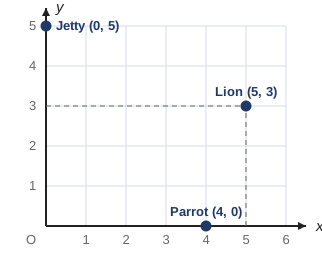
- The parrot is at (4, 0). Its horizontal distance from the ticket counter is 4 units and its vertical distance is 0.
- The jetty is at (0, 5). Its vertical distance from the ticket counter is 5 units.
- The lion is at (5, 3): 5 units horizontally and 3 units vertically from the origin.
Distance between two points
To find the distance from one point to another, subtract the two horizontal distances, then subtract the two vertical distances. Take the smaller from the larger.
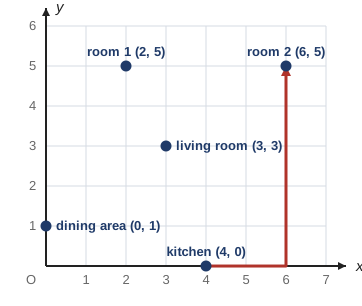
| Place | Horizontal distance from origin | Vertical distance from origin |
|---|---|---|
| kitchen | 4 units | 0 unit |
| room 2 | 6 units | 5 units |
| difference | 6 − 4 = 2 units | 5 − 0 = 5 units |
Vertical: 5 − 1 = 4 units (downwards).
The distance is 2 units horizontally and 4 units vertically.
Show answerHide answer
7.2Ratio between two quantities

- Scouts to MRCS members: 3 : 5 (three to five).
- MRCS members to everybody (scouts and MRCS together): 5 : (3 + 5) = 5 : 8.
- Everybody to the scouts: 8 : 3.
Ratio of masses
A dodol recipe uses 11 kg of granulated sugar and 10 kg of glutinous flour.
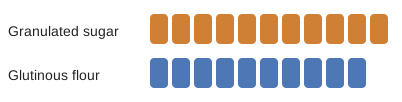
Ratio of the mass of flour to the mass of sugar and flour together = 10 : (11 + 10) = 10 : 21.
Use the same unit
You can only compare two quantities when they are in the same unit. Change the bigger unit to the smaller unit first.
Step 2. Ratio of blue to red = 200 : 75.
Writing 2 : 75 is wrong, because 2 is in metres and 75 is in centimetres.
Show answerHide answer
7.3Proportion to find a value
A batik cake recipe uses 200 g of butter for 600 g of Marie biscuits. How much biscuit is needed for 300 g of butter?
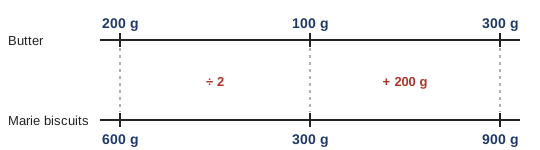
Step 2. Divide by 2: 100 g butter for 300 g biscuits.
Step 3. 300 g = 200 g + 100 g, so 600 g + 300 g = 900 g of biscuits.
Price and mass
Step 2. 100 g: RM8.50 ÷ 10 = RM0.85. So 400 g: 4 × RM0.85 = RM3.40.
Step 3. Add: RM17.00 + RM3.40 = RM20.40.
Show answerHide answer
7.4Solving problems
Use the four steps: understand the problem, plan a strategy, solve, then check. Draw a Cartesian plane, a table or a bar for each quantity.
Step 1. Horizontal: 1 + 4 = 5.
Step 2. Vertical: 0 + 3 = 3.
Step 3. Resma is at (5, 3).
Check: 5 − 1 = 4 and 3 − 0 = 3. Correct.
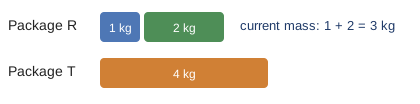
Ratio of R to the total mass of R and T = 3 : 7. The ratio of the total to T = 7 : 4.
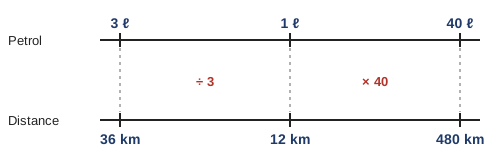
Step 2. 40 × 12 km = 480 km.
Check: 3 × 12 km = 36 km, which matches the given.
Show answerHide answer
Summary
- In the coordinate (x, y), x is the horizontal distance and y is the vertical distance from the origin.
- Distance between two points: subtract the horizontal distances, then subtract the vertical distances.
- A ratio a : b compares two quantities of the same kind. Order matters.
- Ratio of a part to the whole: add the parts to get the total first.
- Use the same unit before stating a ratio (2 m and 75 cm becomes 200 : 75).
- Proportion: if one quantity doubles, the other doubles. Divide to find one unit, then multiply.
- Solve problems in four steps: understand, plan, solve, check.