Science questions, unit 9
Nama / NameKelas / ClassTarikh / Date
Phases of the Moon and constellations
40 marks. Use Practice to check each answer as you go, or Exam to answer everything first. Ask a grown-up to help you mark the written answers.
Section A: objective questions
10 marksChoose the best answer for each question.
1
Question 1
Why can we see the Moon at night?
Show answerHide answer
B
The Moon does not give out its own light. It reflects the light from the Sun.
2
Question 2
Which pair shows the two movements of the Moon?
Show answerHide answer
D
The Moon rotates on its own axis and revolves around the Earth.
3
Question 3
We always see the same surface of the Moon from the Earth. Why?
Show answerHide answer
A
Both movements take 27 days, so the same surface always faces the Earth. The Moon does rotate, and both movements are anticlockwise.
4
Question 4
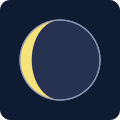
Diagram 1 shows the Moon on one night. What is this phase called?
Show answerHide answer
C
Only a small, thin part of the lit surface faces the Earth, so it is a crescent moon.
5
Question 5
We cannot see the Moon at the new moon phase. Why?
Show answerHide answer
D
At the new moon the lit side faces away from the Earth and the dark side faces the Earth (textbook p. 204).
6
Question 6
What phase of the Moon is seen on the 5th day of a lunar month?
Show answerHide answer
B
The 5th day is between the 3rd and the 6th day, when the crescent moon is seen.
7
Question 7
What is a constellation?
Show answerHide answer
A
A constellation is a group of stars which appears to form a certain pattern in the sky that can be seen at night.
8
Question 8
A traveller in the southern hemisphere is lost at night. Which constellation can help to find the direction south?
Show answerHide answer
C
The Southern Cross always points to the south. The Big Dipper (part of the Great Bear) points to the north.
9
Question 9
Aina sees a half-moon on the 8th day of a lunar month. She looks at the Moon again 14 days later. What phase will she see?
Show answerHide answer
A
8 + 14 = 22nd day. The 21st to 24th days are the half-moon phase. A full moon is on days 14 to 16.
10
Question 10
Which statement correctly explains the phases of the Moon?
Show answerHide answer
C
The Moon does not give out its own light and its rotation time does not change. The phases happen because its position changes as it revolves around the Earth, so we see different parts of the part lit by the Sun.
Section B: structured questions
30 marksAnswer all questions. Circle the answer or write it in the space.
11
Question 11
Ana and Melia observe the Moon. Their teacher uses a mirror and a torch to show how the Moon shines.
[1 mark]
(a)Does the Moon give out its own light?
Show answerHide answer
No
[1 mark]
(b)In the activity, what does the torch represent?
Show answerHide answer
The Sun
The mirror represents the Moon and the light from the torch represents the light from the Sun.
[1 mark]
(c)What does the Moon do to the light from the Sun?
Show answerHide answer
Tick each point you got.
12
Question 12
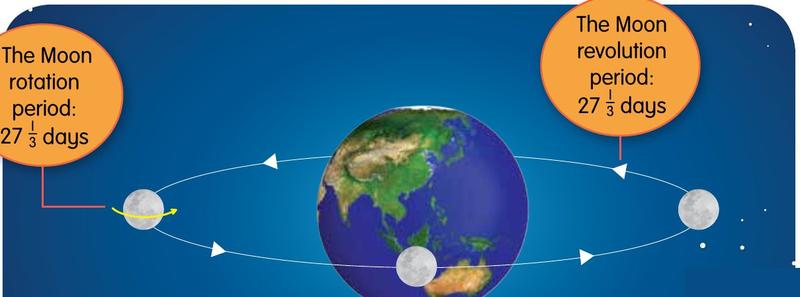
Diagram 2 shows the Moon moving around the Earth. Are these statements true or false?
[1 mark]
(a)The Moon revolves around the Earth.
Show answerHide answer
True
[1 mark]
(b)The Moon takes a longer time to rotate once than to revolve once.
Show answerHide answer
False
Both take 27 days.
[1 mark]
(c)The Moon rotates and revolves in the same direction.
Show answerHide answer
True
Both are anticlockwise.
13
Question 13
The Moon takes 27 days to rotate once on its axis.
[1 mark]
(a)How long does the Moon take to revolve once around the Earth?
Show answerHide answer
27 days
[1 mark]
(b)Which surface of the Moon faces the Earth all the time?
Show answerHide answer
The same surface
[1 mark]
(c)Explain your answer to (b).
Show answerHide answer
Tick each point you got.
14
Question 14
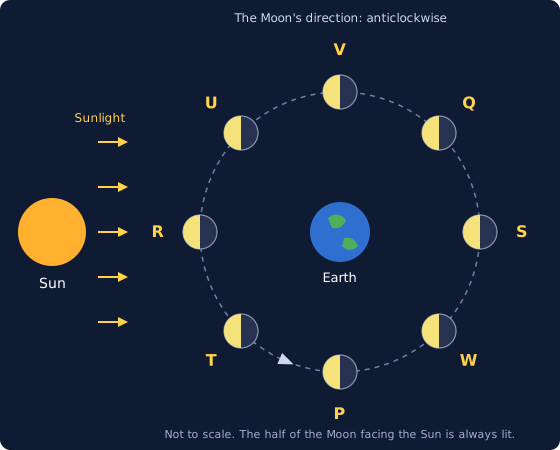
Diagram 3 shows the Moon at eight positions, P to W, as it revolves around the Earth. The side of the Moon facing the Sun is always lit.
[1 mark]
(a)At which position is the new moon seen?
Show answerHide answer
R
At R the Moon is between the Earth and the Sun, so the dark side faces the Earth.
[1 mark]
(b)At which position is the full moon seen?
Show answerHide answer
S
At S the Moon is on the opposite side of the Earth from the Sun, so the whole lit surface faces the Earth.
[1 mark]
(c)What phase of the Moon is seen at P?
Show answerHide answer
P is a quarter of the way round the orbit, so half of the lit surface faces the Earth.
Tick each point you got.
15
Question 15
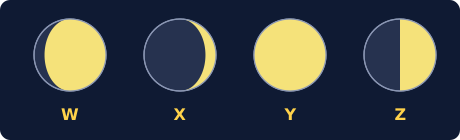
Diagram 4 shows four phases of the Moon, W, X, Y and Z. They are not in order.
[2 marks]
(a)Arrange the phases in the order they are seen after the new moon.
Show answerHide answer
X, Z, W, Y
Crescent, half-moon, gibbous, then full moon: more of the lit surface is seen each night.
Tick each point you got.
[1 mark]
(b)Name the phase of the Moon shown by W.
Show answerHide answer
Tick each point you got.
16
Question 16
1 Muharam 1442H was on 20 August 2020. The new moon had fully appeared on that day.
[1 mark]
(a)What phase of the Moon is seen on 9 Muharam?
Show answerHide answer
Half-moon
The 7th to 10th days are the half-moon phase.
[2 marks]
(b)On which date in the Gregorian calendar was 15 Muharam? Show how you find it.
Show answerHide answer
3 September 2020
August has 31 days, so day 34 of August is 3 September.
Tick each point you got.
17
Question 17
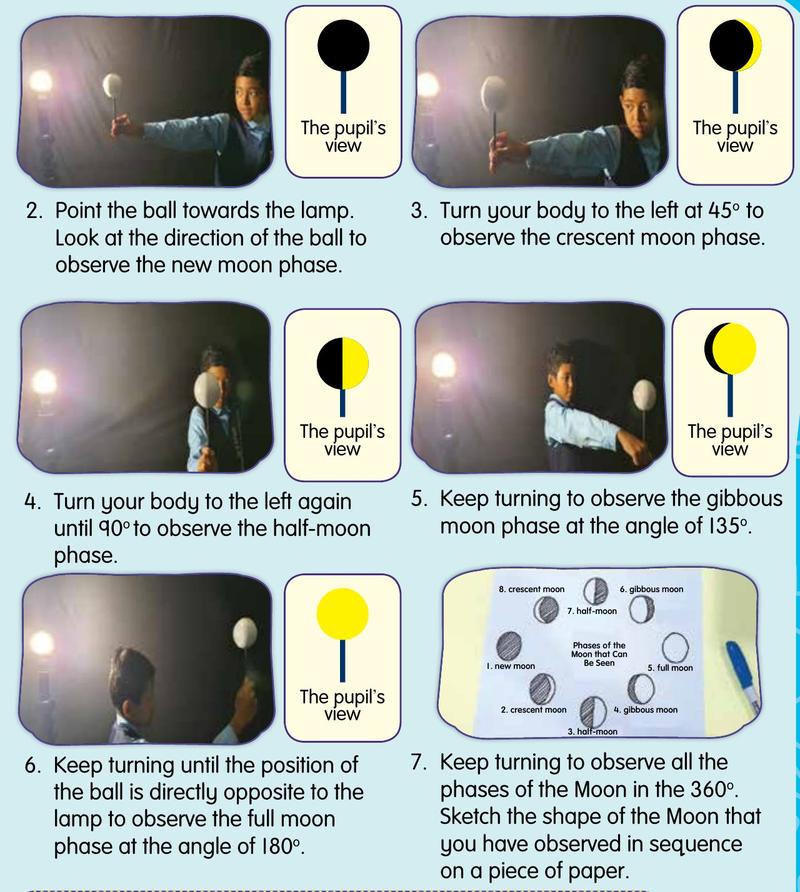
Hafiz uses a lamp and a polystyrene ball on a pencil to study the phases of the Moon, as in Diagram 5. He turns his body to the left to see each phase.
[1 mark]
(a)What does the lamp represent?
Show answerHide answer
The Sun
[1 mark]
(b)At what angle of turning does Hafiz see the full moon?
Show answerHide answer
180°
At 180° the ball is directly opposite the lamp.
[1 mark]
(c)Why must this activity be done in a dark room?
Show answerHide answer
Tick each point you got.
18
Question 18
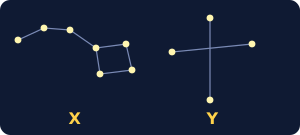
Diagram 6 shows two constellations, X and Y.
[1 mark]
(a)Name constellation X.
Show answerHide answer
Big Dipper
The Big Dipper has seven stars that look like a water dipper or scoop.
[1 mark]
(b)Name constellation Y.
Show answerHide answer
Southern Cross
The Southern Cross is the smallest constellation. It has four stars joined in a cross shape, which the textbook compares with a kite.
[1 mark]
(c)In which hemisphere is constellation Y seen?
Show answerHide answer
Southern hemisphere
19
Question 19
Long ago, before calendars were invented, farmers in the northern hemisphere used constellations to plan their work.
[1 mark]
(a)Which constellation told farmers that it was time to start planting?
Show answerHide answer
Big Dipper
[1 mark]
(b)What did the appearance of the Scorpion constellation tell farmers?
Show answerHide answer
Tick each point you got.
[1 mark]
(c)Name one other use of constellations.
Show answerHide answer
Tick each point you got.
20
Question 20
A radio announcer says: "In two weeks, Malaysians will celebrate Hari Raya Aidilfitri." Hari Raya Aidilfitri is on 1 Syawal.
[1 mark]
(a)What phase of the Moon is seen on 1 Syawal?
Show answerHide answer
New moon
The first day of each lunar month is when the new moon has appeared.
[2 marks]
(b)What phase of the Moon was seen when the announcement was made? Explain your answer.
Show answerHide answer
Full moon. The full moon appears in the middle of the lunar month, about two weeks before 1 Syawal.
Tick each point you got.