Phases of the Moon and constellations
What this chapter covers
- You can explain that the Moon does not give out its own light but reflects light from the Sun (9.1.1)
- You can describe the rotation and revolution of the Moon, including the time taken and the direction (9.1.2)
- You can name the phases of the Moon and say what we see in each phase (9.1.3)
- You can use the lunar calendar to link dates with the phases of the Moon (9.1.3)
- You can explain with a simulation why the phases of the Moon happen (9.1.4)
- You can name some constellations and describe their patterns (9.2.1)
- You can explain how constellations are used to show direction and to indicate seasons (9.2.2)
- You can build a model of a constellation (9.2.3)
9.1The Moon
The moonlight
The Moon looks bright at night. Does it make its own light, like the Sun?
Remember the experiment on the reflection of light. A mirror shines because it reflects the light from the torch. The mirror stands for the Moon. The torch stands for the Sun.
The Moon rotates and revolves
The Earth rotates on its axis and revolves around the Sun at the same time. The Moon makes two movements too.
| Movement | What it means | Time for one complete turn | Direction |
|---|---|---|---|
| Rotation | The Moon spins on its own axis. | 27 days | Anticlockwise |
| Revolution | The Moon moves around the Earth. | 27 days | Anticlockwise |
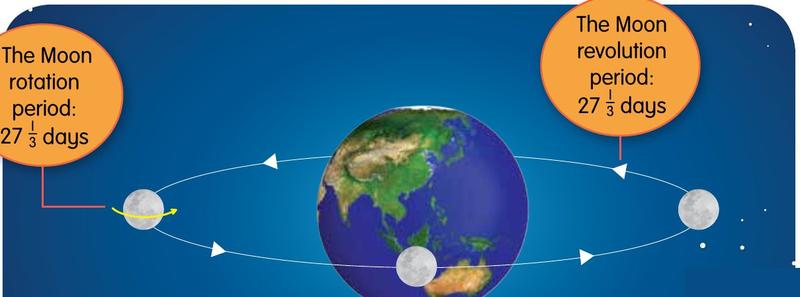
Picture: Science Year 5 (DLP) textbook, p. 202.
2. Why do we always see the same surface of the Moon?
Show answerHide answer
2. The Moon takes the same time to rotate once and to revolve once around the Earth, so the same surface always faces the Earth.
9.2Phases of the Moon
The Moon revolves around the Earth, so its position changes with time. Half of the Moon is always lit by the Sun. But from the Earth we see different parts of the lit half on different nights.
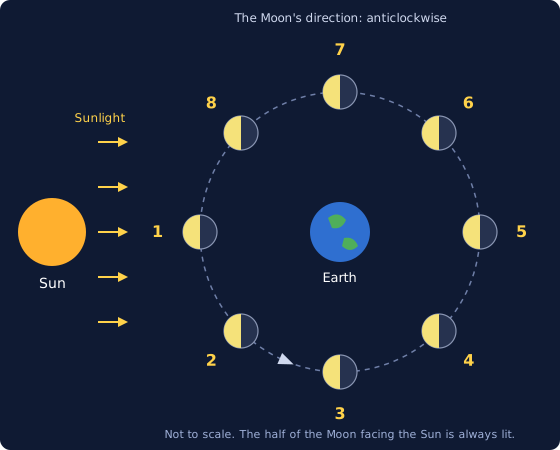
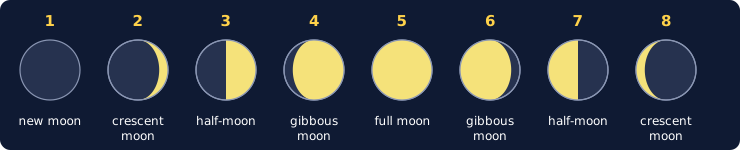
| Position | Phase | What is facing the Earth |
|---|---|---|
| 1 | New moon | The dark side of the Moon. We cannot see the Moon. |
| 2 and 8 | Crescent moon | A small part of the lit surface |
| 3 and 7 | Half-moon | Half of the lit surface |
| 4 and 6 | Gibbous moon | A large part of the lit surface |
| 5 | Full moon | The whole lit surface |
Simulation with a ball and a lamp
Use a lamp (the Sun) in the middle of a dark room and a polystyrene ball on a pencil (the Moon). Turn your body to the left and look at the ball.
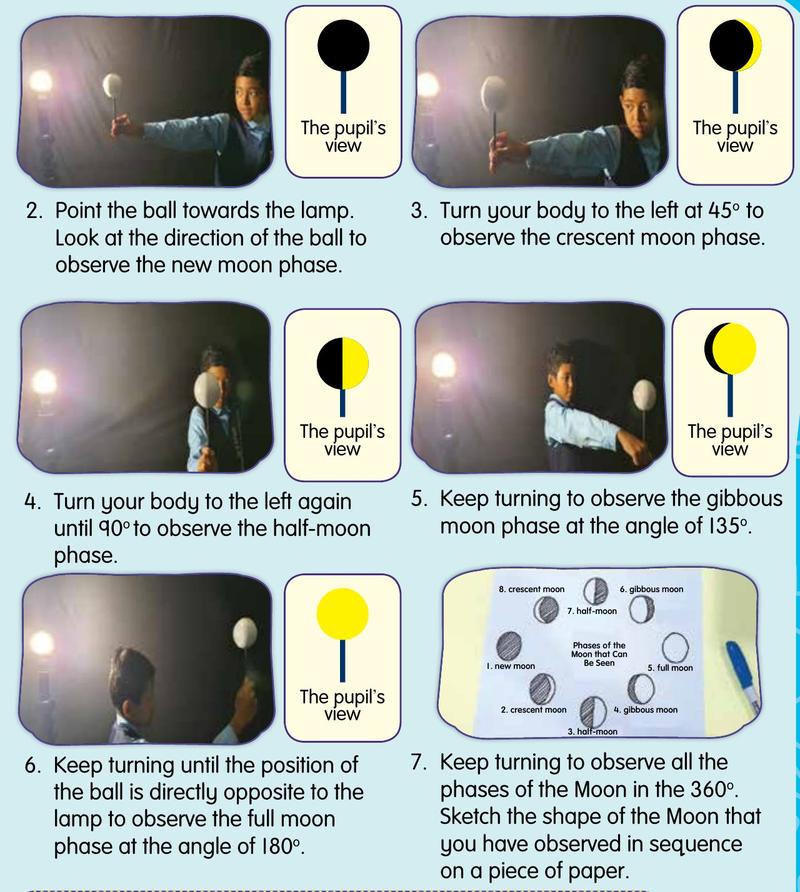
Picture: Science Year 5 (DLP) textbook, p. 207.
| Ball position | Phase you see |
|---|---|
| Pointing at the lamp | New moon |
| Turn 45° | Crescent moon |
| Turn 90° | Half-moon |
| Turn 135° | Gibbous moon |
| Turn 180° (opposite the lamp) | Full moon |
2. Why do the phases of the Moon happen?
Show answerHide answer
2. As the Moon revolves around the Earth, we see different parts of the Moon that are lit by sunlight.
9.3The lunar calendar
The lunar calendar is based on the phases of the Moon. It is also called the Hijra calendar. The first day of each lunar month is when the new moon has fully appeared.
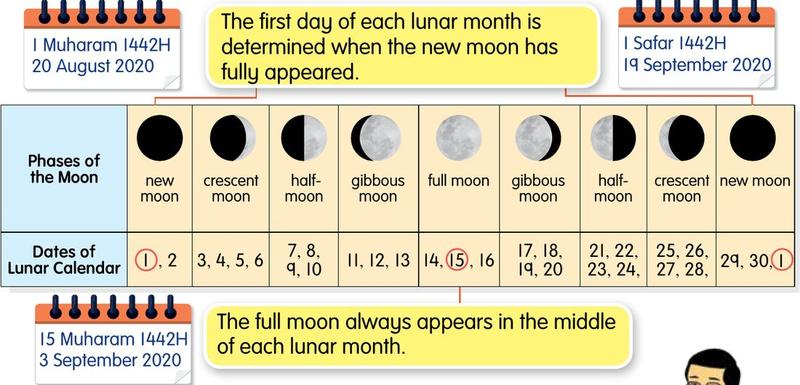
Picture: Science Year 5 (DLP) textbook, p. 206.
| Phase | Dates of the lunar month |
|---|---|
| New moon | 1, 2 |
| Crescent moon | 3 to 6 |
| Half-moon | 7 to 10 |
| Gibbous moon | 11 to 13 |
| Full moon | 14 to 16 (the middle of the month) |
| Gibbous moon | 17 to 20 |
| Half-moon | 21 to 24 |
| Crescent moon | 25 to 28 |
| New moon | 29, 30, then 1 again |
15 Muharam is 15 − 1 = 14 days later. 20 August + 14 days = 34 August = 3 September 2020. The Moon was a full moon.
Show answerHide answer
8 + 14 = 22nd day: half-moon (21 to 24).
9.4Constellations
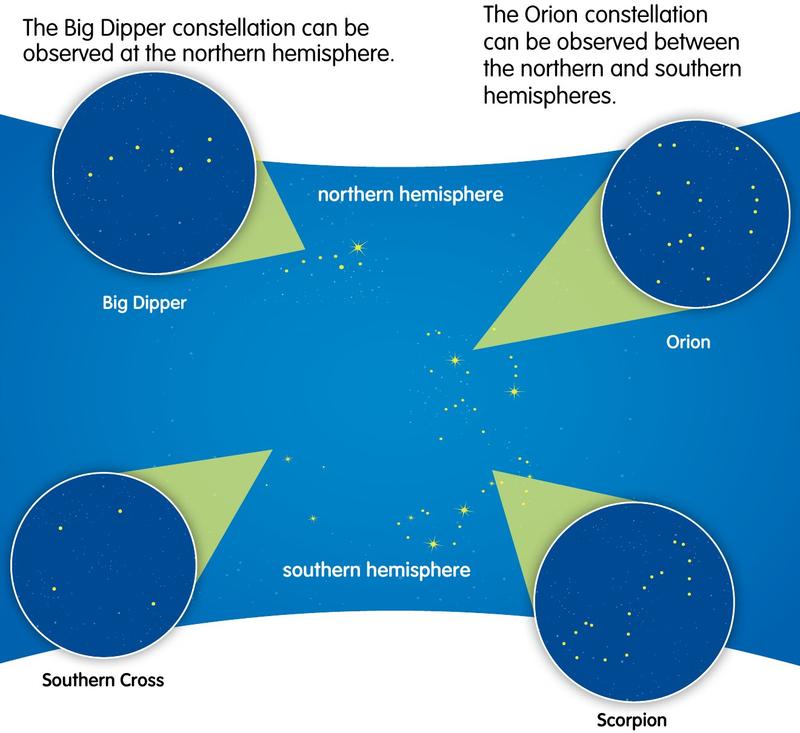
Long ago, sailors looked at the stars at night. Some stars seem to form patterns. A group of stars with a pattern is a constellation.
Not every constellation can be seen from every place on the Earth. Some are seen in the northern hemisphere, some in the southern hemisphere, and some in between.
| Constellation | Pattern it looks like | Where it is seen |
|---|---|---|
| Big Dipper | A water dipper or scoop (7 stars) | Northern hemisphere |
| Orion | A hunter wearing a belt and holding a weapon | Between the northern and southern hemispheres |
| Southern Cross | A kite (4 stars). It is the smallest constellation. | Southern hemisphere |
| Scorpion | A scorpion | Southern hemisphere |
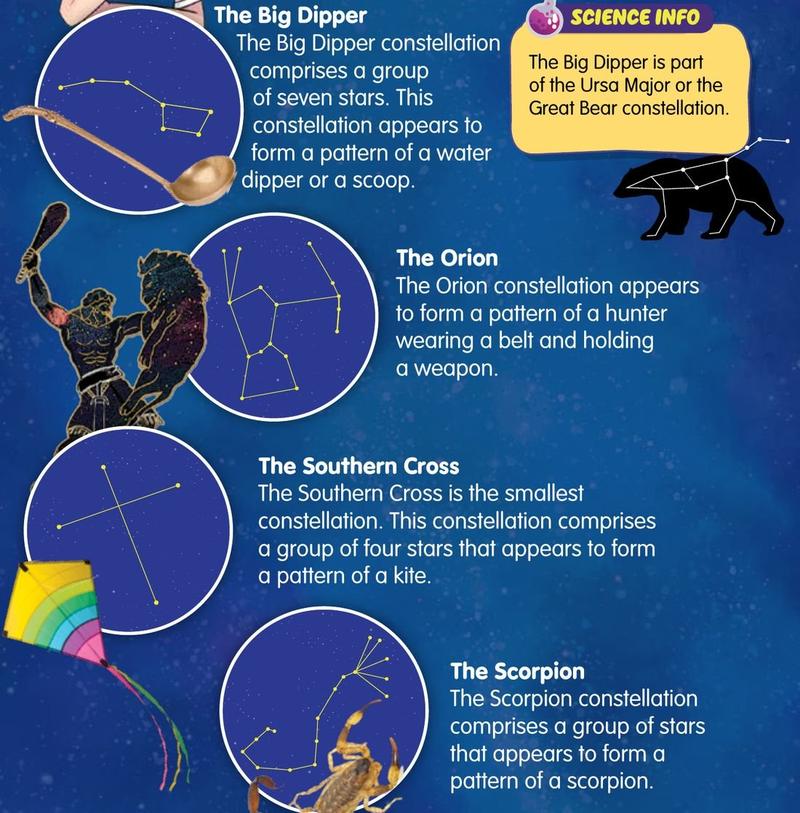
Picture: Science Year 5 (DLP) textbook, p. 210.
Show answerHide answer
9.5Uses of constellations
Constellations help humans to find certain stars. The patterns tell us direction and the time of the year.
To show direction
Travellers and sailors used constellations like a compass.
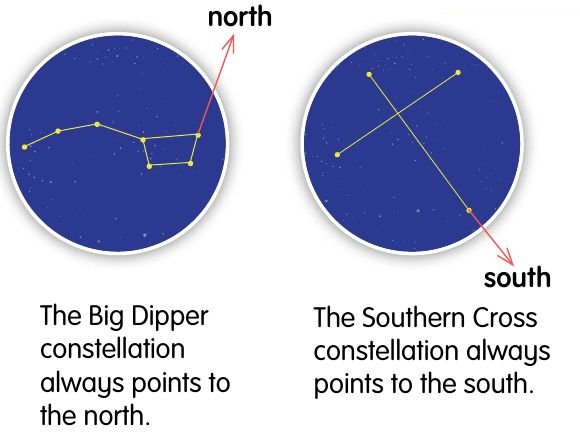
Picture: Science Year 5 (DLP) textbook, p. 211.
To indicate seasons
Before calendars were invented, farmers in places with four seasons in the northern hemisphere looked at constellations to plan their work.
| Constellation | It tells the farmer |
|---|---|
| Big Dipper | The start of the planting season |
| Orion | The start of winter |
| Scorpion | The start of the harvesting season |
Make a model
You can make a model of a constellation with seven small balls of modelling clay and skewer sticks joined to look like the Big Dipper. Use the same way to make Orion, the Southern Cross and the Scorpion. Be careful when you cut the skewer sticks. (Textbook p. 213)
Show answerHide answer
Summary
| Topic | Remember |
|---|---|
| Moonlight | The Moon reflects the light of the Sun. It does not make its own light. |
| Movements | The Moon rotates on its axis and revolves around the Earth. Each takes 27 days and goes anticlockwise. |
| Phases | New moon, crescent, half-moon, gibbous, full moon, gibbous, half-moon, crescent. They happen because we see different parts of the lit half as the Moon revolves around the Earth. |
| Lunar calendar | Also called the Hijra calendar. The month starts at the new moon. The full moon is in the middle of the month. |
| Constellations | A group of stars that forms a pattern. Big Dipper, Orion, Southern Cross, Scorpion. |
| Uses | To show direction (Big Dipper: north, Southern Cross: south) and to indicate seasons. |