Matter
What this chapter covers
- You can name the three states of matter and give examples of each in your surroundings (8.1.1)
- You can state the properties of solid, liquid and gas: mass, volume, shape and space (8.1.2, 8.1.3, 8.1.5)
- You can name the three states of matter of water (8.1.4)
- You can describe how particles are arranged in a solid, a liquid and a gas (8.2.1)
- You can name the processes of melting, freezing, boiling, evaporation and condensation, and say whether heat is gained or lost (8.2.1, 8.2.2)
- You can explain how clouds and rain form in the natural water cycle (8.2.3)
- You can give examples of changes of state in daily life and explain them (8.2.4)
Everything around you is made of matter: the sand on the beach, the sea and the wind that flies your kite. In this unit you will learn the three states of matter, their properties and how water changes from one state to another.
8.1States of matter
Matter exists in three states: solid, liquid and gas. On the beach we can find all three.
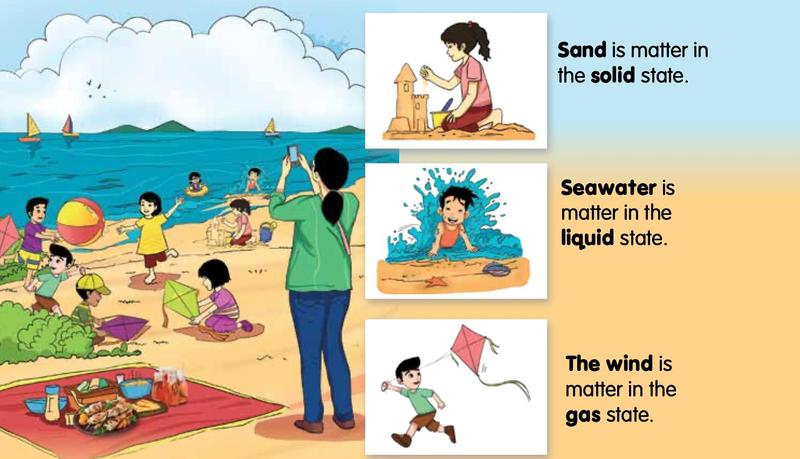
Liquid: drinking water, soy sauce, palm oil, sweat.
Gas: air, oxygen, carbon dioxide, water vapour.
Properties of solid, liquid and gas
Each state has its own properties. In the textbook activities you weigh a stone, pour coloured water into different containers and inflate balloons to find them.
| Property | Solid | Liquid | Gas |
|---|---|---|---|
| Has mass | Yes | Yes | Yes |
| Occupies space | Yes | Yes | Yes |
| Volume | Fixed | Fixed | Not fixed |
| Shape | Fixed | Not fixed (takes the shape of its container) | Not fixed (fills its container) |
- Solid: pressing a small stone does not change its shape.
- Liquid: water pours into a cup, a flask or a glass container and takes the shape of each one, but its volume stays the same.
- Gas: air fills a balloon and spreads out in all directions. When you push the piston of a syringe with the tip covered, the air is pushed into a smaller space.
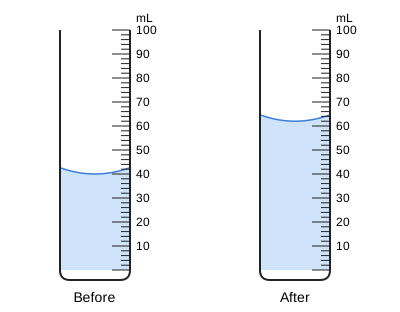
Volume of stone = final volume − initial volume = 62 − 40 = 22 mL.
Show answerHide answer
Particles in matter
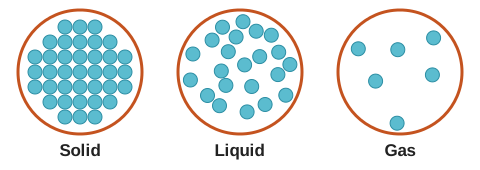
Matter is made of very tiny particles. The arrangement of the particles is different in each state.
| State | Arrangement of particles |
|---|---|
| Solid | Very closely packed and arranged in an orderly way |
| Liquid | Less packed and not in an orderly way |
| Gas | Spread out and not in an orderly way |
8.2Changes in the state of matter of water
Water can exist in all three states.
| State | Name |
|---|---|
| Solid | Ice |
| Liquid | Water |
| Gas | Water vapour |
Five processes
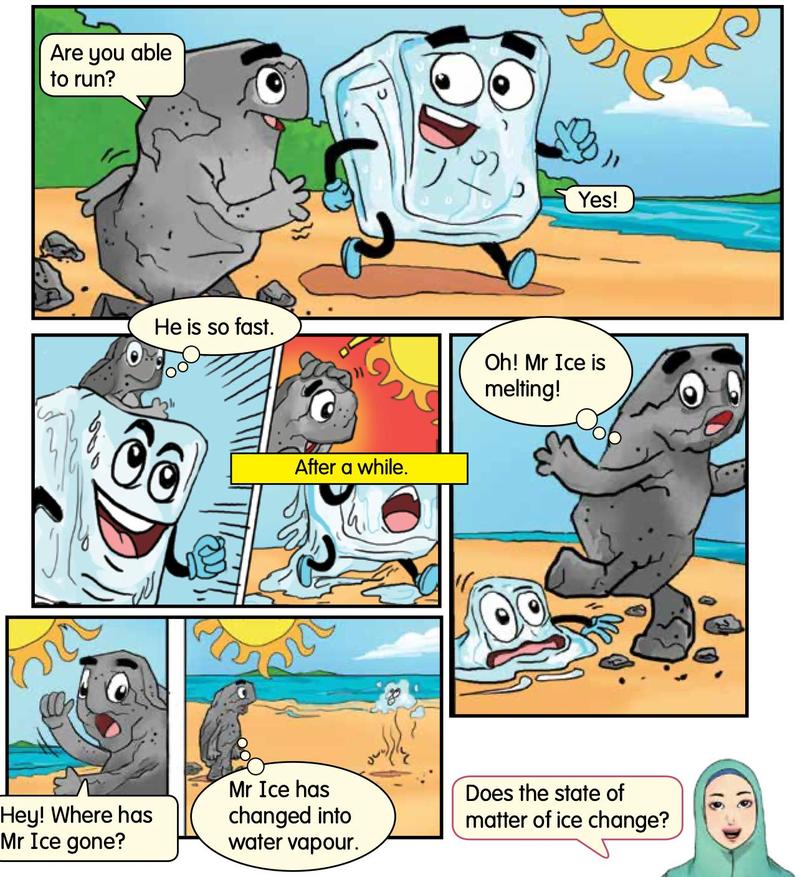
The state of water changes when it gains heat from the surroundings or loses heat to the surroundings.
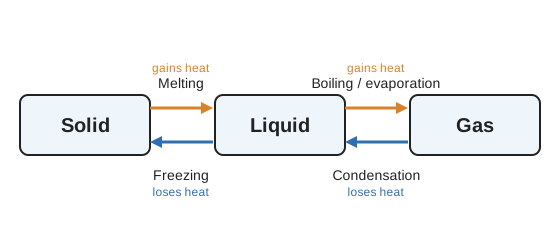
| Process | Change | Heat | Example |
|---|---|---|---|
| Melting | Solid to liquid | Gained | Ice cream melts; ice cubes in a petri dish become water |
| Freezing | Liquid to solid | Lost | Water becomes ice cubes in a freezer |
| Boiling | Liquid to gas | Gained | Water in a kettle at 100 °C makes water vapour |
| Evaporation | Liquid to gas | Gained | Wet clothes dry on a clothes line |
| Condensation | Gas to liquid | Lost | Dew on leaves; a foggy mirror above hot water |
Show answerHide answer
Simple investigations
| Activity | What you do | What happens | Process |
|---|---|---|---|
| 1 | Put a test tube of coloured water in a box of ice and salt | The water becomes solid after 30 minutes | Freezing |
| 2 | Leave ice cubes in a petri dish for 10 minutes | The ice becomes water | Melting |
| 3 | Heat 150 mL of water in a beaker | Bubbles and steam form at 100 °C | Boiling |
| 4 | Leave two drops of water in the sun for 20 minutes | The water disappears | Evaporation |
| 5 | Place a mirror above hot water, then lift it | Water droplets form on the mirror | Condensation |
Clouds and rain: the natural water cycle
The quantity of water on the Earth is always kept the same by the natural water cycle. It involves evaporation and condensation of water.
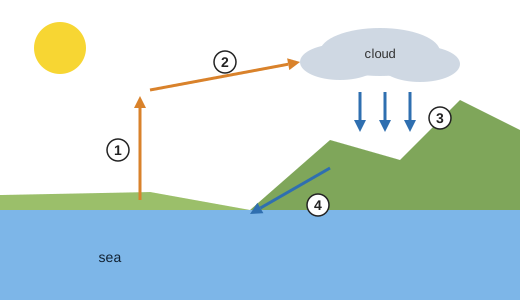
- The heat from the Sun makes water from soil, oceans, rivers and lakes evaporate into water vapour.
- Water vapour rises, cools and condenses into tiny water droplets that form clouds.
- Higher up, cold air makes the droplets join into bigger clouds. The clouds become heavy and the water falls as rain.
- Rainwater soaks into the ground and flows back to lakes, rivers and oceans. The cycle starts again.
Show answerHide answer
Pictures: Science Year 5 (DLP) textbook, pp. 177–198 (beach p. 178, Mr Ice story p. 184). The particle diagrams, state-change diagram, measuring cylinders and water cycle are drawn for this site.
Summary
| Idea | Remember |
|---|---|
| Matter | Has mass and occupies space; solid, liquid or gas |
| Solid | Fixed shape and volume; particles closely packed and orderly |
| Liquid | Fixed volume, no fixed shape; particles less packed |
| Gas | No fixed shape or volume; particles spread out |
| Gains heat | Melting, boiling, evaporation |
| Loses heat | Freezing, condensation |
| Water cycle | Evaporation then condensation, then rain; keeps the quantity of water on Earth the same |