Science questions, unit 8
Nama / NameKelas / ClassTarikh / Date
Matter
45 marks. Use Practice to check each answer as you go, or Exam to answer everything first. Ask a grown-up to help you mark the written answers.
Section A: objective questions
10 marksChoose the best answer for each question.
1
Question 1
Which of these is matter in the gas state?
Show answerHide answer
B
The wind is moving air, which is a gas. Sand and a paper clip are solids and seawater is a liquid.
2
Question 2
What is matter?
Show answerHide answer
C
Matter is any substance that has mass and occupies space. Solids, liquids and gases are all matter.
3
Question 3
Coloured water is poured from a beaker into a conical flask and then into a cup. Which property of the water does not change?
Show answerHide answer
A
A liquid has a fixed volume, so its volume stays the same. It has no fixed shape, so its shape changes to fit each container.
4
Question 4
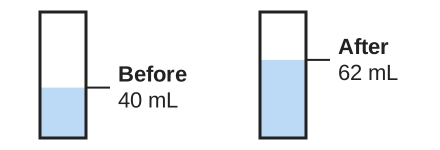
Diagram 1 shows the water level in a measuring cylinder before and after a small stone is put in. What is the volume of the stone?
Show answerHide answer
D
Volume of stone = 62 mL − 40 mL = 22 mL.
5
Question 5
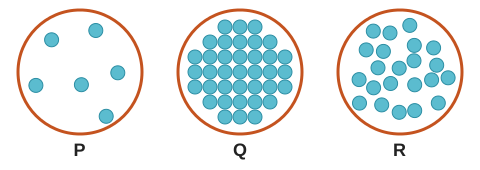
Diagram 2 shows the arrangement of particles of matter in three containers, P, Q and R. Which one shows a liquid?
Show answerHide answer
B
In a liquid the particles are less packed and not in an orderly way, as in R. P is a gas and Q is a solid.
6
Question 6
Ice cream changes into liquid in the hot sun. Which process is this?
Show answerHide answer
C
A solid that gains heat and becomes a liquid is melting.
7
Question 7
In which change does water lose heat to the surrounding?
Show answerHide answer
C
Melting, boiling and evaporation gain heat. Freezing and condensation lose heat. Of the four, only condensation is a loss.
8
Question 8
Wet clothes on a clothes line are dry after four hours. Which process makes the clothes dry?
Show answerHide answer
D
The water in the clothes gains heat from the surroundings and changes into water vapour. This is evaporation.
9
Question 9
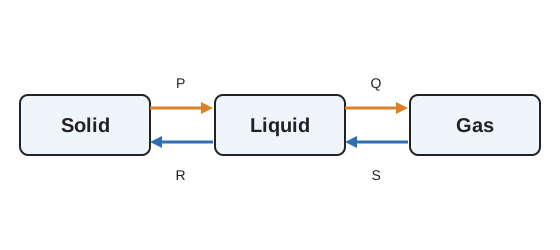
Diagram 3 shows the processes that change the state of matter of water. Ice cubes become water. Which letter shows this change?

Show answerHide answer
A
Ice is a solid and water is a liquid. Solid to liquid is arrow P, which is melting.
10
Question 10
Hana says, "Boiling and evaporation are the same because both change water into water vapour." Which statement is the best reply?
Show answerHide answer
B
Both processes change a liquid into a gas by gaining heat, but boiling happens at the boiling point only, 100 °C for water.
Section B: structured questions
35 marksAnswer all questions. Circle the answer or write it in the space.
11
Question 11
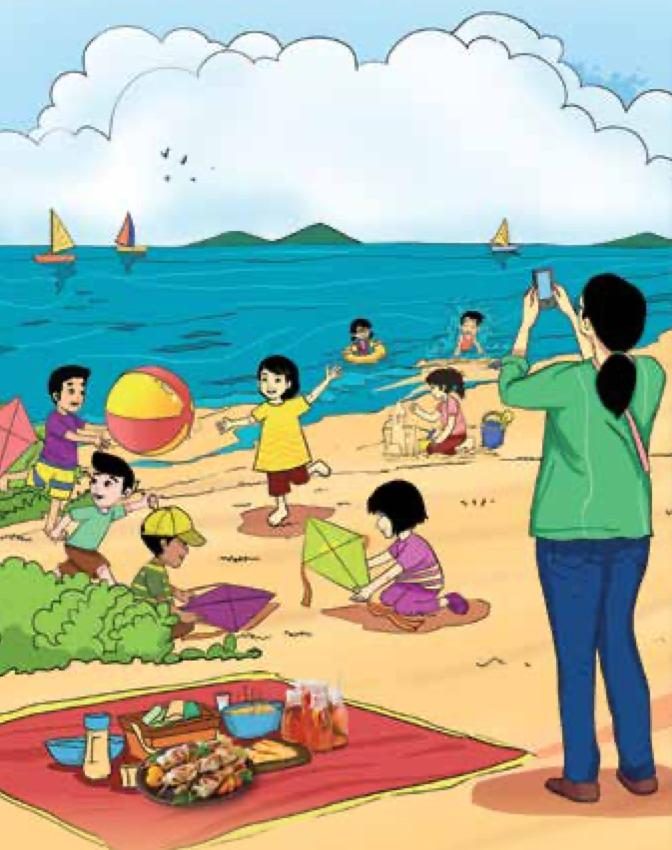
Diagram 4 shows children at the beach. Name the state of matter of each thing.
[1 mark]
(a)Sand
Show answerHide answer
Solid
[1 mark]
(b)Seawater
Show answerHide answer
Liquid
[1 mark]
(c)Wind
Show answerHide answer
Gas
12
Question 12
Solid, liquid and gas are the three states of matter.
[2 marks]
(a)State two properties that all three states of matter have in common.
Show answerHide answer
Tick each point you got.
[2 marks]
(b)Why can a liquid be poured into containers of different shapes but its volume stays the same?
Show answerHide answer
Tick each point you got.
13
Question 13
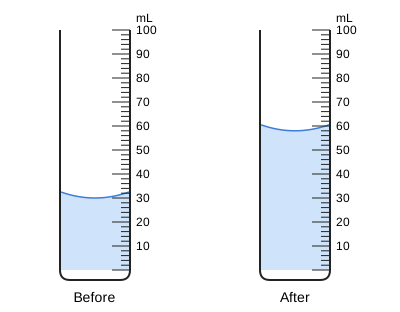
A pupil wants to find the volume of a small stone. Diagram 5 shows the water level before and after the stone is put in.
[2 marks]
(a)Calculate the volume of the stone.
Show answerHide answer
Tick each point you got.
[1 mark]
(b)The pupil presses the stone hard with her hand. Does its shape change?
Show answerHide answer
No
A solid has a fixed shape.
14
Question 14
Diagram 6 shows the arrangement of particles of matter in three containers, P, Q and R.
[1 mark]
(a)Which container shows a solid?
Show answerHide answer
Q
[1 mark]
(b)Which container shows a gas?
Show answerHide answer
P
[2 marks]
(c)Describe the arrangement of the particles in container R.
Show answerHide answer
Tick each point you got.
15
Question 15
Answer each question. For (a) to (c), choose the process involved in the situation.
[1 mark]
(a)Ice cubes in a glass of water become smaller.
Show answerHide answer
Melting
[1 mark]
(b)A wet floor becomes dry after 20 minutes.
Show answerHide answer
Evaporation
[1 mark]
(c)Dew forms on leaves in the morning.
Show answerHide answer
Condensation
[1 mark]
(d)Does the water gain or lose heat when it freezes?
Show answerHide answer
Loses heat
16
Question 16
Study Diagram 7.
[1 mark]
(a)Name the process P.
Show answerHide answer
Tick each point you got.
[1 mark]
(b)Does water gain or lose heat in process R?
Show answerHide answer
Loses heat
R is liquid to solid, which is freezing. Freezing loses heat.
[1 mark]
(c)Water vapour changes into water droplets on the outside of a cold glass. Which letter shows this?
Show answerHide answer
S
17
Question 17
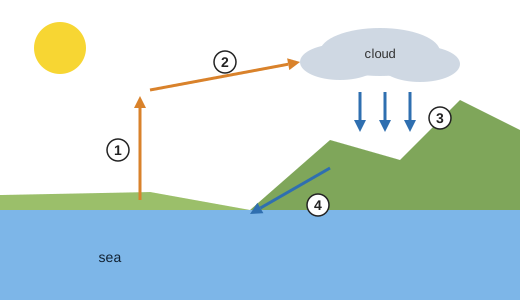
Diagram 8 shows the natural water cycle.
[1 mark]
(a)Name the process at 1.
Show answerHide answer
Tick each point you got.
[1 mark]
(b)Name the process at 2 that forms clouds.
Show answerHide answer
Tick each point you got.
[1 mark]
(c)Why does the water vapour change into water droplets at 2?
Show answerHide answer
Tick each point you got.
[1 mark]
(d)State one reason why the natural water cycle is important.
Show answerHide answer
Any 1 points
Tick each point you got.
18
Question 18
Fatimah does an activity called "raining in a glass container". She pours hot salt water into a glass container, puts a small clear plastic container in the middle, covers the top with plastic food wrap and puts ice cubes on top. After 10 minutes, water collects in the small plastic container.
[2 marks]
(a)Name the two processes involved.
Show answerHide answer
Tick each point you got.
[1 mark]
(b)What is the state of matter of the water that collects in the small plastic container?
Show answerHide answer
Liquid
[1 mark]
(c)Why are the ice cubes placed on top of the plastic wrap?
Show answerHide answer
Tick each point you got.
19
Question 19
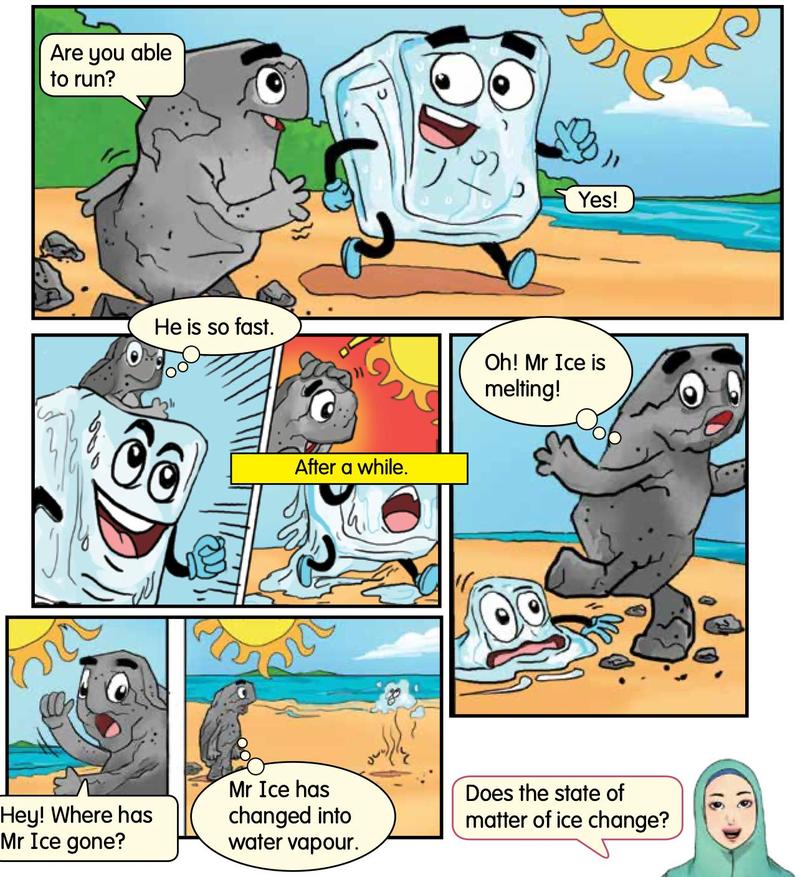
In the story of Mr Ice (Diagram 9), Mr Ice disappears under the hot sun. Mr Rock thinks Mr Ice has gone for ever.
[1 mark]
(a)Why did Mr Ice melt?
Show answerHide answer
Tick each point you got.
[1 mark]
(b)Name the process that changed the water into water vapour.
Show answerHide answer
Tick each point you got.
[1 mark]
(c)Is Mr Rock right that Mr Ice has gone for ever?
Show answerHide answer
No
The water vapour is still there in the air. It is the same matter in a different state.
20
Question 20
Zul wants to show that water vapour condenses into water. He has a glass, ice cubes and water.
[2 marks]
(a)Describe a simple activity he can do.
Show answerHide answer
Any 2 points
Tick each point you got.
[1 mark]
(b)What will he observe?
Show answerHide answer
Tick each point you got.