Life in the past
What this chapter coversMatlamat bab ini
- I can read the diary extracts of Samuel Pepys and use the pictures to understand what is happening (Reading)
- I can infer meaning and draw conclusions from a diary, and put events in order (Reading comprehension)
- I can make nouns from verbs by adding -er or -or, for example paint - painter (Working with words)
- I can use used to and didn't use to to talk about past habits and situations (Grammar)
- I can ask and answer questions with used to, for example Where did you use to live? (Language in use)
- I can listen for specific information, such as numbers and facts, in a talk about an old school (Listening)
- I can write an informal diary entry with exclamation marks, sounds, block capitals and informal words (Writing)
- I can give a short talk about life in the future and ask a speaker to clarify (Speaking)
Unit 2 is about life in the past. You read extracts from a famous diary written in 1666, learn to make nouns from verbs, and use used to and didn't use to to talk about things that were true in the past but are not true now. The unit ends with Review 1 (Units 1 and 2).
2.1Reading: a diary from 1666 (pp. 22-23)
Lesson 1 shows pictures and diary entries. In 1666 Samuel Pepys, a writer and government administrator in Great Britain, wrote a famous diary. The task asks you to look at the pictures first and guess when the man wrote his diary (two years ago, fifty years ago, or more than 350 years ago), then to say what is happening in each picture. The reading skill is use pictures to help understanding.
Academy Stars Year 6 Pupil's Book, pp.22-23.
| Word | Meaning (from the context) |
|---|---|
| servant | a person who works in a house for a rich person, for example making the fire |
| freezing | extremely cold |
| portrait | a painting of a person |
| possessions | the things that belong to you |
| bury / buried, dig / dug | to put something in the ground and cover it / to make a hole in the ground |
| burn down | to be destroyed by fire |
| soldier | a person in an army (here, men trying to stop the fire) |
Words from Academy Stars Year 6 Pupil's Book, p.22; meanings written for this site.
What the diary says (my summary)
| Date | Main idea |
|---|---|
| Monday, 22nd January | Ice on the inside of the windows. Servants made a fire, but Samuel wore three jackets and was still freezing. He needed two candles to write. |
| Wednesday, 7th February | Most people have no clock or watch because they are very expensive. The night watchman shouted the time. Samuel bought his very first watch. |
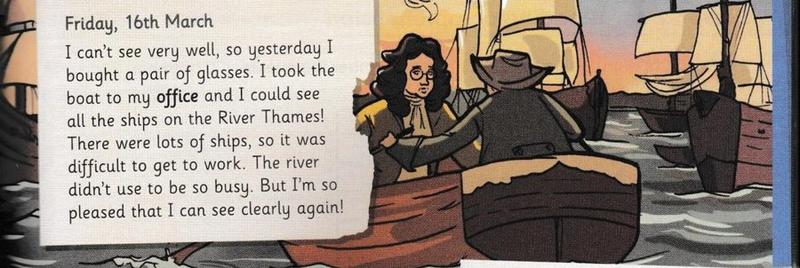
| Friday, 16th March | He bought glasses, went to his office by boat and saw all the ships on the River Thames. |
| Friday, 15th June | He bought Elisabeth an expensive necklace. An artist, Mr Hales, came to paint her portrait. |
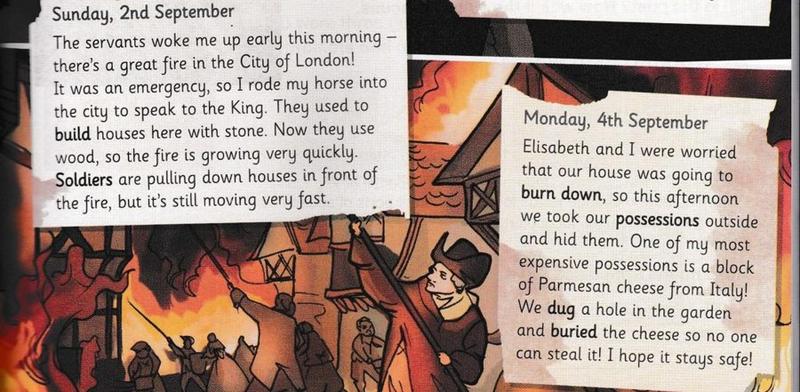
| Sunday, 2nd September | A great fire in the City of London. Samuel rode a horse to speak to the King. Soldiers pulled down houses. |
| Monday, 4th September | He and Elisabeth took their possessions outside and buried a valuable block of cheese in the garden. |
Summary of Academy Stars Year 6 Pupil's Book, pp.22-23 (adapted by the book from The Diary of Samuel Pepys).
Textbook figure: Academy Stars Year 6 Pupil's Book, p.23.
Textbook figure: Academy Stars Year 6 Pupil's Book, p.23.
Show answerHide answer
2.2Reading comprehension: infer and conclude (p. 24)
Lesson 2 asks you to number the events of Samuel's life in order (for example, the fire in London, burying the cheese, the artist painting a portrait, buying the first watch). The first event is when Samuel had to wear three jackets (the January entry), and then you follow the dates in the diary.
Academy Stars Year 6 Pupil's Book, p.24.
The Be a star task asks you to work out answers that the diary does not say directly. This is called inferring: use clues plus what you know.
| Question type | Clue in the diary | Inference |
|---|---|---|
| Why didn't Samuel know the time when he woke up? | "Most people haven't got a clock or a watch" | He had no clock in the house. |
| Why was he able to see the ships? | He had just bought glasses. | Glasses helped him see clearly. |
| Why did the fire grow so quickly? | "They used to build houses here with stone. Now they use wood." | Wood burns easily. |
| Why did they bury the cheese? | "... so no one can steal it" | It was valuable, and they wanted it safe from the fire and thieves. |
Questions adapted from Academy Stars Year 6 Pupil's Book, p.24; the inferences are written for this site.
The last discussion question is "How do you think life was different in the past? How was it the same?" Use sentences like: "In the past, people didn't have clocks, but they still needed to know the time."
Show answerHide answer
2.3Working with words: make nouns from verbs (p. 24)
Academy Stars Year 6 Pupil's Book, p.24.
| Verb | Noun (the person) | Note |
|---|---|---|
| paint | painter | book's example |
| direct | director | book's example |
| act | actor | book's example (the first item in the exercise) |
| farm | farmer | original example |
| swim | swimmer | original: double the m |
| collect | collector | original |
| explore | explorer | original: the verb already ends in e, so add only -r |
Show answerHide answer
2.4Grammar: used to (p. 25)
Textbook figure: Academy Stars Year 6 Pupil's Book, p.25.
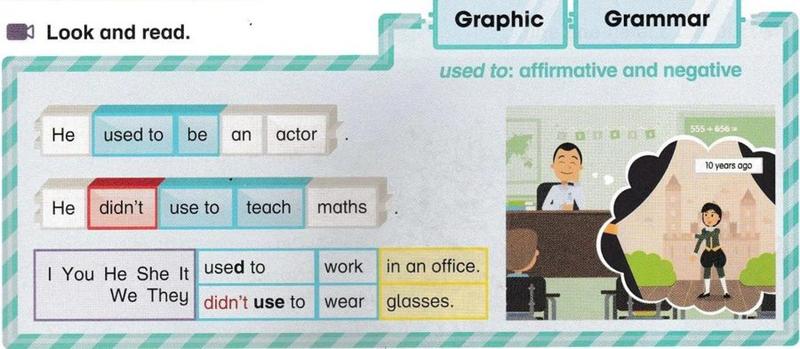
| Form | Pattern | Example |
|---|---|---|
| Affirmative | subject + used to + base verb | He used to be an actor. (book) |
| Negative | subject + didn't use to + base verb | He didn't use to teach maths. (book) |
| Question | Did + subject + use to + base verb? | Did you use to have servants? (book, p. 26) |
Academy Stars Year 6 Pupil's Book, pp.25-26. The same form is used with I, you, he, she, it, we and they.
Rules to remember
- used to has no -s: "She used to work in an office", not "uses to".
- After didn't and did, the word used loses its d: didn't use to, Did you use to. The past is already shown by did.
- The verb after to is the base form: "used to wear", not "used to wore".
- Used to is only for the past. For the present we use the present simple: "I live in a flat now."
The book's sample sentences about Samuel Pepys show the pattern: he used to have servants who made a fire; people didn't use to have electricity, so Samuel lit candles; and, because people didn't use to have cars, Samuel used to travel to his office by boat. In the diary itself: "They used to build houses here with stone" and "The river didn't use to be so busy" (p. 23).
Based on Academy Stars Year 6 Pupil's Book, p.23 and p.25 (the text-completion activity on p. 25 describes life in Samuel's time).
My grandmother didn't use to have a mobile phone.
Did your school use to have a canteen?
Activity 3 on p. 25 asks you to talk about when you were three years old, using prompts such as "play / with toys", "not / go / to school", "mum / read / to me", "go / to bed very early" and "not / choose / my own clothes". The model answer is "I used to play with toys when I was little."
Academy Stars Year 6 Pupil's Book, p.25.
Show answerHide answer
Show answerHide answer
2.5Language in use: questions with used to (p. 26)
In the dialogue on p. 26, a boy asks his grandfather questions about when he was little. The new words are calculator, carpet, cottage, history, vacuum. Here are some of the question patterns and answers (shortened):
| Question | Answer |
|---|---|
| Where did you use to live? | I used to live in a cottage in the countryside. |
| Did you use to have servants? | No, we didn't. I used to help with the chores. |
| Did you use to study maths at school? | Yes, I did. ... We didn't use to have calculators. |
Quoted from Academy Stars Year 6 Pupil's Book, p.26 (the listening and speaking dialogue, track 1.10).
Activity 2 asks you to make a new dialogue by replacing the underlined words with the phrases flat in the city, dust and wash up, history, find information in the library and the internet. Activity 3 asks you to write questions about the past, for example "where / live" becomes "Where did you use to live?", then to add two of your own and ask a partner (Activity 4).
Academy Stars Year 6 Pupil's Book, p.26.
B: I used to go to the market with my father.
A: Did you use to take a bus?
B: No, I didn't. We used to walk.
Show answerHide answer
2.6Listening: an old school (p. 27)
Lesson 5 shows a photo of an old classroom and a vocabulary panel (guide, ink, kilometre, oil lamp, in those days). You listen to a guide and tick how this school is different from many modern schools. The ideas to tick or not tick are: one classroom, pupils the same age, travel by bus, no electricity, light from lamps, no heating, very cold, no computers. Then you circle correct words (for example whether children used oil lamps or torches for light, and what they used to write with). Listening skill: listen for specific information.
Academy Stars Year 6 Pupil's Book, p.27. The audio (track 1.11) is not printed here, so only the tasks are described.
The Values box asks: "What can we learn from studying the past?" Think about how people solved problems with simpler tools, and how we can appreciate what we have today. After listening, compare the old classroom with your own classroom: two ways it is different, and one way it is similar.
Show answerHide answer
2.7Writing: a diary entry (pp. 28-29)
First you look again at Samuel's diary and answer: What did he always write first? (the date, with the day), who did he write about, and what did he write about? The book gives a list to tick (events, feelings, opinions, shopping, stories, family and friends): look at the entries and decide which ones the diary really shows. Then you read Gemma's diary entry and decide whether diaries are formal or informal.
Academy Stars Year 6 Pupil's Book, p.28.
Gemma's entry for Friday, 26th May is about a school trip to the zoo. It is informal: she writes as if she is talking to a friend. Compare a plain sentence with the way Gemma writes the same idea:
| Plain sentence (the book's prompt) | Diary style (Gemma) |
|---|---|
| Today was difficult. | What a day!! |
| I didn't remember we had a trip. | (I forgot!) |
| Snakes are horrible. | Yuck! I HATE snakes! |
| Mum told me to do my homework. | Mum shouted, "GEMMA, HOMEWORK!" |
Quoted from Academy Stars Year 6 Pupil's Book, pp.28-29 (Gemma's diary entry).
Note that Gemma also uses used to: "she used to be my favourite teacher" and "we didn't use to get so much homework".
How to plan and write your own entry
Activity 5 asks you to make notes about a school trip: day and date, where you went, who with, what you did, the best thing about the day, how you felt, and what you thought about people and events. Then you write a diary entry together, starting "Yesterday was awesome!! We went on a school trip to ...". Use some informal features from the box above.
Academy Stars Year 6 Pupil's Book, p.29.
What a morning!! We went to the beach with Aunty Siti. The waves were HUGE! Splash! My little cousin got wet from head to toe. Ha! Ha! Best day ever!
Show answerHide answer
Learning to learn: memorise new vocabulary (p. 29)
Learn a small number of new words (about eight) and repeat them regularly. This is easier than trying to learn 25 words at the same time.
- Write the words on labels and stick them on your wall so you see them every day.
- Record the words and play them back.
- Write sentences with the words. Practise saying the sentences to a friend.
Academy Stars Year 6 Pupil's Book, p.29.
2.8Speaking, and Think about it! (pp. 30-31)
Speaking: give a talk, clarify information (p. 30)
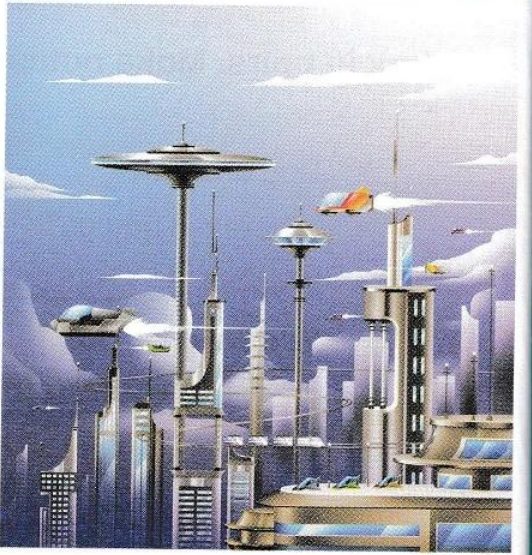
The book asks you to imagine it is the year 2120 and discuss how life will be different. The topics are shopping, transport, food, entertainment, clothes, communication and chores. The sample answer is "There won't be any shops. People will do all their shopping online." Then you act out a dialogue: Student A is a guide in a history museum in 2120 who gives a talk about life in the 21st century. Student B listens and asks questions.
Academy Stars Year 6 Pupil's Book, p.30.
Textbook figure: Academy Stars Year 6 Pupil's Book, p.30.
| The guide says | The listener says (to clarify) |
|---|---|
| Welcome to ... I'm going to talk about ... In those days, ... Another interesting thing is that ... | Could you repeat that, please? What do you mean by ... ? Can I check something, please? |
Phrases from Academy Stars Year 6 Pupil's Book, p.30.
Joe's model starts: "Welcome to the History Museum ... In those days, people used to buy things in shops." Notice how used to describes the 21st century from the point of view of 2120. The last discussion is "In 2120, what things about life now will seem strange?" Model answer: "Libraries will seem strange because people will read electronic books."
Think about it! In the wrong time (p. 31)
The thinking skills are analyse and evaluate information. You read a text about Mr Brockbank, a man who lived 300 years ago. Six things in the text are from the wrong time (the lamp is already underlined for you as an example). Then you cross the pictured things that people did not have 300 years ago (for example a book, a bus, a horse, a mobile phone, a vacuum cleaner and a candle) and write four more. Finally you rewrite the text so it fits, starting "It was dark when Mr Brockbank woke up, so he needed a candle ...".
Academy Stars Year 6 Pupil's Book, p.31.
Show answerHide answer
2.9Review 1 (pp. 32-33)
Review 1 revises Units 1 and 2. It has five parts:
| Activity | What you do | Skill |
|---|---|---|
| 1 | Write the correct word for each definition (ambulance, bury, electricity, emergency, freezing, possessions) | Vocabulary |
| 2 | Complete a text about a school play using the correct past forms (past continuous and past simple) | Unit 1 grammar |
| 3 | Ask and answer in pairs about what Bill and Anna used to do (live in a cottage, work in an office, paint portraits, write with pen and ink ...) | used to |
| 4 | Circle the correct words (excited/exciting, actor/action, builder/building ...) | -ed/-ing adjectives and nouns from verbs |
| 5 | Read a story about a hotel power cut and choose a word from a box for each gap, then choose the best title | Reading and Writing, Part 3 |
Academy Stars Year 6 Pupil's Book, pp.32-33.
Tips for the review
- Past continuous with past simple: the longer action uses was/were + -ing; the shorter, interrupting action uses the past simple. "We were singing when the alarm rang." ("while" goes with the longer action.)
- Adjectives: -ed adjectives say how a person feels (excited, frightened, embarrassed); -ing adjectives describe the thing or event that causes the feeling (exciting, frightening, embarrassing).
- Nouns from verbs: actor, builder, painter. Use the meaning: "a good ______" (a person).
- used to: think about what is true then but not now. Use used to for a tick and didn't use to for a cross.
- Gap-fill story: read the whole story first, decide whether each gap needs a noun, verb or joining word, then pick the word that fits the meaning.
An easy way to prepare for Activity 3: pretend you are Bill. If Bill used to live in a cottage you say "He used to live in a cottage." If a cross is shown for working in an office you say "He didn't use to work in an office."
Show answerHide answer
Summary
| Topic | Remember |
|---|---|
| Reading | Use pictures and context to understand a diary; infer meaning and draw conclusions. |
| Nouns from verbs | add -er or -or: paint - painter, direct - director; explore - explorer. |
| used to | He used to be an actor. He didn't use to teach maths. Did you use to have servants? |
| After did / didn't | use to (no -d). |
| Listening | Listen for specific information (numbers, facts). |
| Diary writing | informal: !, sounds, block capitals, informal words. |
| Speaking | Give a talk, and clarify: "Could you repeat that, please?" |
| Learning skill | Learn about eight new words at a time and repeat them. |