Adventure time
What this chapter coversMatlamat bab ini
- I can read a photo blog, use predictions and context clues to understand adventure words, and tell a fact from an opinion
- I can use the present perfect (have / has + past participle, including irregular ones such as gone, seen, flown and swum) and never to talk about experiences up to now
- I can ask and answer questions with ever, such as "Have you ever been camping?" "Yes, I have." / "No, I haven't."
- I can listen for similarities and differences between two sets of facts, for example at work and at home
- I can plan with a mind map and write a short, friendly blog entry with a date, an opening, my experience, my feelings and a finish
- I can conduct an interview, ask about likes and experience, and show interest with Really? and Wow! That's interesting!
- I can compare people against an advert and use logical reasoning to decide who gets a job
- I can read the adventure story Mystery on the beach, put events in order and give a personal response
Unit 3 is about adventure. You read a photo blog from Canada, learn the present perfect to talk about experiences, ask "Have you ever ...?", plan and write a blog entry, run an interview, decide who gets a job and finish with the adventure story Mystery on the beach.
3.1Reading: Emma's photo blog
Emma lives in Vancouver, Canada, and writes a blog about her adventures. Before you read, make predictions: look at the photos and the title and guess what the text will be about. Then read quickly to check your guesses (this is the Reading skill on p.35).
| Date | What Emma writes about |
|---|---|
| 5th January | She welcomes readers. Canada has the sea, mountains, forests and lots of wildlife. |
| 10th January | She goes skiing with her family at Whistler ski resort. Her favourite ski run is the Ice Monster. |
| 12th June | Kayaking in Ottawa: a kayak is much smaller than a canoe and the paddle has two blades. After three hours of practice with an instructor, they travel down the Madawaska River. |
| 18th August | A hot-air balloon festival near Montreal with over 200 balloons. The flame is "really loud" and hot, so balloons are not quiet. |
| 1st September | Her 15th birthday: the Edge Walk around the top of the CN Tower in Toronto (553 metres high, and they were 350 metres above the ground). |
Academy Stars Year 6 Pupil's Book, pp.34-35.
Key sentences to notice:
- "Have you ever seen a big brown bear?" (a question with ever)
- "I've never travelled in a hot-air balloon or visited Toronto before." (never)
- "It's the most exciting experience I've ever had!" (a superlative with ever)
Academy Stars Year 6 Pupil's Book, pp.34-35.
Vocabulary from the blog
The vocabulary panel lists: flame, hot-air balloon, instructor, kayaking, landscape, paddle, scenery, skiing, view, wildlife. The book asks you to use the context (the words around a new word) to work out the meaning.
| Word | Meaning (in the blog) |
|---|---|
| landscape / scenery / view | what you can see in a place: mountains, sea, forests, hills |
| wildlife | wild animals and plants, such as bears |
| instructor | a person who teaches you an activity and shows you how to be safe |
| paddle | the pole with a flat blade that moves a kayak or canoe through the water |
| flame | the hot, bright part of a fire that heats a balloon |
Academy Stars Year 6 Pupil's Book, p.34 (vocabulary panel); the meanings are written in my own words.
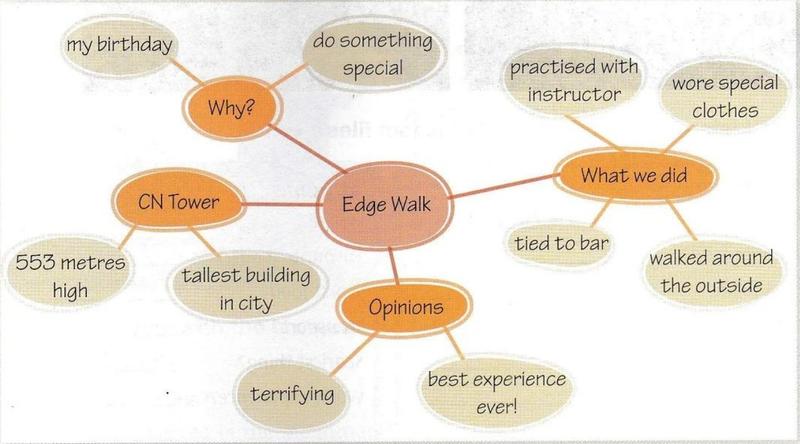
Textbook figure: Academy Stars Year 6 Pupil's Book, p.40.
Show answerHide answer
3.2Reading comprehension: fact or opinion?
The comprehension page (p.36) asks you to finish sentences with because and then decide whether a sentence is a fact or an opinion.
| Sentence | Fact or opinion? | Why |
|---|---|---|
| Whistler is a ski resort near Vancouver. | Fact | You can check it on a map. |
| Canada is the perfect place for sport and adventure. | Opinion | "Perfect" is what Emma thinks. |
| The CN Tower is 553 metres high. | Fact | It is a measurement. |
Academy Stars Year 6 Pupil's Book, pp.34-36 (sentences from the blog and the comprehension page).
Show answerHide answer
3.3Working with words: irregular past participles
A past participle is the verb form used after have / has. Regular verbs add -ed (visit, visited, visited). Some irregular verbs have a past participle that is different from the past simple. Keep a list in your notebook.
| Verb | Past simple | Past participle |
|---|---|---|
| go | went | gone |
| see | saw | seen |
| fly | flew | flown |
| write | wrote | written |
| swim | swam | swum |
| sleep | slept | slept (the same) |
| meet | met | met (the same) |
| hear | heard | heard (the same) |
| have | had | had (the same) |
Academy Stars Year 6 Pupil's Book, p.36 (go and see in the notebook box; the other verbs come from the practice paragraph "I've flown to lots of different countries ...").
More verbs to add to your list (original examples): do, did, done; take, took, taken; eat, ate, eaten; ride, rode, ridden.
Show answerHide answer
3.4Grammar: present perfect (affirmative and never)
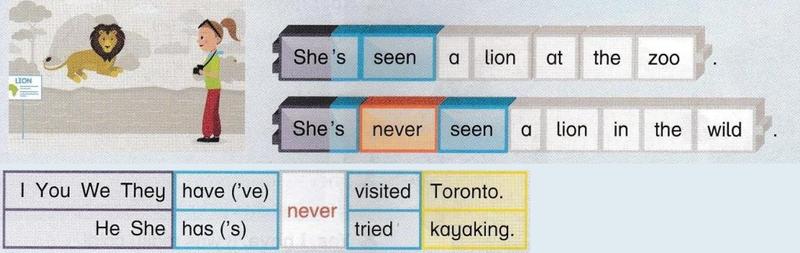
Textbook figure: Academy Stars Year 6 Pupil's Book, p.37.
| Subject | have / has | (never) | past participle | Example |
|---|---|---|---|---|
| I, you, we, they | have ('ve) | never | visited, tried | I've never visited Toronto. |
| he, she, it | has ('s) | never | visited, tried | She's never tried kayaking. |
Academy Stars Year 6 Pupil's Book, p.37 (sentences and table). The example in the second row is made from the table's words.
- Affirmative: "She's seen a lion at the zoo." (She has seen one, at some time in her life.)
- With never: "She's never seen a lion in the wild." (never goes between has / have and the past participle.)
- The page also shows a class sentence: "I've tried skiing, but I've never swum in the sea."
Academy Stars Year 6 Pupil's Book, p.37.
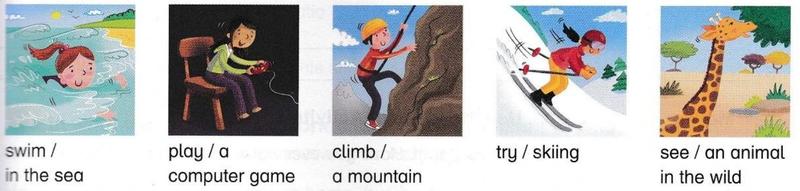
Textbook figure: Academy Stars Year 6 Pupil's Book, p.37.
Present perfect or past simple?
| Present perfect (experience, no time) | Past simple (finished time stated) |
|---|---|
| I've visited Penang. | I visited Penang last year. |
| She's tried kayaking. | She tried kayaking in June. |
The examples above are original. In the blog, Emma first uses the past simple with a time ("We went to a kayak school in Ottawa") and the present perfect for her whole life ("It's the most exciting experience I've ever had!").
Show answerHide answer
3.5Language in use: present perfect with ever
The Woodlands Camp dialogue (p.38) has a camp leader asking Alice about her first camping trip. Words in the panel: camp, compass, put up (a tent), rucksack, sleeping bag. Some lines from it:
Academy Stars Year 6 Pupil's Book, p.38 (shortened).
| Question | Short answers |
|---|---|
| Have you ever put up a tent? | Yes, I have. / No, I haven't. |
| Has she ever made a fire? (original) | Yes, she has. / No, she hasn't. |
Academy Stars Year 6 Pupil's Book, p.38 (first question); the second is original.
On p.38 you also write questions from prompts, such as walk / in the mountains becoming "Have you ever walked in the mountains?", and make a new dialogue with a partner.
Show answerHide answer
3.6Listening: similarities and differences
On p.39 you look at two photos (a man in a forest and a long red road across dry land) and ask: Where is the man? What is he doing? You then listen to an interview with an explorer called Mike. There are no printed audio scripts, so here is what the tasks ask you to do.
- Words in the panel: bite (bit), delicious, explorer, horrible, mosquito, strange.
- Task 1: check your guesses about the photos while you listen.
- Task 2: fill in two fact files, "At work" and "At home", with the same six headings: Where? Favourite food? Worst food? Transport? Scariest thing? Worst experience?
- Task 3: write T (true) or F (false) for four statements, then listen again to check.
- Task 4: say how Mike's work and home life are similar and different.
Academy Stars Year 6 Pupil's Book, p.39.
The book gives a model answer: "He eats fish in the Amazon and at home, but he doesn't catch fish at home." Notice the pattern: say the similarity, then use but for the difference. The Values box asks: What can you learn from travelling to new places?
Academy Stars Year 6 Pupil's Book, p.39.
Show answerHide answer
3.7Writing: plan with a mind map, write a blog entry
The Learning to learn box says: use a mind map to plan. Look back at Emma's mind map in 3.1.
- Write the topic in the middle of the page.
- Draw lines to ideas about it and write them at the ends (Why? What we did? Opinions?).
- Add more information to each idea.
Academy Stars Year 6 Pupil's Book, p.40.
Features of a blog
Tick the things that are true for a blog (p.40). A blog is written in date order, uses "I" and "we", has a friendly, informal style, includes the writer's feelings and opinions, and describes places and experiences. It is not private (anyone can read it) and not formal.
Academy Stars Year 6 Pupil's Book, p.40 (the six statements are checked against Emma's blog on pp.34-35).
The writing guide (p.41)
| Part | What to do |
|---|---|
| Start | Write the date (day, month and year). |
| Opening | Introduce yourself and welcome readers to your blog. |
| Main section | Use your mind map to write about your experience. Keep it short: do not include information that is not interesting or exciting. Describe your feelings and opinions. |
| Finish | Write something friendly so readers want to come back. |
Academy Stars Year 6 Pupil's Book, p.41.
The task on p.41 is to complete a mind map from three pictures about swimming with dolphins (branches: Why? Dolphins, What we did, Opinions) and then write the entry. Here is an original model on a different topic.
Today I went to a jungle park with my class. We walked across a rope bridge and I held on tightly. It was frightening, but I loved the view of the trees. I've never been so high before. It was the best school trip ever! Come back soon for my next adventure.
Show answerHide answer
3.8Speaking: conduct an interview
On p.42 an interviewer talks to a young person who wants a job at Treetops Adventure Camp. The words in the panel are: act, coach, first aid. The form has two sections:
| Section | Question pattern | Ideas on the form |
|---|---|---|
| 1 Likes and dislikes | Do you like ...? | swimming, doing sport, cooking, painting and drawing |
| 2 Experience | Have you ever ...? | been kayaking, coached a sport, acted in a play, learnt first aid |
Academy Stars Year 6 Pupil's Book, p.42.
- Student A (interviewer): ask the questions, add one more to each section, complete the form and show interest.
- Student B (job seeker): answer and give as much information as possible.
B: Yes, I do. I go swimming three times a week. I've won lots of races ...
Academy Stars Year 6 Pupil's Book, p.42.
Show answerHide answer
3.9Think about it! Decide who gets the job
The thinking skill is reaching a decision through logical reasoning (p.43). You read an advert, look at three candidates (Marco, Janice and Elisha), listen to their interviews, complete notes and then decide.
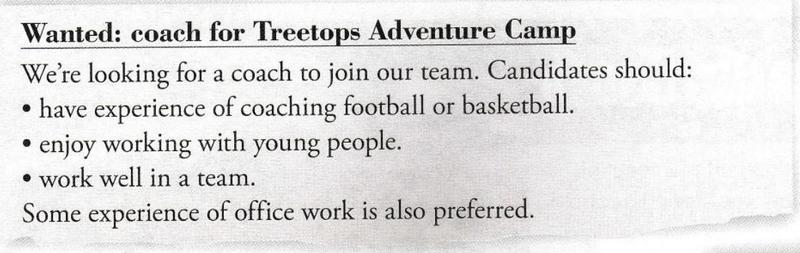
Textbook figure: Academy Stars Year 6 Pupil's Book, p.43.
| Candidates should ... | Kind of requirement |
|---|---|
| have experience of coaching football or basketball | main (essential) |
| enjoy working with young people | main |
| work well in a team | main |
| have some experience of office work | "also preferred": a bonus, not essential |
Academy Stars Year 6 Pupil's Book, p.43 (the kind-of-requirement column is my explanation).
The notes you complete use the present perfect for experience: Marco "has stayed at Treetops", "has worked in an office" and "has organised university events"; Janice "has coached" and "hasn't worked in an office", and "really likes children"; Elisha "coaches basketball" and "is studying to be a teacher". The other gaps come from the audio.
Academy Stars Year 6 Pupil's Book, p.43.
How to reason to a decision
- List the must-haves (main requirements) and the extras (preferred).
- Make a table: one row for each requirement, one column for each person.
- Mark each box with a tick, a cross or a question mark (not enough information).
- Choose the person who meets the most must-haves first. Use the extras only if two people are equal.
- Give your reason: "I think ____ should get the job because ____."
Show answerHide answer
3.10Reading time 2: Mystery on the beach
This adventure story is on pp.44-46. The activities are on p.47. It is a story, so look for the setting, characters, problem and ending. Before you read, the book asks: Where were April and Sandy? Who were the three men?
Summary in order (my words)
- Setting. April lives on a small island off the coast of Africa. Her cousin Sandy is visiting from Australia. One evening they follow a rocky path down to the beach.
- They see kayaks. April asks, "Have you ever been kayaking?" and Sandy says, "No, I haven't ... I've never tried kayaking." April tells him about the island: lovely beaches, houses, palaces and gardens, and its history as an important trading route. The food is a mixture of cultures (Portuguese, Indian and Chinese).
- Suddenly they hear voices and see a small boat arrive with three men. The men look around "to make sure that they were alone", take two spades and start digging.
- Sandy thinks they might be traders. April says "not in the 21st century" and guesses smuggling gold or silver. She realises what they are doing and says they must call the police. There is no phone signal, so they go back up the hill to the road.
- Two hours later the police arrive. The three men are the Turtle Gang.
- Solution. Hawksbill turtles come back to the beaches every two or three years to dig nests and lay eggs. The villagers protect the nests, but the eggs are valuable, so the gang was stealing them. "Thanks to you two, the turtle eggs are safe."
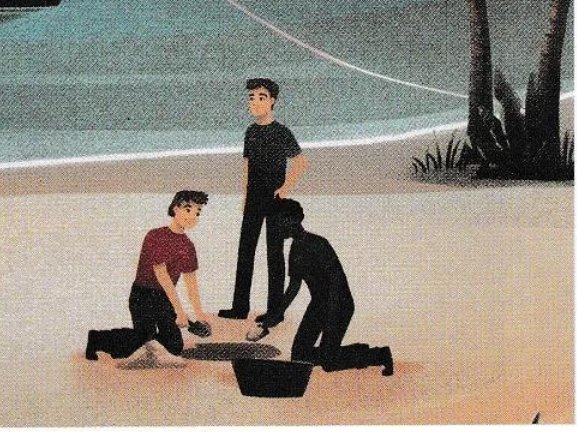
Textbook figure: Academy Stars Year 6 Pupil's Book, p.47 (illustration also on p.45). Story summarised from pp.44-46.
Useful words
| Word | Meaning here |
|---|---|
| trading route | a way people travelled to buy and sell goods |
| smuggle | to take things secretly and illegally from one place to another |
| spade | a tool for digging |
| signal | the connection a mobile phone needs to make a call |
| valuable | worth a lot of money |
| nest | a place where an animal lays eggs |
Academy Stars Year 6 Pupil's Book, pp.44-46 (words from the story; the meanings are written in my own words).
Reading time 2 activities (p.47)
- List everything you can see in the pictures on pp.44-46 (the model starts "compass, hot air-balloon ...").
- Choose the correct words to complete facts about the story.
- Number eight events in order.
- Discuss: What does Sandy learn about the island? What information did you find most interesting? Would you like to visit the island?
- Watch the video for a different ending (not available in this study site: invent your own ending instead).
Academy Stars Year 6 Pupil's Book, p.47.
Show answerHide answer
3.11Quick recap
- Present perfect = have / has + past participle: "She's seen a lion at the zoo." With never: "She's never seen a lion in the wild."
- Questions: "Have you ever ...?" Answers: "Yes, I have." / "No, I haven't."
- Irregular participles: gone, seen, flown, written, swum.
- Reading: make predictions, use context, tell fact from opinion.
- Blog entry: date, opening, main section (mind map), feelings and opinions, friendly finish.
- Interview: "Do you like ...?", "Have you ever ...?", then "Really?" and "Can you tell me more about ...?"
- Reading time 2: the Turtle Gang stole hawksbill turtle eggs; April and Sandy called the police.
Review 2 comes after Unit 4 in the book, so it is not part of this chapter.