Cool jobs
What this chapter coversMatlamat bab ini
- I can read a magazine article about unusual jobs and use the context to work out words such as challenging, rewarding and energetic
- I can scan a text for specific information, such as how long a person has done a job and why they chose it
- I can ask questions with How long ... ? and the present perfect, and answer with for (a period of time) or since (a moment in the past)
- I can use already and yet with the present perfect to say what has and has not been done
- I can listen for the order of steps in a process and answer questions about a radio programme
- I can write an article about a person's job from my interview notes, in paragraphs, and check my grammar, spelling and punctuation
- I can use make and do in common phrases such as make a poster and do the cleaning
- I can apologise politely, make offers and accept offers in a dialogue
- I can use a Caesar code to code and decode a secret message
Welcome to Unit 4. You will read an article about four unusual jobs, scan a text for facts, ask and answer questions with How long, for and since, use already and yet, listen for the order of steps, write an article, practise make and do, be polite in a dialogue and crack a secret code. The last part revises Units 3 and 4 (Review 2).
4.1Reading: Unusual jobs
The magazine article asks: "Have you ever thought about what job you'd like to do?" It talked to four people with unusual jobs and asked why they chose the job and what they like most about it.
| Person and job | What the job is | Why they chose it | What they like most |
|---|---|---|---|
| Adela Campo, search and rescue pilot | flies a helicopter to look for and save people in difficult situations | she loves flying and it is rewarding to help people and keep them safe | working as part of a team |
| Tyler Hadden, police officer | rides a horse called Bess instead of driving a police car | he loves horses and every day is different | meeting new people |
| Jill Johnson, wildlife vet | looks after wild animals in South Africa and makes sure they are healthy | it is exciting, with something new and challenging every day | every animal teaches something different |
| Derek Chatham, gardener | looks after very tall plants at an adventure safari park in Britain, now using stilts | he has always been interested in plants and never wanted to work in an office | working outside in the fresh air |
Academy Stars Year 6 Pupil's Book, pp.48-49 (summary in my own words).
Vocabulary panel
| Word | Meaning |
|---|---|
| challenging | difficult in a way that makes you try hard |
| clever | quick at learning and understanding |
| energetic | full of energy, always active |
| gardener | a person who looks after plants and gardens |
| interested in | wanting to know or do more about something |
| pilot | a person who flies a plane or helicopter |
| rewarding | giving you a good feeling because the work is worth doing |
| safe | not in danger |
| vet | a doctor for animals |
| university | a place where people study after school |
Word list: Academy Stars Year 6 Pupil's Book, p.48. Meanings written for this site.
Show answerHide answer
4.2Reading comprehension: scan for information
The book's example question is "Which animal did Jill Johnson help last week?". The key words are Jill, last week and animal. Look for Jill's text, then for "last week": you find a baby elephant stuck in the mud.
Academy Stars Year 6 Pupil's Book, p.50 (Learning to learn).
Tyler: for eight years
Jill: since she left university
Derek: since 2001
Academy Stars Year 6 Pupil's Book, pp.48-50.
Show answerHide answer
4.3Grammar: present perfect with How long?, for and since
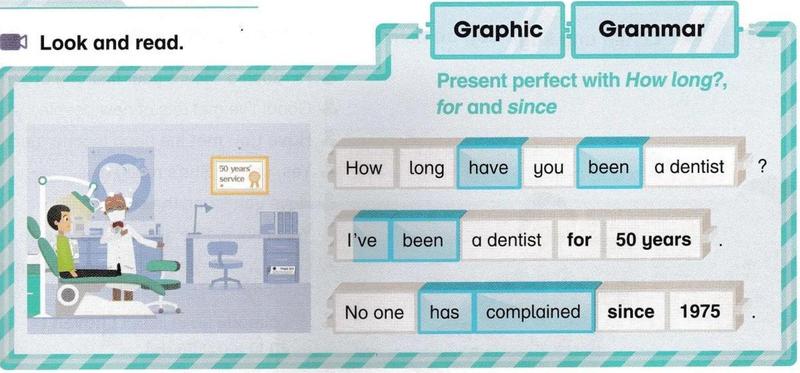
Textbook figure: Academy Stars Year 6 Pupil's Book, p.51.
| Pattern | Example |
|---|---|
| Question: How long + have / has + subject + past participle? | How long have you been a dentist? (book) |
| Answer with for + a period of time | I've been a dentist for 50 years. (book) |
| Answer with since + a moment in the past | No one has complained since 1975. (book) |
Academy Stars Year 6 Pupil's Book, p.51.
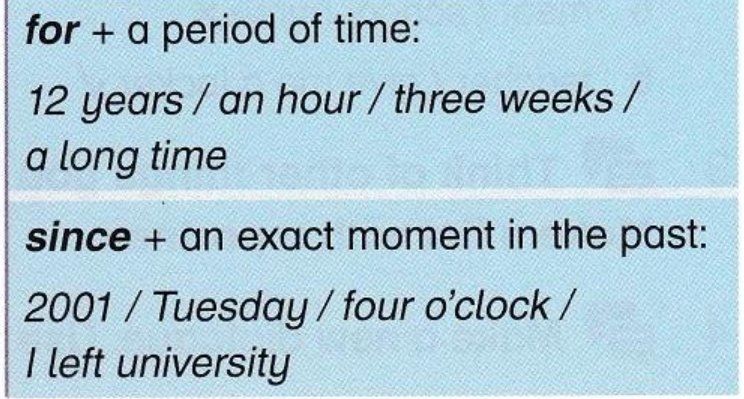
Textbook figure: Academy Stars Year 6 Pupil's Book, p.51.
| Use | For | Examples |
|---|---|---|
| for | a period of time (how long) | 12 years / an hour / three weeks / a long time |
| since | an exact moment in the past (when it began) | 2001 / Tuesday / four o'clock / I left university |
Academy Stars Year 6 Pupil's Book, p.51.
He has taught at this school since 2018.
My cousin has had a puppy for two weeks. She has had it since the first of the month.
Use has with he, she, it and one person's name; use have with I, you, we, they and more than one person. Pupils' book question: "How long has Adela been a pilot?" (answer: "For 12 years.")
Show answerHide answer
4.4Language in use: already and yet
Sophia is on her first day at a new school. A friend asks what she has done. The dialogue gives the key sentences:
Have you found the canteen yet? Yes, I have. I've already had lunch.
I've already seen it, but I haven't been to the gym yet.
Has your teacher shown you the cloakroom yet? No, he hasn't.
Academy Stars Year 6 Pupil's Book, p.52 (new words: canteen, cloakroom, gym, locker).
| Word | Where it goes | Meaning | Example |
|---|---|---|---|
| already | in statements, between have / has and the past participle | it is done, sooner than you might expect | I've already met the PE teacher. (book) |
| yet | at the end of questions and negative sentences | it has not happened so far, but it may happen | Have you met the head teacher yet? / I haven't been to the gym yet. (book) |
Academy Stars Year 6 Pupil's Book, p.52.
She hasn't called her grandmother yet.
The bus has already left.
Show answerHide answer
4.5Listening: the best job in the world
On Life Radio the presenter asks "What's the best job in the world?" and gives three choices shown in photos: a video game tester, a travel writer and an ice cream taster. Words in the task: factory, flavour, freeze, spit, spoon.
The task is to listen for sequence: you hear how to taste ice cream and number six jumbled steps in order (the first, "look at the ice cream", is already numbered 1). The steps cover looking at, warming, tasting and spitting out the ice cream, and writing down the results. You also answer five questions, such as how many flavours Jean tastes each day and how long she has had this job.
Academy Stars Year 6 Pupil's Book, p.53. The recording is not on this site, so only the printed task is described; use the sequence words you hear to decide the order.
Show answerHide answer
4.6Writing: an article about a job
The model text is The paramedic. Sandra Smith works in a hospital in the USA and has worked there since she was 23. She drives an ambulance to emergencies every day. She chose the job because she wanted to help people. Last week she and her team rescued a man from a burning car: they pulled him out through the window in only two minutes. She likes the job most because it is rewarding and challenging, and she has to make decisions very quickly.
Academy Stars Year 6 Pupil's Book, p.54 (summary).
Activity 1 gives seven interview questions (a-g) and asks you to number them in the order the information appears in the text. The order is: name, job, place of work, how long, why she chose the job, an interesting situation, and what she likes most.
Academy Stars Year 6 Pupil's Book, p.54, Activity 1.
How the article is built
- Give it a heading, for example "My English teacher".
- Paragraph 1: name, job, place of work, how long (with since or for).
- Paragraph 2: why the person chose the job and an interesting situation (past tense).
- Paragraph 3: what they like most.
| Checklist (p.55) |
|---|
| Is your article interesting? |
| Did you organise it in paragraphs? |
| Did you use correct grammar, spelling and punctuation? |
Academy Stars Year 6 Pupil's Book, p.55.
4.7Working with words: make or do?
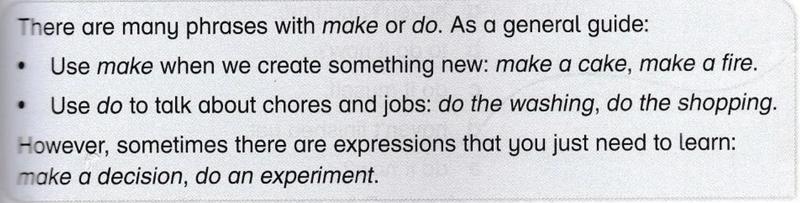
Textbook figure: Academy Stars Year 6 Pupil's Book, p.55.
| Use | Examples |
|---|---|
| make: to create something new | make a cake, make a fire (book); make a poster, make a model |
| do: chores and jobs | do the washing, do the shopping (book); do your homework, do the cleaning |
| phrases to learn | make a decision, do an experiment (book); make a noise, do the cooking |
Academy Stars Year 6 Pupil's Book, p.55. Extra phrases are from the exercise on the same page.
Show answerHide answer
4.8Speaking: apologise, make offers and accept offers
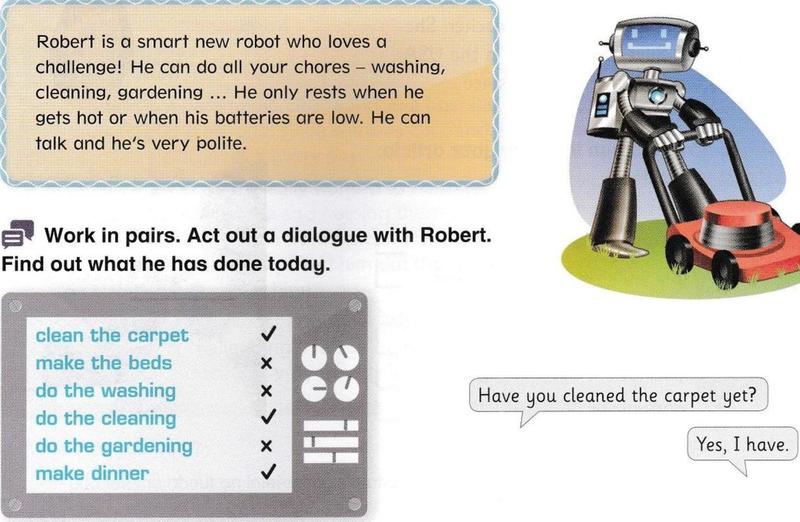
Textbook figure: Academy Stars Year 6 Pupil's Book, p.56.
Robert is a smart new robot who loves a challenge and can do all your chores. In pairs, ask what he has done today. The list shows the carpet cleaned, the cleaning done and dinner made; the beds, the washing and the gardening are not done yet. A model question: "Have you cleaned the carpet yet?" "Yes, I have."
| Apologising | Make offers | Accept offers |
|---|---|---|
| I'm afraid I ... | Shall I ...? | That would be great. |
| I'm sorry, I ... | Would you like ...? |
Academy Stars Year 6 Pupil's Book, p.56.
Robert: I'm sorry, I haven't finished yet. Shall I make them now?
Aina: That would be great.
4.9Think about it! Decode a message

Textbook figure: Academy Stars Year 6 Pupil's Book, p.57.
Computer programming is a popular job and needs people who understand codes. Julius Caesar used a code to send secret messages to his soldiers. In the book's code, under a you write c, so every letter moves two places forward.
2. To decode, move two places back: c becomes a, d becomes b.
Original example: vgcej decodes to teach (v to t, g to e, c to a, e to c, j to h).
Show answerHide answer
4.10Review 2: Units 3 and 4
Review 2 (pp.58-59) checks words from both units, sorted into jobs, places, things and adjectives (for example canteen, factory and university are places; challenging, polite and strange are adjectives). It also revises matching sentence halves with for, since and already, a pair survey ("Have you had lunch yet?" "Have you ever tried kayaking?"), a make or do text and a listening task.
Academy Stars Year 6 Pupil's Book, pp.58-59 (summary).
| Question type | Answer |
|---|---|
| Have you ever + past participle? (once in your life) | Yes, I have. / No, I haven't. |
| Have you + past participle ... yet? (today, so far) | Yes, I have. / No, I haven't. |
| How long have you ...? | for + period / since + moment |