Getting around
What this chapter coversMatlamat bab ini
- I can predict what kind of story I am going to read from its pictures, and read the science fiction story A trip to remember (Lesson 1, Reading)
- I can identify the main theme of a story and infer the meaning of new words from the text around them (Reading skill, Reading comprehension)
- I can use the suffixes -ful (full of) and -less (without) to work out and build adjectives such as careful and fearless (Working with words)
- I can compare two things with just as ... as and not as ... as, for example "Real tennis is just as good as virtual tennis" (Grammar)
- I can use too and not enough with an adjective to say something is more or less than I would like, for example "too crowded" and "not fast enough" (Language in use)
- I can listen for key facts such as numbers and prices, and say who thinks what, in a conversation about skateboarding (Listening)
- I can use the beginning, middle and end of a story to plan and write a short story from six pictures (Writing)
- I can find information in a complex table such as a ferry timetable, and ask about journey time, how often a bus departs and ticket prices at a ticket office (Learning to learn, Speaking)
- I can analyse a problem step by step, such as the boat-car race, and explain my plan with First, ... and ... because ... (Think about it!)
Unit 5 is about getting around: bikes, buses, ferries and even a bike that travels in time. You will read a science fiction story, learn two new ways to compare things (just as ... as and too / not enough), read a ferry timetable, and plan a journey. This unit has no Reading time or Review of its own: Review 3 comes after Unit 6.
5.1Reading: A trip to remember
Before you read, look at the pictures and ask: what type of story is this? The book's choices are a mystery, a science fiction story or a biography. A bike with wings, a flying trumpet and a robot window cleaner tell you it is science fiction: it is about science and technology that does not exist yet.
Words from the vocabulary panel:
| Word | Meaning in this story |
|---|---|
| virtual | made by a computer, not real (a virtual tennis game on a tablet) |
| workshop | a room where you make or mend things (Grandma's inventions) |
| hug (hugged) | put your arms round someone to show love |
| lift (lifted) | pick something up, or raise it |
| old-fashioned | not modern; from a time long ago |
| pedal (pedaled) | push the pedals of a bike to move it |
| forwards, backwards | to the front, to the back |
| skyscraper | a very tall building |
| polluted | dirty because of smoke or chemicals |
Academy Stars Year 6 Pupil's Book, p.60 (vocabulary panel; the meanings are in my own words).
Academy Stars Year 6 Pupil's Book, p.66.
The story in order (my summary):
- Abi is playing a virtual tennis game. Grandma says, "Why don't you go and play tennis outside?" Abi thinks virtual tennis is "just as good as real tennis".
- Next day is Abi's birthday. She goes to Grandma's workshop, which is full of inventions. Grandma says, "Remember not to touch anything!"
- Abi finds an old-fashioned purple bike under a sheet. She thinks the bike "isn't as interesting as Grandma's other inventions", but she pedals forwards anyway.
- Whoosh! Clunk! The bike lifts her into the air and she arrives in the town centre of the future: glass skyscrapers, flying cars and a robot cleaning the street.
- The sky is grey, the air is polluted, there is no grass, no trees, no birds, and no children playing outside. The robot does not even know what grass or trees are.
- Abi is unhappy. She pedals backwards and is back in the workshop.
- Grandma gives her a time-travel game for her tablet. Abi asks, "Can we go outside and play tennis?" Grandma laughs: "Real tennis is just as good as virtual tennis."
Academy Stars Year 6 Pupil's Book, pp.60-61 (summary; key sentences quoted).
Show answerHide answer
5.2Reading comprehension and working with words
Infer meaning. A text does not always say things directly. You use clues, then decide what is true. In Lesson 2 you decide who said sentences such as "Young people don't play outside as much as they used to" (a grandma, not a 12-year-old) and why Abi does not like the future (no children outside, polluted air).
Academy Stars Year 6 Pupil's Book, p.62.
Inference: it is not a happy or busy place. Abi feels lonely and wants to go home.
| Word | Meaning |
|---|---|
| careful (p.60: "Be careful") | full of care: you take care |
| careless | without care: you do not take care |
| colourful | full of colour |
| powerful | full of power |
| homeless, tasteless, fearless | without a home, without taste, without fear |
Academy Stars Year 6 Pupil's Book, p.62 (rule and word list; meanings in my own words).
Show answerHide answer
5.3Grammar: just as ... as and not as ... as
Academy Stars Year 6 Pupil's Book, p.63.
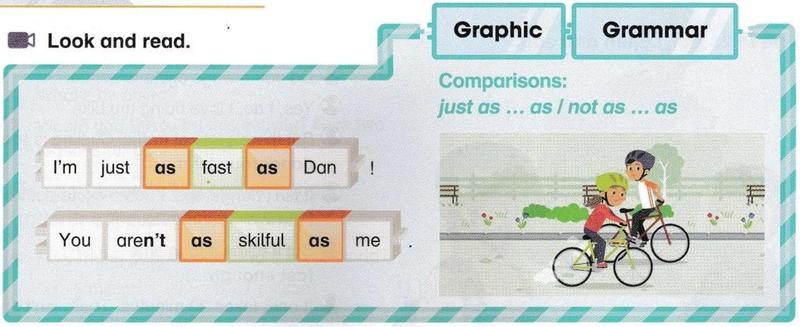
| Pattern | It says | Example |
|---|---|---|
| just as + adjective + as | the two things are equal | I'm just as fast as Dan! |
| not as + adjective + as | the first thing has less of the quality | You aren't as skilful as me. |
Academy Stars Year 6 Pupil's Book, p.63 (examples); the "It says" column is my own.
Other sentences from the unit: "Virtual tennis is just as good as real tennis" (p.60) and "this bike isn't as interesting as Grandma's other inventions" (p.60). On p.63 two children say, "I think helicopters are just as exciting as motorbikes" and "And they aren't as dangerous!".
A bicycle is not as fast as a motorbike.
A train is not as noisy as a plane.

Academy Stars Year 6 Pupil's Book, p.63.
Show answerHide answer
5.4Language in use: too and not enough
In the Lesson 4 conversation two friends argue about how to get to school. Their sentences show the new words.
| Pattern | Meaning | Example from the book |
|---|---|---|
| too + adjective | more than is good or allowed (a problem) | "Cycling is too dangerous for me." "That's too expensive!" |
| not + adjective + enough | less than you need or would like (a problem) | "It isn't fast enough." "I'm not fit enough to cycle." |
| not as + adjective + as | less than something else | "I've got a travel card, so it isn't as expensive." |
Academy Stars Year 6 Pupil's Book, p.64 (sentences from the Listen and say dialogue; the Meaning column is my own).
The vocabulary panel lists crowded (full of people), cycle path (a path only for bikes), fit (healthy and strong) and travel card (a card that lets you take buses or trains).
The ferry is not big enough for fifty cars.
It is too cold to swim today. = It is not warm enough to swim today.
Show answerHide answer
5.5Listening: skateboarding facts
Lesson 5 starts with a photo of a skateboarder in a helmet and pads, and the words popular, protect and safety equipment. In the audio (not available here) you listen to a conversation between Mum and Elena. The tasks are:
- choose the correct number or fact in five questions: how many people skateboard in the world, how many skate parks there are, where the biggest skate park is, when most accidents happen and how much a good skateboard costs;
- listen again and write M (Mum) or E (Elena) for opinions such as "popular", "too dangerous", "not dangerous", "a good way to keep fit" and "an expensive hobby";
- discuss with a partner what other sports need safety equipment.
Academy Stars Year 6 Pupil's Book, p.65 (the audio script is not printed, so I describe the tasks).
Values. The book asks: "Is price or quality more important when we buy something? Why?" Give a reason, for example "Quality matters, because a cheap helmet may not protect my head."
Show answerHide answer
5.6Writing: the structure of a story
A story has three parts. The book matches each part to what you write in it:
| Part | What you write |
|---|---|
| At the beginning | Introduce the characters. Say where they are and what they are doing. |
| In the middle | Introduce the problem. Describe the main events. |
| At the end | Say how the characters solve the problem and how they feel. |
Academy Stars Year 6 Pupil's Book, p.66 (matching task, shown as the answer table).
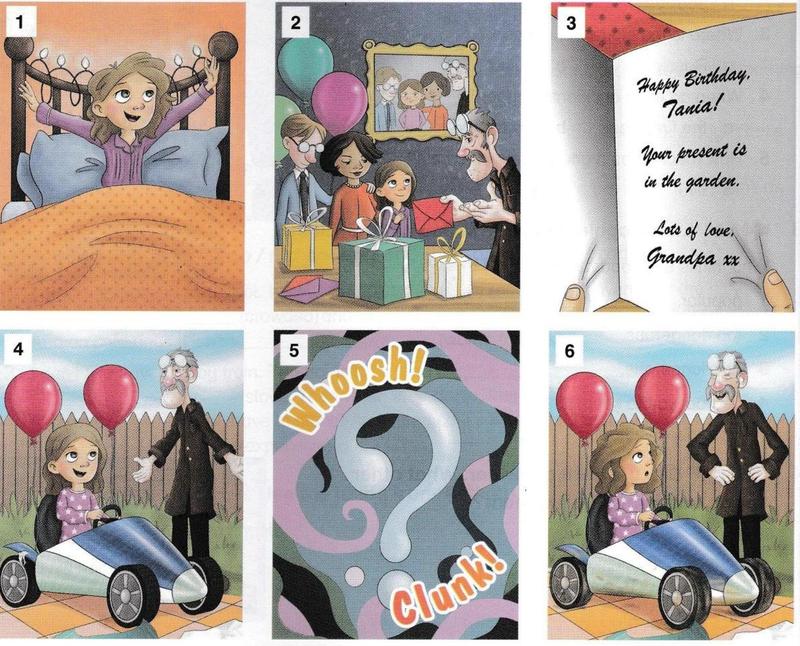
The time-travel picture story (see 5.1) shows Tania waking up on her birthday, a party with presents, a card from Grandpa that says her present is in the garden, a small blue car, then Whoosh! Clunk! and a surprised Tania. You decide what happens in picture 5 and then write a six-part story. The book's plan gives the start of each part and asks questions for you to answer:
- Tania wakes up and sits up in bed: why is she excited?
- She goes downstairs: who is there and what do they do?
- She opens her card: what does it say and how does she feel?
- She runs out to the garden: what does she see and do?
- Suddenly it goes dark and the car flies very fast: where does she go?
- Whoosh! Clunk! She opens her eyes: where is she and how does she feel?
Academy Stars Year 6 Pupil's Book, pp.66-67 (the plan is summarised in my own words).
Show answerHide answer
5.7Learning to learn: read complex tables
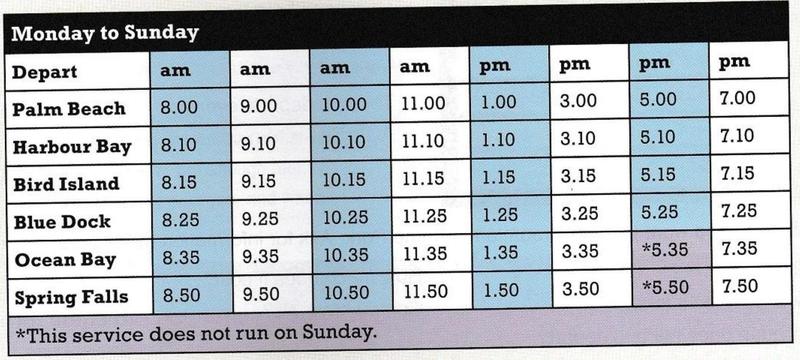
A timetable holds a lot of information, so first decide what you want to know, then find that row and column. The book gives a ferry timetable, Monday to Sunday.
Academy Stars Year 6 Pupil's Book, p.67.
- The ferry starts at Palm Beach and stops at Harbour Bay, Bird Island, Blue Dock, Ocean Bay and Spring Falls.
- It leaves Palm Beach every hour in the morning (8.00, 9.00, 10.00, 11.00), then at 1.00, 3.00, 5.00 and 7.00 pm.
- Read down a column to follow one ferry. Read along a row to see all the times at one stop.
- The note says that the service marked with * (the 5.00 ferry's last two stops, at 5.35 and 5.50 pm) does not run on Sunday.
Show answerHide answer
5.8Speaking: ask about a journey
Lesson 7 is set at a ticket office. Useful words: ferry, single / return (ticket) (one way, or there and back), discount (a lower price). In the book's role play, Student A works at the ticket office for Dreamland Theme Park (bus every 15 minutes, 25 minutes journey, single $4, return $7) and Student B is the customer.
| Customer (Student B) | Ticket office (Student A) |
|---|---|
| (starts the conversation) | How can I help you? |
| Could you tell me how to get to ...? | The best way is by ... |
| How long does it take? | It takes ... |
| How often does the bus depart? | The bus departs every ... |
| How much does it cost? Could I have ...? | A single / return costs ... |
Academy Stars Year 6 Pupil's Book, p.68 (phrases, regrouped into a table; I have matched each question to its likely reply).
Clerk: The best way is by train. It takes 40 minutes.
Customer: How often does the train depart?
Clerk: The train departs every 20 minutes.
Customer: How much does it cost? Could I have two returns, please?
Show answerHide answer
5.9Think about it!: work out how to get there
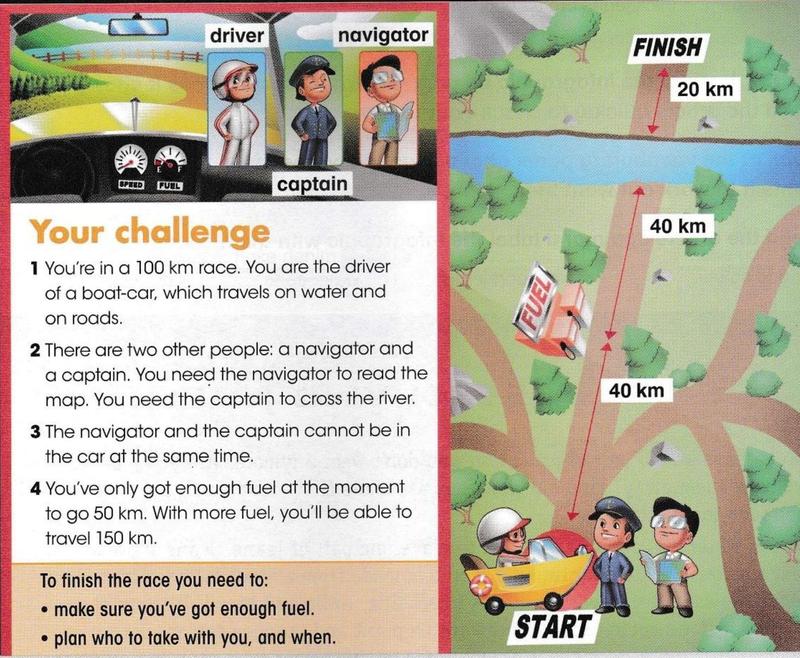
Lesson 8 is a video-game puzzle: a 100 km race in a boat-car, which drives on roads and floats on water. You are the driver. You need two helpers: a navigator (reads the map) and a captain (crosses the river). The navigator and the captain cannot be in the car at the same time. Your car has fuel for only 50 km now, but with more fuel it can travel 150 km.
Academy Stars Year 6 Pupil's Book, p.69.
Thinking skill: analyse and resolve a problem. Break it into parts: (1) what do I need to reach the Finish? (fuel, a person to read the map, a person to cross the river); (2) what limits me? (50 km of fuel, the two helpers cannot ride together, the river); (3) in what order should I do things? Then explain with the book's frame: First, you drive to ... and you take ... with you because ...