Music and song
What this chapter coversMatlamat bab ini
- I can read a music magazine interview and a song for gist, and say which text type each one is (Reading, pp. 82-84)
- I can answer questions about an interview and a song, and add the prefixes im-, dis- and un- to make negative words (Reading comprehension and Working with words, p. 84)
- I can use will and won't for predictions and going to for plans and for predictions based on what I can see now (Grammar, p. 85)
- I can use the present simple to talk about timetables and fixed future events, such as when a concert starts (Language in use, p. 86)
- I can listen for specific information and describe a song with words like catchy, lively and cheerful, and phrases like It makes me feel ... and It reminds me of ... (Listening, p. 87)
- I can explain rhythm, verse and chorus, and write a new verse of a song that rhymes (Learning to learn and Writing, pp. 88-89)
- I can give a short talk about a song I like, joining my ideas with because, but and so (Speaking, p. 90)
- I can use clues in a script to decide whether it is a romantic film, an action film, a comedy or a horror film (Think about it!, p. 91)
- I can read the play "A stranger to the rescue", follow how the characters try to solve a problem, and give my own response to it (Reading time 3, pp. 92-95)
Unit 7 is about music and song. You will read an interview with a folk singer and a song about Robin Hood, learn how to talk about the future with will, going to and the present simple, find out how a song is built, give a talk about a song you like, and read a short play about a problem on a forest path.
7.1Reading: a music magazine interview
Lesson 1 starts with four talking questions: how many types of music can you think of, what is your favourite and why, when do you usually listen to music, and how do you listen to it? Then you read an article in Songboard magazine with two kinds of text in it: an interview with the singer Martin Stark and a song.
Academy Stars Year 6 Pupil's Book, p.82.
| Word | What it means (our simple meaning) |
|---|---|
| folk music | traditional music from a country or a community; its songs often tell stories |
| pop music, rap, classical music | three different types of music |
| accordion | an instrument you squeeze and press keys on; Martin says it is quite similar to the piano |
| tune | the notes you sing or play, the melody of a song |
| rhythm | the pattern of beats in music, for example fast or slow |
| perform | to sing, play or act in front of an audience |
| tour | to travel to different places to give shows |
| promote | to tell people about something so that they want to see, hear or buy it |
Word list: Academy Stars Year 6 Pupil's Book, p.82. The meanings are our own; the book sends you to the dictionary on p. 140.
What Martin Stark says (pp. 82-83)
- Favourite music: he likes all kinds, including pop music, rap and classical music, but his "real love" is folk music.
- Why folk music? It is traditional music that is not usually popular with young people, but he thinks it is "the most interesting kind of music". The songs "tell great stories about people's lives, and about our history and culture", and every country has its own folk music.
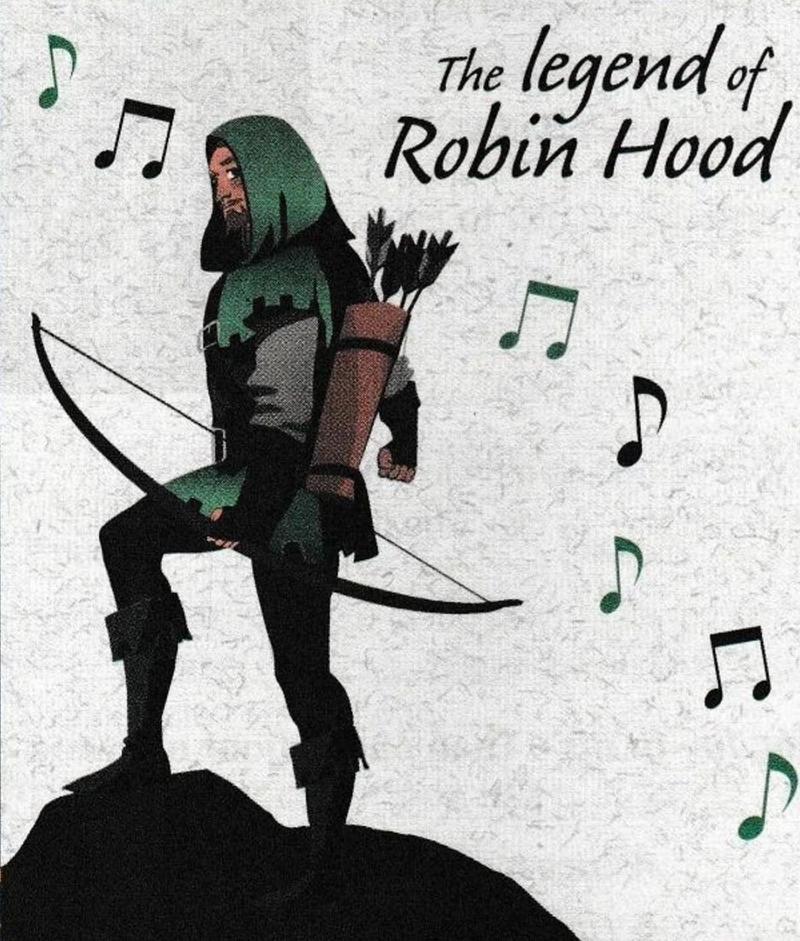
- His new song: it is about the English legend of Robin Hood. A good story needs drama, action and humour.
- How he writes a song: the story is the most important part (all folk songs have a narrative, which means a story). He thinks about where he is, who he is with and what they are doing. Then he thinks about the tune and rhythm: is it happy and fast, or sad and slow?
- Instruments: he plays the guitar and the piano, and he is going to learn the accordion next year.
- Plans: he is going to promote his music through social media and continue to tour and perform.
Academy Stars Year 6 Pupil's Book, pp.82-83 (summary).
Textbook figure: Academy Stars Year 6 Pupil's Book, p.83.
The song in short: the singer walks with his daughter on a sunny spring day and they hear children sing about a local man. The chorus says Robin Hood was "the man who helped the poor" and "a hero in folklore". The verses say he lived in Sherwood Forest, wore a big green hood and was noble and honest.
Show answerHide answer
7.2Reading comprehension and prefixes
Lesson 2 asks you to read both texts again and answer questions about them: why Martin loves folk music, why Robin Hood is his favourite folk story, which three things he says are important when writing a song, how he will promote his music, where Robin Hood lived and whether he was a good person. Give a reason from the text each time.
Academy Stars Year 6 Pupil's Book, p.84.
Interview or song? Features of the two text types
| Text type | Features | In this unit |
|---|---|---|
| Interview | questions and answers; the person speaks in the first person ("I like ...") | Martin Stark's answers to the magazine's questions |
| Song | verses, a chorus, rhyme and rhythm; often tells a story | "The legend of Robin Hood" |
Based on Academy Stars Year 6 Pupil's Book, p.84 (Reading skill: identify the features of different text types).
Working with words: prefixes im- and dis-
| Prefix | Book examples | Our examples |
|---|---|---|
| im- | impossible (im + possible) | impatient, improper (before p or m) |
| dis- | disagree, dishonest | dislike, disobey |
| un- | (many negative words start with un-) | unhappy, unkind |
Academy Stars Year 6 Pupil's Book, p.84. The column "Our examples" is original.
Show answerHide answer
7.3Grammar: will and going to
Textbook figure: Academy Stars Year 6 Pupil's Book, p.85.
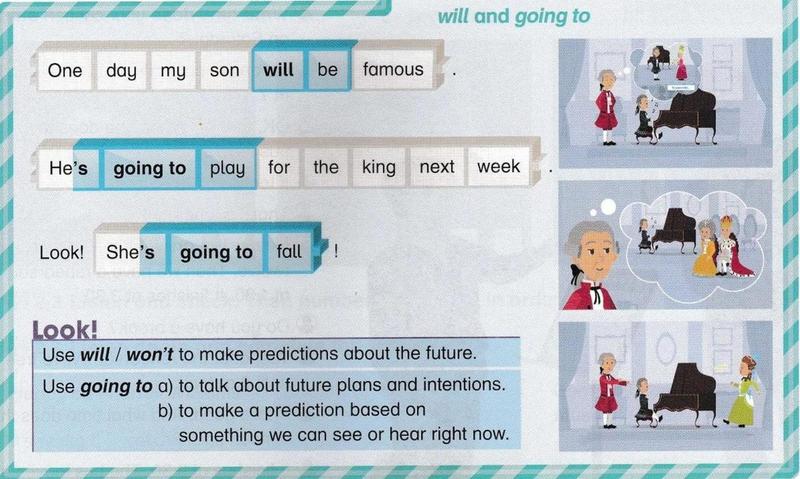
| Use | Form | Book example |
|---|---|---|
| will / won't: a prediction about the future | will (won't) + base verb | One day my son will be famous. |
| going to (a): a future plan or intention | am / is / are + going to + base verb | He's going to play for the king next week. |
| going to (b): a prediction from something we can see or hear right now | am / is / are + going to + base verb | Look! She's going to fall! |
Academy Stars Year 6 Pupil's Book, p.85.
More examples from the unit's own texts:
- Plans: "I'm going to learn the accordion next year." "I'm going to promote my music through social media." "I'm going to look for help." (pp. 83 and 93)
- Predictions with will: "Everyone says it will be difficult." "We won't be late for market!" "We'll be here until midnight!" (pp. 83, 93 and 94)
- Predictions from evidence: "The branches aren't going to catch fire, they're too wet." (p. 93)
- A question: "What are we going to do now?" (p. 93)
Academy Stars Year 6 Pupil's Book, pp.83, 93 and 94 (quotations).
Show answerHide answer
7.4Language in use: the present simple for future events
In Lesson 4 a man and a boy with a violin talk about the boy's coming concert. They use the present simple to talk about times that are fixed on a calendar or timetable.
Academy Stars Year 6 Pupil's Book, p.86 (quotations). The dialogue also gives the rehearsal start (1.30), the end of the concert (9.30) and the time they get back (midnight).
| Rule | Example |
|---|---|
| Use the present simple for a timetable, a calendar event or a fixed programme. | The concert starts at 7 o'clock. |
| Add -s or -es after he / she / it. | The bus leaves. The rehearsal finishes. |
| Make questions with do / does + base verb (no -s on the verb). | What time does the bus leave? |
| Say the time with at. | at 1.30, at midnight |
Rules based on Academy Stars Year 6 Pupil's Book, p.86; the "Rule" wording is our own.
The coach leaves school at 8.15. We arrive at the hall at 9.30 and the show starts at 10.00.
Show answerHide answer
7.5Listening: describing songs
There is no audio on this site, so here is what Lesson 5 asks you to do. You look at photos that show a musical, traditional music and pop music, listen to three people talk about songs and complete notes, then say which speakers (Paul, Clare and Anna) talk about a song that is happy, uses a traditional instrument, is not in English and so on. The three songs in the notes are Happy by Pharrell Williams, Bambo by Ba Cissoko and Consider Yourself from the musical Oliver!.
Academy Stars Year 6 Pupil's Book, p.87 (task described; no audio).
| Word | Means |
|---|---|
| catchy | easy to remember, so you keep singing it |
| cheerful | happy and bright |
| lively | full of energy and fast |
| optimistic | hopeful, thinking good things will happen |
| romantic | about love |
Word lists: Academy Stars Year 6 Pupil's Book, pp.87 and 90. The meanings are our own.
Show answerHide answer
7.6Writing: rhythm, verses and a chorus
Textbook figure: Academy Stars Year 6 Pupil's Book, p.88.
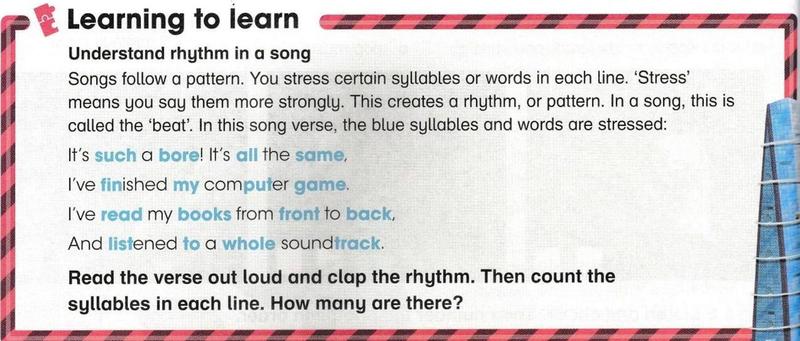
The sample verse (four lines about being bored, from "It's such a bore!" to "a whole soundtrack") is for you to clap. Clap the stressed words and count the syllables. Our count: each line has 8 syllables and 4 stressed beats, so the verse has an even rhythm.
Lesson 6 then plays a song about a girl who is ill at home. She is missing school, her friends will be online again later, and being inside makes her feel down. You write a title, find the rhyming words, find how many verses there are and which part is the chorus.
Academy Stars Year 6 Pupil's Book, pp.88-89 (summary).
| Part of a song | What it does |
|---|---|
| verse | tells the story; describes actions and events |
| chorus | is repeated several times; describes the main idea of the song |
| rhyme | words that end with the same sound, such as same / game and back / soundtrack (p. 88) |
Academy Stars Year 6 Pupil's Book, pp.88-89 (verse and chorus matching task, our wording).
Writing a new verse (p. 89)
- Use the plan with four questions, one for each line: how long has she been ill, what is she doing now, what else is she doing, what is she waiting for?
- Choose words from the box (ages, go, pages, pictures, radio; the book has already used days) or your own ideas.
- Decide which line-end words must rhyme.
- Check the number of syllables in each line so the rhythm matches the first verse.
Academy Stars Year 6 Pupil's Book, p.89 (steps summarised).
Show answerHide answer
7.7Speaking: a talk about a song
In Lesson 7 you choose a song you like, make notes, connect your ideas and give a short talk. The six note questions are: what sort of song is it (rap, a pop song and so on), why have you chosen it, why do you like it, how does it make you feel, what does it remind you of, and what is it about?
| Say | Phrases from the book |
|---|---|
| the song | It's got a great tune / rhythm / story ... |
| the sound | It's really catchy / lively / cheerful / romantic ... |
| your feelings | It makes me feel happy / sad / relaxed / energetic / optimistic ... |
| a memory | It reminds me of ... |
Academy Stars Year 6 Pupil's Book, p.90.
It makes me feel happy because I first heard it on holiday. It's a traditional song, but it's really catchy so it makes you want to dance.
Academy Stars Year 6 Pupil's Book, p.90. The talk opens: "I'm going to talk about a song called ... I've chosen it because my grandma used to sing it to me ..."
| Linking word | Use |
|---|---|
| because | gives a reason |
| but | shows a contrast |
| so | shows a result |
Show answerHide answer
7.8Think about it! Create the right atmosphere
Lesson 8 shows four film scripts, each beginning with the same line, "Give me your hand". You match every script to a type of film (a romantic film, an action film, a comedy or a horror film) and underline the words that helped you decide. Then you listen to four pieces of music, write two adjectives for each, and match each piece to a script.
Academy Stars Year 6 Pupil's Book, p.91 (task summarised; the music is audio).
| Film type | Clues to look for |
|---|---|
| action | danger and fast events: "I'm going to fall!", "We have to get down before Rex escapes", "The rope!" |
| horror | fear and strange noises: "I heard a noise downstairs", "I'm frightened", "There's someone in the living room" |
| romantic | love and family: "We've had a good life", "our grandson has got married", "It's going to be a wonderful year!" |
| comedy | a funny surprise: someone wants a hand because there is chocolate on it, and the answer is "You've eaten all my chocolates!" |
Academy Stars Year 6 Pupil's Book, p.91 (clues quoted; our own sorting of the scripts into film types).
Show answerHide answer
7.9Reading time 3: A stranger to the rescue
This is a play in two scenes. Before you read, decide where the characters are, what the problem is and how many ideas they try. The characters are Roger (a villager), Joan (his wife), Ava (their daughter), Henry (a farmer) and a man.
Textbook figure: Academy Stars Year 6 Pupil's Book, p.92.
What happens (pp. 92-94)
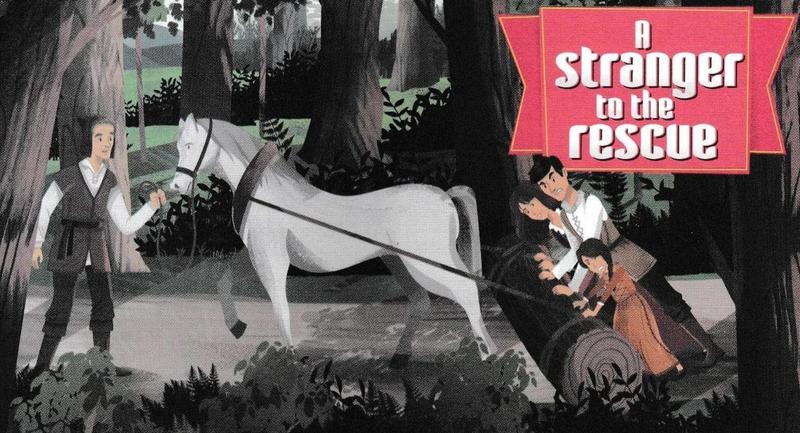
- The problem. In a leafy forest in England, a fallen tree blocks the path. Roger, Joan and Ava need to get to the market to sell their vegetables and have been there since 7 o'clock. Henry, a farmer on his way to the market, meets them.
- Idea 1: the horse. Henry suggests tying leather straps round the tree and letting the horse pull while the others push. It fails because the tree is too heavy for the horse, and Roger hurts his back.
- Idea 2: the axe. Joan finds an axe in the cart. An hour later it has not worked because the axe is too small and not sharp enough, and Roger says they will be there until midnight.
- Idea 3: fire. Joan wants to burn the tree. Henry says it is too dangerous because they are in the middle of a forest. They try a very small fire, but the branches are too wet to catch fire. Henry runs off to look for help: he has heard of a community of people in the forest who help people in trouble.
- Scene 2: the solution. Henry returns with a strange man. He asks whether they have tried going over the tree. They take the vegetables out of the cart, each person stands by a wheel, and all lift the cart over together.
- The ending. The man says, "there's always a way to solve a problem, especially when you work together!" He gives his name as "Hood, Robin Hood", and everyone gasps.
Academy Stars Year 6 Pupil's Book, pp.92-94 (summary with key sentences quoted).
Grammar in the play
- going to: "What are we going to do now?", "This isn't going to work", "I'm going to look for help".
- will: "It will cut the tree in half in no time!", "We'll be here until midnight!", "We won't be late for market!"
Academy Stars Year 6 Pupil's Book, pp.93-94.
Activities (p. 95)
You finish sentences with because (for example "They can't continue along the path because ..."), write a diary entry as Roger about your favourite part of the play, tick what the play teaches about solving problems, think of a different solution to the problem, and watch a video of a different ending. The best lessons to choose are: if you cannot work out a problem, ask for help; if it does not work the first time, try again; and every problem has a solution, but you may need to try different ideas.
Academy Stars Year 6 Pupil's Book, p.95 (tasks described; video not available here).
Show answerHide answer
Summary
| Topic | Remember |
|---|---|
| Interview and song | an interview has questions and answers; a song has verses, a chorus, rhyme and rhythm |
| Vocabulary | accordion, folk music, perform, promote, rhythm, tour, tune; catchy, cheerful, lively |
| Prefixes | un-, im- (before p or m) and dis- make negative words: impossible, disagree |
| will / won't | predictions: One day my son will be famous. |
| going to | plans and predictions from evidence: He's going to play for the king. Look! She's going to fall! |
| Present simple for the future | timetables: The concert starts at 7 o'clock. What time does the bus leave? |
| Song structure | stress makes the beat; a verse tells the story; the chorus is repeated |
| Linking ideas in a talk | because (reason), but (contrast), so (result) |
| The play | three ideas fail (horse, axe, fire); the stranger's idea works because everybody works together |