How is it made?
What this chapter coversMatlamat bab ini
- I can read an information text and an infographic about how jeans are made, put the stages in order, and work out words such as denim, yarn, harvest and dye from context (Reading, Reading comprehension)
- I can form nouns from verbs by adding -tion or -sion, and remember the spelling changes (Working with words)
- I can use the passive voice in the present simple, such as "The cotton is grown" and "The jeans are washed", to describe a process (Grammar)
- I can ask and say what things are made of and used for, for example "What's it made of?" and "It's used for cutting herbs" (Language in use)
- I can listen to adverts and tell facts from opinions (Listening)
- I can use an infographic to write an article about a process, ordering the stages with first, then, next, after that and finally (Writing)
- I can research information in different ways and check that it is correct (Learning to learn)
- I can advertise a new product on the radio, using adjectives, two facts and two opinions, and compare adverts to decide how to spend money (Speaking, Think about it!)
- I can use too and not enough, as ... as, and word forms to review Units 5 and 6 (Review 3)
Unit 6 asks "How is it made?". You will read about how a pair of jeans travels from a cotton seed to a shop, learn the passive voice to describe a process, say what things are made of and used for, tell fact from opinion in adverts, and write about how pasta is made. Review 3 at the end covers Units 5 and 6.
6.1Reading: A new life for your jeans
The unit opens with an information text and an infographic (a picture that explains a process step by step). The text is titled "A new life for your jeans".
Summary of the text in order:
- Cotton, the plant that gives us denim, grows in warm, wet countries such as China, India and Brazil. A cotton seed takes about six months to grow into a plant. It needs a lot of water: rain, or farmers watering the plants when the weather is dry.
- After the cotton is harvested, it is transported to a factory and made into yarn.
- Indigo dye colours the yarn and gives jeans their dark blue colour. Then the yarn is made into denim, which is cut to make jeans.
- Many people like stonewashed jeans. They are washed with stones in a washing machine to make them soft and more comfortable. Stonewashing can change the colour to light blue.
- Finally, the jeans are packed in boxes and transported all over the world, up to 60,000 kilometres to the shops.
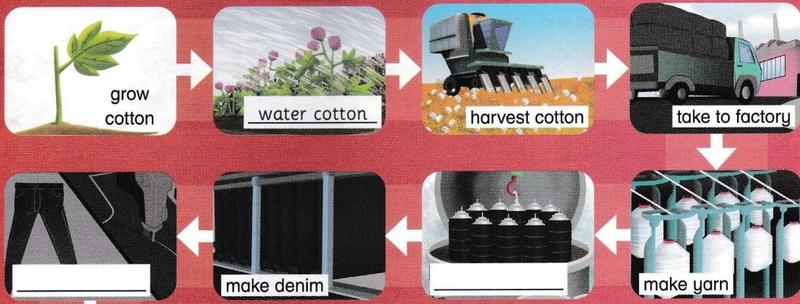
Textbook figure: Academy Stars Year 6 Pupil's Book, p.71 (infographic, first two rows). Text summarised from pp.70-71.
| Word | Meaning, from the text |
|---|---|
| cotton | a plant grown in warm, wet countries; denim is made from it |
| denim | the strong material that jeans are made of |
| harvest | to pick or cut a crop when it is ready (harvested: past) |
| yarn | thread made from cotton, used to make cloth |
| dye | a substance used to colour something (indigo dye makes jeans blue) |
| throw away | to put something in the bin because you do not want it (thrown away: past participle) |
| soft, light, dark | soft: not hard; light blue: pale blue; dark blue: deep blue |
Academy Stars Year 6 Pupil's Book, p.70 (vocabulary panel). Meanings written in simple English for revision.
The big numbers and the message
- Making one pair of jeans uses 10,000 litres of water and many other resources (energy, materials, people to do the work).
- Almost half of the jeans made in the world are sold in the USA. Last year people there bought 450 million pairs.
- The writer's message: do not throw away old jeans. Suggestions: give them to friends or family, take them to a charity shop, have a swapping party, or make them into a new creation, such as a bag or a toy.
Academy Stars Year 6 Pupil's Book, p.71.
Show answerHide answer
6.2Reading comprehension and working with words
Lesson 2 checks that you understood the process. It asks you to put eight stages in order, answer five questions about stonewashing, the country that buys most jeans, the water used and what to do with old jeans, and discuss why it is good to reuse or recycle clothes.
Academy Stars Year 6 Pupil's Book, p.72 (the task); the order follows the article on pp.70-71.
Suffixes -tion and -sion
Academy Stars Year 6 Pupil's Book, p.72 (Working with words).
| Verb | Noun | What changes |
|---|---|---|
| collect (original) | collection | ends in t: add -ion |
| pollute (original) | pollution | drop the e, add -ion |
| invite (original) | invitation | drop the e, add -ation |
| discuss (original) | discussion | add -ion |
Show answerHide answer
6.3Grammar: the passive voice (present simple)
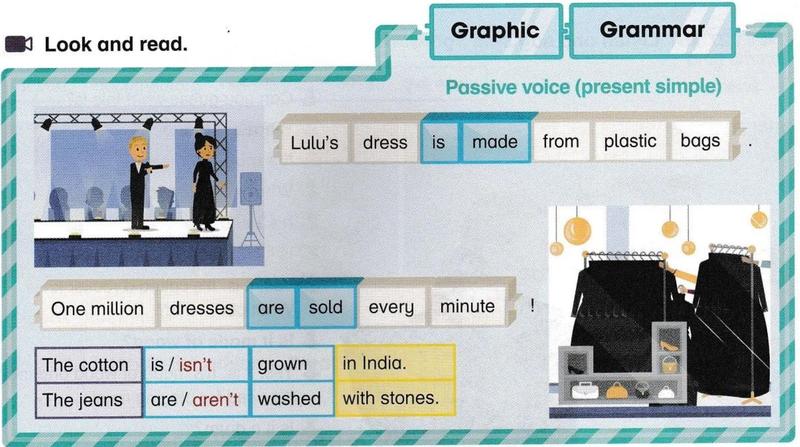
Textbook figure: Academy Stars Year 6 Pupil's Book, p.73 (Graphic Grammar).
| Active (who does it) | Passive (what happens to it) |
|---|---|
| They throw away millions of pairs of jeans every year. | Millions of pairs of jeans are thrown away every year. |
| Workers make this style of dress in France. | This style of dress is made in France. |
Academy Stars Year 6 Pupil's Book, p.73, Activity 2.
| Subject | is / isn't, are / aren't | past participle | extra information |
|---|---|---|---|
| The cotton | is / isn't | grown | in India. |
| The jeans | are / aren't | washed | with stones. |
Academy Stars Year 6 Pupil's Book, p.73 (table); more examples from the grammar box: "Lulu's dress is made from plastic bags." "One million dresses are sold every minute."
How to make a passive sentence
- Put the thing that receives the action first: The yarn.
- Choose is (one thing) or are (more than one): The yarn is / The jeans are.
- Add the past participle of the verb: coloured, packed, sold.
- Add where, how or when if you need it: The yarn is coloured with indigo dye.
| Verb | Past participle (passive) |
|---|---|
| make | made |
| grow | grown |
| sell | sold |
| take | taken |
| throw | thrown |
| cut | cut |
| buy | bought |
| harvest, wash, pack | harvested, washed, packed (add -ed) |
Participles such as made, grown, sold, taken and thrown are used on pp.70-73. The table is a revision list.
Active: Machines cut the denim. Passive: The denim is cut by machines.
Negative: The yarn isn't coloured with paint. The jeans aren't washed by hand.
Show answerHide answer
Show answerHide answer
6.4Language in use: made of and used for
Lesson 4 is a guessing game with objects in a Discovery Room (a glass weather instrument, a drum, a herb knife). The questions and answers are the key language.
| Question | Answer |
|---|---|
| What's it made of? | It's made of metal. |
| What's it used for? | It's used for cutting herbs. |
| Is it made of wood? | Yes, it is. It's made of wood and leather. |
| Is it used for checking the weather? | Yes, it is! |
Academy Stars Year 6 Pupil's Book, p.74 (dialogue, Activity 1). Word box: glass, herb, leather, metal, wood.
A guitar: "It's made of wood and metal. It's used for playing music."
Show answerHide answer
6.5Listening: adverts, fact and opinion
Lesson 5 starts with four TV screens (an advert, a documentary, the news and a sports programme). The audio is not printed here, so these notes describe the tasks. You match programmes to screens, listen to four adverts (a new film, orange juice, a computer game, jeans) and number them in order, decide whether statements are F (fact) or O (opinion), and answer detail questions about the film name, jeans colours, number of players and juice ingredients.
Academy Stars Year 6 Pupil's Book, p.75 (Listening skill: differentiate between fact and opinion).
| Fact | Opinion | |
|---|---|---|
| It is... | something that can be checked and proved | what a person thinks or feels |
| Clues | numbers, prices, dates, names | best, biggest, most exciting, wonderful, lovely, I think, we all love |
| Example | "Two pairs ... are just £60." | "Don't miss the biggest film of the year." |
Academy Stars Year 6 Pupil's Book, p.75 (statements from the activity).
Show answerHide answer
6.6Writing: how pasta is made
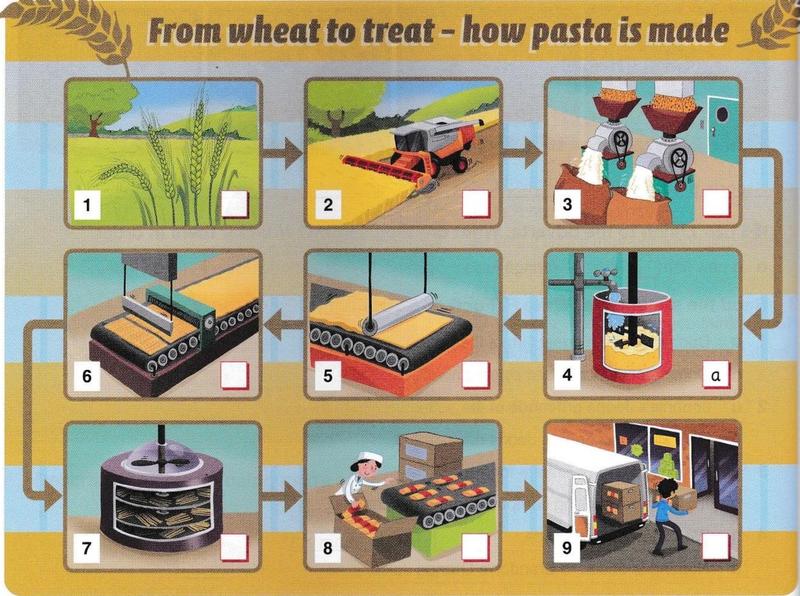
Textbook figure: Academy Stars Year 6 Pupil's Book, p.76 (Lesson 6 Writing).
The task: match nine stages to the pictures, write each stage as a passive sentence, then write an article about how pasta is made. Start with an introduction, then the stages in order.
Academy Stars Year 6 Pupil's Book, p.77 (Look! box). The book's model introduction says why pasta is popular and where it is eaten, then starts the process: "To make pasta, first the wheat is grown ..."
Learning to learn: research information
- Ask people: teachers, parents, grandparents.
- Use a library: books, encyclopaedias, old newspapers, local history.
- Watch TV programmes, such as the news or a documentary.
- Look on the internet. It is quick and easy, but check that the information is correct and exactly what you need.
Academy Stars Year 6 Pupil's Book, p.77 (Learning to learn: research information).
Show answerHide answer
6.7Speaking: make a radio advert
The model is the advert for the Lumina torch, which is also a pen. It uses made of, used for, comparing words and opinions.
Academy Stars Year 6 Pupil's Book, p.78 (Activity 1). Word box: cheap (cheaper), plastic, special, useful.
To make your own radio advert, follow the four steps in the book:
- Introduce the product: why is it different or special?
- Say two facts about it (what it is made of, what it is used for, its price).
- Give two opinions about it.
- Use adjectives to describe it.
Academy Stars Year 6 Pupil's Book, p.78 (Activity 4).
Show answerHide answer
6.8Think about it! Choose the best jeans
You have £50 to spend on a pair of jeans. Read three adverts and compare them before you decide. This is evaluating options: look at cost, time to arrive, good points and bad points, then reach a decision.
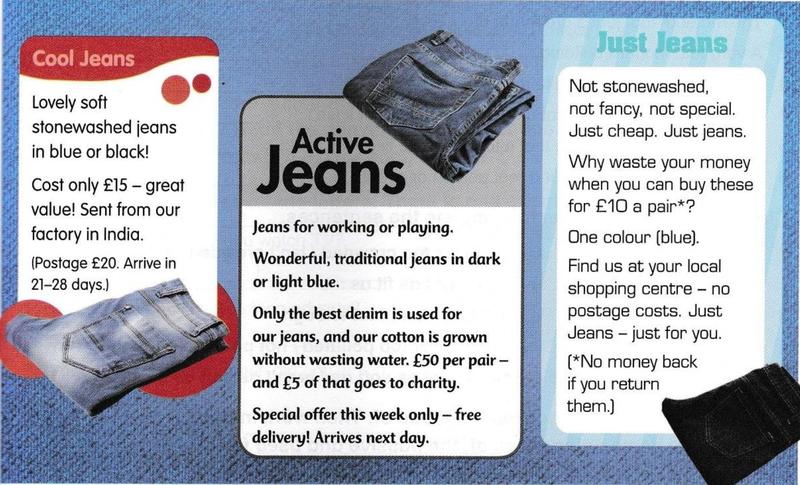
Textbook figure: Academy Stars Year 6 Pupil's Book, p.79 (Lesson 8 Think about it!).
| Advert | Cost | Time to arrive | Good | Bad |
|---|---|---|---|---|
| Cool Jeans | £15 (+ £20 postage) | 21-28 days | great value, soft, blue or black | postage costs more than the jeans |
| Active Jeans | £50 (£5 goes to charity) | next day, free delivery this week | best denim, cotton grown without wasting water | the most expensive |
| Just Jeans | £10 | buy in the shop | cheap, no postage | one colour, no money back if you return them |
Information read from the three adverts, Academy Stars Year 6 Pupil's Book, p.79.
Show answerHide answer
6.9Review 3: Units 5 and 6
Review 3 (pp.80-81) tests both units. Here is what each task practises.
| Task | Skill | Reminder |
|---|---|---|
| 1 Definitions | vocabulary | words: denim, documentary, pedal, popular, skyscraper, virtual |
| 2 Circle the correct phrase | too / not enough, as ... as | see below |
| 3 Describe four objects | made of, the passive, used for | "It's made of wood. It's designed by an artist. It's used for keeping jewellery in." |
| 4 Word forms | suffixes | care, fear, use, colour, educate, create |
| 5 Match answers | conversation about watching TV | choose the reply that answers the question |
Academy Stars Year 6 Pupil's Book, pp.80-81 (Review 3). Task content summarised.
The soup isn't hot enough. (less than needed)
My cat is just as fast as your dog. / My cat isn't as fast as your dog.