Tell me a story
What this chapter coversMatlamat bab ini
- I can predict what a story is about from its pictures and title, and read the traditional story The perfect swan (Reading)
- I can find the main message of a story and use context to work out new words such as furious, astonished and forgive (Reading, Learning skills)
- I can answer true or false questions and say who said what, giving proof from the story (Reading comprehension)
- I can tell first person from third person narrative and say how the narrator shows how characters feel (Learning to learn)
- I can use the first conditional, such as "If you rest, you'll feel better", to talk about possible future situations (Grammar)
- I can use may, might and could, and may not or might not, to say what is possible (Language in use)
- I can listen for the order of events in a story and say what its moral is (Listening, Values)
- I can write a short summary of a story, with the main characters and events only, in no more than 100 words (Writing)
- I can find synonyms, give a talk about a story I like, and choose a book and give two reasons (Working with words, Speaking, Think about it!)
Unit 8 is about stories. You will read a traditional Chinese story, learn two kinds of narrator, talk about what will and might happen, and learn how to write a short summary. Review 4 at the end covers Units 7 and 8.
8.1Reading: The perfect swan
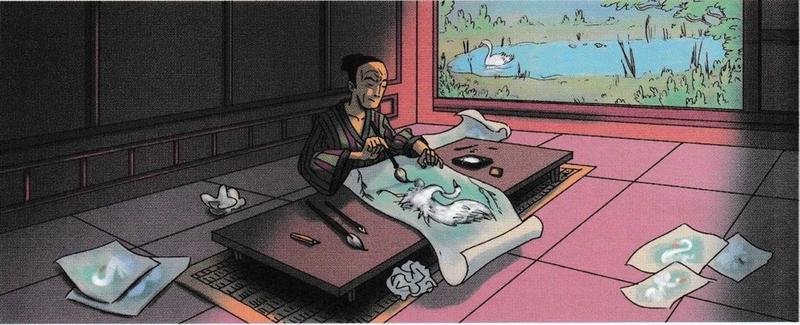
Before you read, look at the pictures and the title and make predictions: which country, which animal and who the main characters are. Then read quickly and check your ideas.
Academy Stars Year 6 Pupil's Book, p.96.
| Word | Meaning in the story |
|---|---|
| emperor | the ruler of a country (Zhang Wei is a Chinese emperor) |
| powerful | strong and able to control people |
| bad temper | he becomes angry very quickly |
| own (owned) | to have something that belongs to you |
| palace | the big house where an emperor lives |
| collect | to go and get something |
| astonished | very surprised |
| furious | very angry |
| forgive | to stop being angry with someone who did something wrong |
Academy Stars Year 6 Pupil's Book, p.96. The meanings are written for this site.
The story in order (a summary in our own words):
- Zhang Wei is a strong and powerful emperor. He is kind to his people, but he has a bad temper.
- He loves art and owns thousands of paintings, but he always wants one more. His assistant Hong tells him that Cheng Li is the best painter in China.
- The emperor invites Cheng Li to the palace and asks for a picture of a swan. Cheng Li says it will take some time.
- After one year Cheng Li asks for more time because "swans are not easy to paint". After a second year the same thing happens, and the emperor is furious and warns him: "If my painting isn't finished, you'll be sorry!"
- After the third year Cheng Li paints a beautiful swan in a few minutes. Zhang Wei is astonished and says "That ... is ... perfect!"
- But he is still furious: he waited three years and the painting took two minutes. He sends Cheng Li to a land far away.
- A week later servants empty the room and find thousands of paintings of swans. The emperor realises that Cheng Li practised every day for three years.
- Zhang Wei says sorry and invites Cheng Li back. Cheng Li forgives him and becomes the emperor's royal painter.
Academy Stars Year 6 Pupil's Book, p.102.
Key sentences to remember: "He had a bad temper and became angry very quickly." (p.96) and "Zhang Wei had made a terrible mistake because of his bad temper." (p.97)
Show answerHide answer
8.2Reading comprehension and points of view
On p.98 you decide if sentences are True or False and underline the part of the story that proves your answer. You also decide who said a sentence: Zhang Wei (Z) or Cheng Li (C). The book's examples show the idea: "I want the best picture of a swan in China" can only be said by the emperor (Z).
Academy Stars Year 6 Pupil's Book, p.98.
Show answerHide answer
Learning to learn: points of view
Every story has a narrator, the storyteller. The narrator tells us about the characters, their actions and the setting.
| Point of view | The narrator | Words used |
|---|---|---|
| First person | usually a main character; we know his or her thoughts and actions | I, we |
| Third person | more like an observer of all the characters | he, she, it, they (I or we only in direct speech) |
Academy Stars Year 6 Pupil's Book, p.98.
The perfect swan is told in the third person: the narrator says "Zhang Wei loved art. He owned thousands of paintings". The narrator also tells us how characters feel with words such as "furious", "astonished" and "was so angry".
An original example: "I opened the door and I was scared" is first person. "Maria opened the door and she was scared" is third person.
Show answerHide answer
8.3Grammar: the first conditional
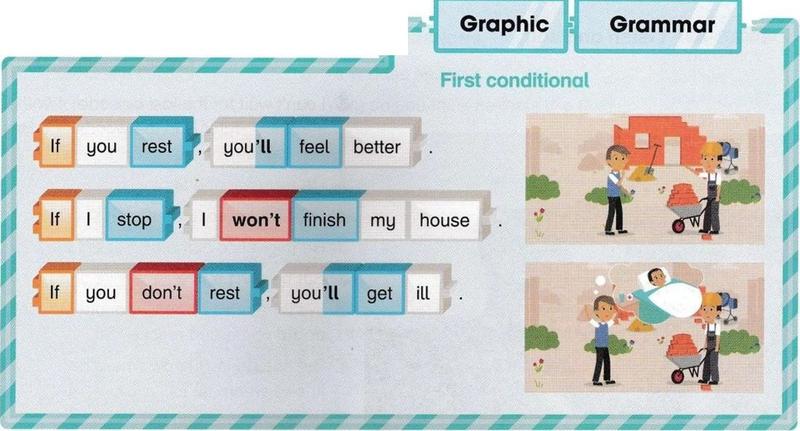
Use the first conditional to talk about a possible situation in the future and its result.
Academy Stars Year 6 Pupil's Book, p.99.
| If clause (the condition) | Result clause |
|---|---|
| If you rest, | you'll feel better. |
| If I stop, | I won't finish my house. |
| If you don't rest, | you'll get ill. |
Academy Stars Year 6 Pupil's Book, p.99.
- "If my friend comes later, we'll go to the park." (not "will come")
- "If we go to the park, we will see the swans on the lake."
- "I won't finish my homework if you don't turn off the TV."
Academy Stars Year 6 Pupil's Book, p.99 (examples from the exercise).
Original examples: "If it rains, we'll stay inside." and "We'll miss the bus if we don't hurry."
Pair speaking (p.99): complete "If it's sunny tomorrow, ..." and "I'll be late for school if ...". For example: "If it's sunny tomorrow, we'll go sailing."
Show answerHide answer
8.4Language in use: may, might and could
Two boys talk about a television show, In the shadows. Tyler is tied up in the woods and Rex is coming. They guess what will happen, using words for things that are possible but not sure.
He may escape first.
He might find something to cut the rope.
He may not escape, but Maribel could come and rescue him.
But they might not think it's an emergency.
Academy Stars Year 6 Pupil's Book, p.100.
| Form | Words | Example |
|---|---|---|
| Affirmative | may / might / could | A ship might rescue her. |
| Negative | may not / might not | They might not know she's lost. |
Academy Stars Year 6 Pupil's Book, p.100 (Look! box and exercise).
- After may, might and could, use the base verb with no -s, -ed or to: "She may call the police" (not "may calls", "may to call").
- They mean "perhaps". The speaker is not sure.
- Original example: "Tom isn't here. He might be ill, or he could be on the bus."
Show answerHide answer
8.5Listening: Jakobo and the lion
The listening lesson shows a boy in a tree with goats and a lion nearby. You discuss where he is, why he is up there and how he feels. Then you listen and put the events in order. The printed events (p.101) tell the story in a short chain: the boy takes the goats up the hill every day and one day plays a trick by shouting for help; his parents come, but it was only a trick; he does it again and they are furious; then a real lion appears, he shouts again and nobody comes, and the lion scares away his goats.
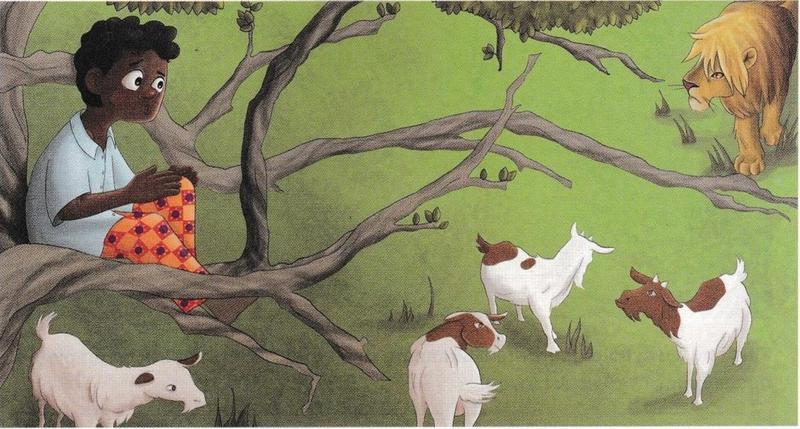
Academy Stars Year 6 Pupil's Book, p.101. The order of events is worked out from the printed sentences; the audio recording is not available on this site.
Listen for sequence: listen for words such as one day, then, again and after that. The picture, and the question "How does he feel and why?", show what the story is about.
Values: the book asks "Why is it important to tell the truth?" The moral of the story: if you tell lies, people may not believe you when you really need help.
Show answerHide answer
8.6Writing: a story summary
A summary gives only the main characters and the main events. Leave out small details and explanations. To plan one, use the five boxes on p.102:
| Box | Ask yourself |
|---|---|
| Someone ... | Who are the main characters? What do we need to know about them? |
| Wanted ... | What did the emperor want? |
| So ... | What did the emperor do? |
| But ... | What was the problem? |
| Then ... | What happened in the end? |
Academy Stars Year 6 Pupil's Book, p.102.
The book shows a summary of a different story (p.103): "Once there was a poor farmer. ... One day he discovered a special goose on his farm." The most important information, such as who the main character is and what happens, comes first. The farmer sells the golden eggs, becomes rich and greedy, opens the goose to find more eggs, and there are none.
Academy Stars Year 6 Pupil's Book, p.103.
- Use the past tense, third person and full sentences.
- Stay within the limit: the book asks for no more than 100 words.
- Start like the book's model: "Once there was a Chinese emperor. He wanted a painting ..."
Show answerHide answer
8.7Working with words: synonyms
Academy Stars Year 6 Pupil's Book, p.103.
| Word | Synonym from the story or Review 4 |
|---|---|
| strong | powerful |
| angry | furious |
| surprised | astonished |
| run away | escape |
| happen | take place |
Academy Stars Year 6 Pupil's Book, pp.103 and 107.
When a synonym is used for repeated words, the writing is more varied and interesting.
Show answerHide answer
8.8Speaking: a talk about a story
You give a short talk about a story you like. Make notes first, using the headings on p.104: title, characters, setting, main events (1, 2, 3), ending, moral and my opinion.
The main character(s) is / are ...
The story takes place in ...
One day ... / A few days / weeks / years later ... / The next day ...
The moral of the story is ...
Academy Stars Year 6 Pupil's Book, p.104.
8.9Think about it! Choose a book for a friend
Lesson 8 asks you to match three books to their types: The Three Musketeers (history and adventure), The Woman in Black (mystery and horror) and I, Robot (science fiction). Short blurbs tell you what each book is about. You then say which book you most want to read and give two reasons, and match three speakers to books they might like.
Academy Stars Year 6 Pupil's Book, p.105.
This is a thinking skill: evaluate information and reach a decision. Read the clues, compare the choices and decide with reasons: "I would choose a mystery because I like solving puzzles, and I enjoy short chapters."
8.10Review 4 (Units 7 and 8)
Review 4 revises words and grammar from both units.
- Adjectives. The list on p.106 mixes adjectives with other words. Adjectives are describing words: furious, lively, powerful, foggy, cheerful, optimistic, catchy. Others are verbs (promote, forgive, escape) or nouns (rhythm, calendar).
- Future forms. The dialogue on p.106 chooses between I'm going to walk (a plan), It's going to rain (clouds make you sure), If we catch the bus, we won't get wet (first conditional), will for a prediction ("I think you'll win"), and the present simple for a timetable ("It starts at seven o'clock").
- Will / won't in situations. Model sentence: "If it snows, I won't go to the beach."
- Synonyms (p.107). powerful = strong, astonished = surprised, furious = angry, happen = take place, run away = escape.
- Opposites with im- and dis-. Words in the box: agree, appear, honest, perfect, polite, possible. The opposites are disagree, disappear, dishonest, imperfect, impolite, impossible.
Academy Stars Year 6 Pupil's Book, pp.106-107.
Show answerHide answer
Summary
| Topic | Remember |
|---|---|
| The perfect swan | Emperor Zhang Wei, bad temper, Cheng Li and the swan, three years, thousands of practice paintings, sorry and forgiveness. |
| Points of view | first person: I, we. Third person: he, she, it, they. |
| First conditional | If + present simple, will / won't + verb. No comma when the if clause goes second. |
| may, might, could | possible but not sure. Negatives: may not, might not. Base verb follows. |
| Listening | listen for sequence. Moral: tell the truth or people may not believe you. |
| Summary writing | Someone, wanted, so, but, then. Main characters and events, no more than 100 words. |
| Synonyms and opposites | strong = powerful, angry = furious; im- / dis- make opposites. |