It's a mystery!
What this chapter coversMatlamat bab ini
- I can read the play script "The robbery", scan it for the main facts and say who the thief is and how Inspector Fox knew
- I can use the context to work out the meaning of crime words such as suspect, statement, valuable, prove, borrow and solve
- I can add the suffix -ment to verbs to make nouns, such as state and statement
- I can use question tags with to be, the present simple and can to check that something I believe is true
- I can use should, shouldn't, must, mustn't, have to, don't have to, can, can't, may and might to talk about advice, rules, permission and possibility
- I can listen to a talk and take notes to answer questions about the Nazca Lines
- I can recognise and write the features of a play script, including characters, scene setting, stage directions and speaker names
- I can tell a short mystery story with phrases such as "A strange thing happened" and "Suddenly", and ask yes/no questions to solve one
- I can speculate and make deductions about someone's identity from clues, and be persistent when a task is difficult
Unit 10 is about crime and mysteries. You read a detective play script, "The robbery", learn question tags and review modal verbs, listen to a talk about the Nazca Lines, write and speak your own mysteries, and work out a mystery identity from clues. Review 5 (Units 9 and 10) ends the unit on pp. 132-133.
10.1Reading: the play script "The robbery" (pp. 122-123)
You first talk about the books, TV programmes and films you like, and what makes a good detective. Then you read the script quickly (this is "scan for main facts": look for names, places and times, not every word) to answer three questions: how many suspects are there, who left the museum with a big bag, and who was the thief.
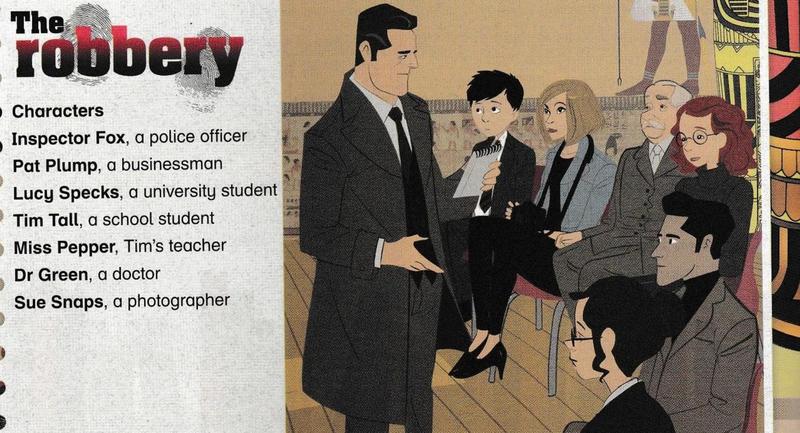
Textbook figure: Academy Stars Year 6 Pupil's Book, p.122.
| Character | Who they are |
|---|---|
| Inspector Fox | a police officer |
| Pat Plump | a businessman |
| Lucy Specks | a university student |
| Tim Tall | a school student |
| Miss Pepper | Tim's teacher |
| Dr Green | a doctor |
| Sue Snaps | a photographer |
Academy Stars Year 6 Pupil's Book, p.122.
The story in short. A valuable dinosaur egg was stolen from the museum yesterday evening. The six visitors who were there are all suspects. Inspector Fox asks each one: "Where were you at five o'clock?"
- Pat Plump was drawing hieroglyphics in the Egyptian Room (his hobby). The Inspector adds that Mr Plump also collects dinosaur eggs.
- Lucy Specks left with a large bag, which the CCTV camera shows. She says it held a present for her brother's birthday, and she has the receipt to prove it.
- Tim Tall was on a school trip. Miss Pepper says Tim lost his school bag, went to find it and got lost; she found him in the Chinese Room at five.
- Sue Snaps says she was in the Restoration Room looking at old paintings. The museum guard saw her go in at quarter to five and leave twenty minutes later.
- Dr Green says he was in the Dinosaur Room all afternoon doing research. Lucy shouts that he is lying and must be the thief.
Academy Stars Year 6 Pupil's Book, p.123 (summary in my own words).
The solution. Inspector Fox says Dr Green is not the thief: the egg was not in the Dinosaur Room at five o'clock. It was in the Restoration Room for cleaning, "and that's when Miss Snaps stole it!" Sue cries out: "I only borrowed it!" She wanted to photograph it in her garden for a magazine. The Inspector tells her she will have to come with him.
Vocabulary panel (p. 122)
The book lists these words and asks you to work out the meaning from context: borrow (borrowed), crime, hobby, lie (lying), prove, robbery, solve (solved), statement, suspect, valuable.
| Word | Clue in the play | Meaning (my words) |
|---|---|---|
| robbery | "there was a robbery at the museum" | the crime of stealing something |
| suspect | "We're all suspects, aren't we?" | a person the police think may have done the crime |
| valuable | "A valuable dinosaur egg is missing" | worth a lot of money or very important |
| statement | "I'm taking statements about where you all were" | what a person says officially about what happened |
| hobby | "drawing hieroglyphics... my favourite hobby" | an activity you enjoy in your free time |
| prove | "I can prove it - here's the receipt" | show that something is true |
| lie (lying) | "He's lying, Inspector!" | say something that is not true |
| borrow | "I only borrowed it!" | take something for a short time and give it back |
| solve | "you've solved the crime!" | find the answer to a problem or mystery |
Word list: Academy Stars Year 6 Pupil's Book, p.122; clues quoted from p.123; meanings are my own.
Show answerHide answer
10.2Reading comprehension and the suffix -ment (p. 124)
You read the script again and label a map of the museum with where each suspect was at five o'clock, then write the reason each suspect gave for being at the museum. The book's example: Pat Plump, "He was drawing hieroglyphics." Then you discuss: do you think Sue Snaps meant to steal the egg, and what will happen to her?
| Suspect | Place and reason |
|---|---|
| Pat Plump | Egyptian Room; drawing hieroglyphics |
| Tim Tall | found in the Chinese Room by Miss Pepper; he was lost after he went to find his bag |
| Miss Pepper | with Tim; she went to look for him |
| Sue Snaps | Restoration Room; looking at old paintings |
| Dr Green | Dinosaur Room; doing research on dinosaur eggs |
| Lucy Specks | leaving the museum shop with a present for her brother |
Task from Academy Stars Year 6 Pupil's Book, p.124; answers worked out from p.123.
Working with words: suffixes -ment
The book asks you to decide which verbs can take -ment (pay, solve, agree, arrange, perform, excite, equip, believe, research) and use a dictionary to check. Not every verb works: you cannot say "solvement". My own examples:
| Verb | Noun with -ment |
|---|---|
| pay | payment |
| enjoy | enjoyment |
| move | movement |
| amuse | amusement |
| improve | improvement |
Rule and first example: Academy Stars Year 6 Pupil's Book, p.124. The other rows are my own examples (pay is also on the book's list).
Show answerHide answer
10.3Grammar: question tags (p. 125)
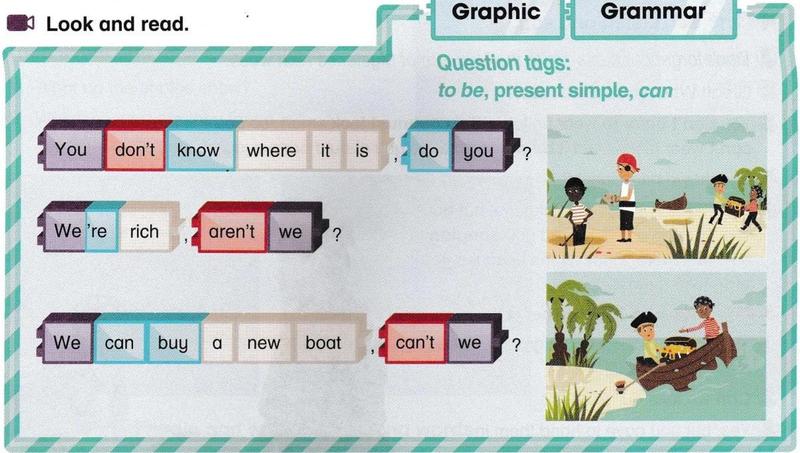
Textbook figure: Academy Stars Year 6 Pupil's Book, p.125.
| Statement | Question tag |
|---|---|
| You don't know where it is, | do you? |
| We're rich, | aren't we? |
| We can buy a new boat, | can't we? |
Academy Stars Year 6 Pupil's Book, p.125.
The rules.
- Opposite sign: a positive statement takes a negative tag, and a negative statement takes a positive tag. (We're rich, aren't we? / You don't know, do you?)
- Use the same helping verb: be with be (is - isn't it), the present simple with do / does (like - don't you, likes - doesn't he), and can with can't.
- Use a pronoun in the tag: Tim Tall is a school student, isn't he?
| Verb in the statement | Positive statement, negative tag | Negative statement, positive tag |
|---|---|---|
| to be | You are a suspect, aren't you? | That isn't a crime, is it? |
| present simple | You live near the school, don't you? | She doesn't know, does she? |
| can | We can start now, can't we? | He can't prove it, can he? |
The three sentences in the Graphic Grammar box are the book's (p.125); the table sentences are my own examples. Characters use real tags in the play (p.123): Lucy says "We're all suspects, aren't we?" and Pat says "That's not a crime, is it?".
Show answerHide answer
10.4Language in use: modal verbs (p. 126)
You listen to a dialogue between a teacher and pupils about a class trip to the Museum of Mysteries. The bold words are modal verbs. Words in the panel: behave, cafeteria, smart. Short quotes from the dialogue: "You don't have to wear uniform." / "You must look smart." / "It might be cold." / "You shouldn't bring valuable possessions because you may lose them."
Academy Stars Year 6 Pupil's Book, p.126.
| Meaning | Modal verbs | Example |
|---|---|---|
| advice | should, shouldn't | You should bring a snack. (book) |
| obligation (a rule you must follow) | must, have to; negative rule: mustn't, can't | You must behave well. (book) |
| no obligation (not necessary) | don't have to | You don't have to wear uniform. (book) |
| permission | can | You can explore in small groups. (book) |
| possibility | might, may | It might be cold. (book) |
Academy Stars Year 6 Pupil's Book, p.126 (the book asks you to put the bold words into a table with these five headings; I have also grouped the negative rules mustn't and can't under obligation: check the book's table with your teacher).
- After a modal use the base verb: "You must behave", never "must to behave" or "must behaves".
- Questions: "Should we bring lunch?", "Can we take our phones?", "Do we have to stay together?".
- Remember might and may are weaker than will: it is possible, not sure.
The book's practice is a school sports day (arrive on time, rain, sandwiches, money, behaviour). My own set for a school trip: "You must wear a seat belt. You don't have to bring money because the entrance is free. You should wear a hat. It might rain."
Show answerHide answer
10.5Listening: the Nazca Lines (p. 127)
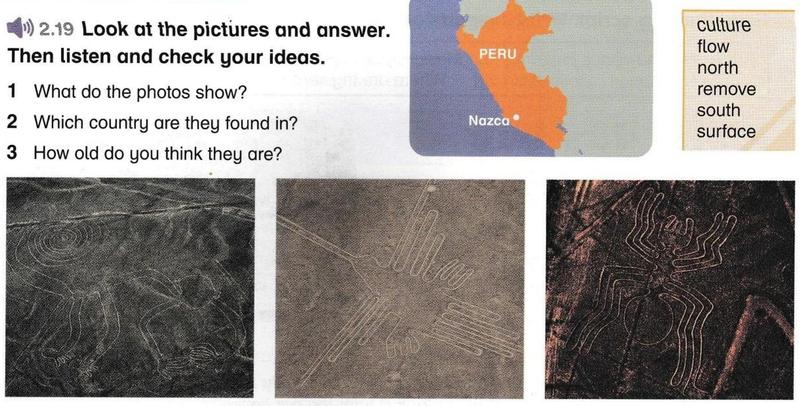
Textbook figure: Academy Stars Year 6 Pupil's Book, p.127.
The audio (track 2.19) and its script are not printed in the pupil's book, so here is the task. You look at three photos of lines drawn in the desert and say what they show, which country they are in, and how old they are. Then you listen to a talk, write the missing words in six sentences and take notes. The word panel gives: culture, flow, north, remove, south, surface.
The book prints a few answers as examples: the Nazca Lines are in the south of Peru, and they are between 500 and 2,000 years old. Other notes ask for the three animals, how people made the lines (they removed something on the surface), why you can still see them today, and three reasons Professor Sanz gives (a way across the desert, the position of something in the sky, and where water flowed under the desert).
Academy Stars Year 6 Pupil's Book, p.127.
Show answerHide answer
10.6Writing: a play script (pp. 128-129)
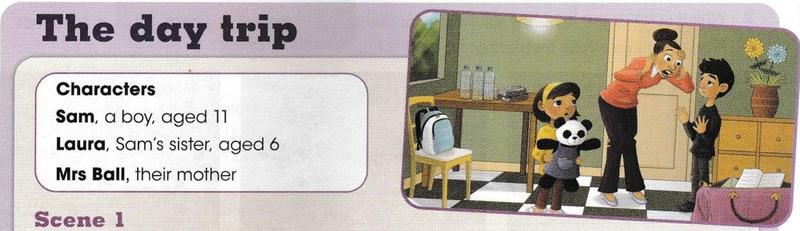
Textbook figure: Academy Stars Year 6 Pupil's Book, p.128.
The story. In Scene 1, early morning in a family kitchen, Sam is playing with the car keys. His mother, Mrs Ball, tells him to stop or he might lose them. Ten minutes later the keys are missing and Sam cannot remember where he put them. Mrs Ball says they will have to take the bus and she will call a taxi. At the end of the story (p. 129), at the bus station a police officer says a thief has escaped and the station is closed. He asks little Laura if the keys are in her panda's pocket, and they are. You write this ending as Scene 2 with stage directions.
Academy Stars Year 6 Pupil's Book, pp.128-129 (summary in my own words).
| Feature of a play script | What it looks like (from "The day trip") |
|---|---|
| title | The day trip |
| list of characters | Sam, a boy, aged 11; Laura, Sam's sister, aged 6; Mrs Ball, their mother |
| scene number | Scene 1 |
| setting (when and where) | Early morning in the kitchen in a family home. |
| speaker's name, then colon | Sam: Are you ready, Laura? |
| stage directions (in brackets, in italics: how to act or what happens) | (throws keys to Laura) (sounds angry) (looks everywhere for the keys) |
| no speech marks | The speaker's name shows who is talking, so you do not need ' ' marks. |
Academy Stars Year 6 Pupil's Book, p.128 (quoted stage directions and the book's questions about features of a play script).
Learning to learn: be persistent (p. 129)
Persistent means you keep trying even when something is difficult. The book says persistence is more important than intelligence for success and high grades. Its tips: take it one step at a time; keep trying again and again; be positive and patient; know when to ask for help.
Academy Stars Year 6 Pupil's Book, p.129.
Show answerHide answer
10.7Speaking: tell a mystery story (p. 130)
You listen to Mystery 1 (track 2.20) and find out why the man did not report the crime. A man comes out of a bank and gets on a train with a big leather bag. As he gets off, someone takes his bag and runs away. A police officer arrives and asks, "Do you want to report a crime?" but the man says, "No, thank you," and goes back into the station for the next train. Why? You find out by asking your teacher questions that can only be answered "yes" or "no". You can ask for a clue and you can guess, but clever questions are better. The new words are break into and clue.
Academy Stars Year 6 Pupil's Book, p.130 (summary in my own words). The answers are in the Teacher's Book, so the solution is not printed here.
Then you choose Mystery 2 or Mystery 3 (notes in the book) and tell it as a story with these phrases:
Phrases: Academy Stars Year 6 Pupil's Book, p.130.
Show answerHide answer
10.8Think about it!: work out the mystery identity (p. 131)
The book's story: a man left a bag at Los Angeles Union Station in 1971 and never came back. Builders found it last week. You look at the objects inside and sort each one into a for travel, b for information, or c to hide someone's identity.
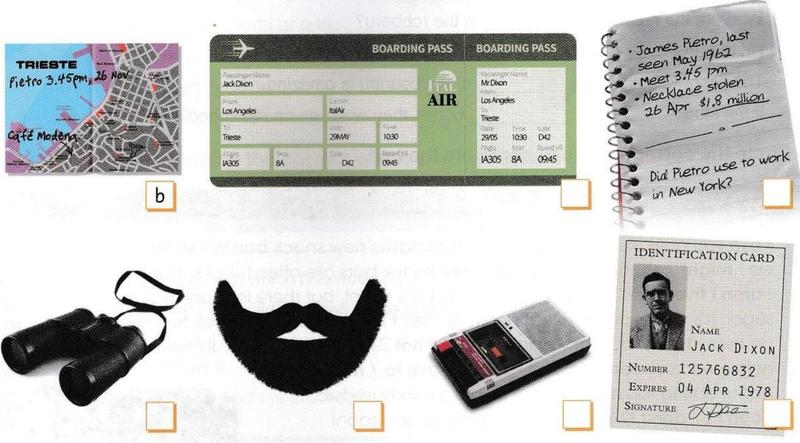
Textbook figure: Academy Stars Year 6 Pupil's Book, p.131.
You answer questions from the photos (the man's name, where he was travelling, who he was going to meet, what he wanted to find out), then speculate about his job, why he wanted to meet James Pietro and why he needed a beard and binoculars. The thinking skills are speculation and deduction. A good model from the book: "I think he was a journalist because ..." or "I think he was a police officer because ...".
Academy Stars Year 6 Pupil's Book, p.131.
Show answerHide answer
10.9Review 5 (pp. 132-133)
Review 5 covers Units 9 and 10. Here is what it checks.
| Task | Skill |
|---|---|
| 1 | Fill in sentences with the words behave, concentrate, crime, snack, south, suspects |
| 2 | Circle the correct modal or question tag in an advert text (might / should, aren't they / isn't it, have to / can, might not / mustn't ...) |
| 3 | Report what Inspector Fox said (reported speech from Unit 9) |
| 4 | Related words: friend - friendly; product, choose, solution, value, energy |
| 5 | Write words ending in -ment from definitions (money you give or receive - payment) |
| 6 | Match 10 definitions to words (for example a skyscraper, a calculator, wildlife) |
Academy Stars Year 6 Pupil's Book, pp.132-133.
Reported speech (the book's example): Inspector Fox says "You are all suspects." The pupil reports: "He said they were all suspects." Rules: change the pronoun (you to they) and move the verb one step back in time (are to were, is to was, am doing to was doing, can to could).
| Direct speech | Reported speech |
|---|---|
| "You are all suspects." | He said they were all suspects. (book) |
| "I am drawing." | She said she was drawing. (my example) |
| "We can leave." | They said they could leave. (my example) |