What's your opinion?
What this chapter coversMatlamat bab ini
- I can read posts in a discussion forum and find the main idea of a text
- I can find supporting information in a text and use related words (word groups) to work out new vocabulary
- I can report what someone said, changing the present tense to the past (for example "Sugar is bad for you" becomes "I said sugar was bad for you")
- I can use someone, no one, anyone, somewhere, nowhere, anywhere, something, nothing and anything correctly
- I can listen for different opinions in a debate and give a reason for each speaker's view
- I can use topic sentences and opinion phrases to plan and write a four-paragraph opinion essay
- I can take part in a class debate, giving and answering opinions politely
- I can evaluate options, give supporting arguments and persuade others in a group (Think about it!)
- I can read an information text about the history of storytelling and give a personal response to it
Unit 9 is about opinions: what you think, why you think it and how you say it politely. You will read an online discussion forum about sugar, learn reported speech and indefinite pronouns, write an opinion essay, take part in a debate and finish with an information text, The power of stories.
9.1Reading: Sugar, sugar (a discussion forum)
Lesson 1 gives two quick tasks before you read: what type of text is it? (a discussion forum) and how many people give their opinion? Then you read quickly to find the main idea: the text is about healthy eating and how much sugar is in food.
Academy Stars Year 6 Pupil's Book, p.108.
The vocabulary panel lists ten words you meet in the posts. Work out each meaning from the context (the words around it).
| Word | Meaning in the forum |
|---|---|
| snack | a small amount of food between meals |
| product | something that is made to be sold, such as a food in a shop |
| sweet | tasting of sugar |
| teaspoon | a small spoon; also the amount it holds |
| media | news and information on TV, radio, newspapers and websites |
| choice | the chance to pick what you want |
| blame | say that someone or something caused a problem |
| diet | all the food and drink that you usually eat |
| app | a program on a phone or tablet |
| barcode | black stripes on a product that a machine or phone can read |
Academy Stars Year 6 Pupil's Book, pp.108-109 (vocabulary panel; short meanings written for this site).
Who says what (summary in my own words):
| Poster | Opinion |
|---|---|
| penny64 | Starts the topic after a documentary: even "healthy" snacks, and foods like bread and soup, have much more sugar than we think. Later she blames the advertisers for pictures of tasty food, and says it is hard to understand how much sugar is added. |
| butterfly22 | Agrees. Food producers add sugar because people like sweet things, and so that food lasts longer on the shelves. Later she tells about the app "Sugar smart". |
| minnie13 | Agrees. You should not have more than six teaspoons of sugar a day, but one fizzy drink has seven. She drinks a can of cola every day. Later she says she will download the app. |
| bart99 | Disagrees. The media always try to scare us about food (first salt, then red meat, now sugar). He thinks people are clever enough to make their own food choices. |
| fred01 | A healthy diet is more than eating less sugar: a diet of burgers and chips is not good either. |
Academy Stars Year 6 Pupil's Book, pp.108-109.
Show answerHide answer
9.2Reading comprehension and word groups
In Lesson 2 you read the forum again for supporting information. A point is an idea ("Adverts make us want to eat unhealthy food"). A supporting statement gives evidence for it ("We see so many pictures of delicious looking food everywhere"). The book asks you to match five points to five supporting statements, and then to say what surprised you most.
Academy Stars Year 6 Pupil's Book, p.110.
Working with words: word groups
Words that come from the same base are related words. If you know one, you can guess the others. The book's example: you know advert, so you can work out advertisers (the people who make adverts); a dictionary also gives the verb advertise. "So that's three words you've learnt from one."
| Noun | Verb | Person / adjective |
|---|---|---|
| advert, advertisement | advertise | advertiser |
| health | - | healthy, unhealthy (more: healthier) |
| agreement | agree, disagree | - |
| product, producer | produce | - |
Academy Stars Year 6 Pupil's Book, p.110 (the advert group is the book's; the other rows are original examples).
Show answerHide answer
9.3Grammar: reported speech (present tenses)
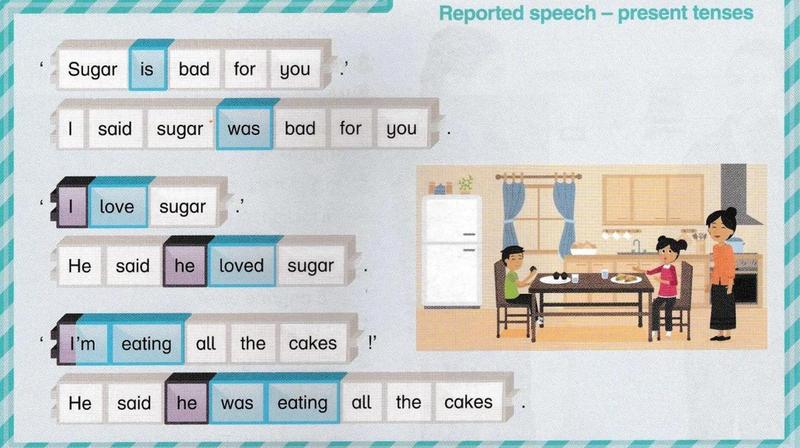
Textbook figure: Academy Stars Year 6 Pupil's Book, p.111.
Direct speech gives the exact words someone said, in quotation marks. Reported speech tells us what they said without the quotation marks. When the reporting verb is in the past (said), the verb in the speech moves one step back into the past, and the pronoun may change.
| Direct speech | Reported speech | What changes |
|---|---|---|
| 'Sugar is bad for you.' | I said sugar was bad for you. | is becomes was |
| 'I love sugar.' | He said he loved sugar. | I becomes he; love becomes loved |
| 'I'm eating all the cakes!' | He said he was eating all the cakes. | I'm eating becomes was eating |
Academy Stars Year 6 Pupil's Book, p.111.
present simple (love, is, has) becomes past simple (loved, was, had);
present continuous (am / is / are + -ing) becomes past continuous (was / were + -ing).
| Direct (said) | Reported |
|---|---|
| 'We are hungry.' (the twins) | The twins said they were hungry. |
| 'I sometimes forget my keys.' (Dad) | Dad said he sometimes forgot his keys. |
| 'Rice usually has less sugar than cake.' (Ms Lim) | Ms Lim said rice usually had less sugar than cake. |
Reported-speech pattern from Academy Stars Year 6 Pupil's Book, p.111; these three pairs are original examples. The book's own practice sentences are in its Activity 2.
Reported: Lina said she was drinking water.
Show answerHide answer
Show answerHide answer
Speaking task on p.111: ask a partner "What's your favourite snack?", "What do you want to do when you leave school?" and "What are you doing right now?", then report the answers: "He said his favourite snack was yoghurt."
9.4Language in use: indefinite pronouns
Lesson 4 begins with a dialogue (Listen and say, track 2.14) about a lost tablet. The girl says she looked "all over the school" and cannot find it anywhere; her friend says "Don't worry! Someone will find it" and asks "Have you told anyone else?". The answer: "No one knows yet." In the end someone has found something: the tablet.
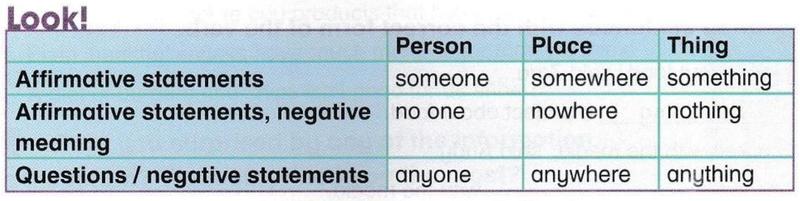
Textbook figure: Academy Stars Year 6 Pupil's Book, p.112.
| Use | Person | Place | Thing |
|---|---|---|---|
| Affirmative statements | someone | somewhere | something |
| Affirmative statements, negative meaning | no one | nowhere | nothing |
| Questions / negative statements | anyone | anywhere | anything |
Academy Stars Year 6 Pupil's Book, p.112.
Academy Stars Year 6 Pupil's Book, p.112.
Show answerHide answer
Speaking task: make a new dialogue about something you have lost, copying the pattern "I've lost my watch. I can't find it anywhere." / "Oh, no! It must be somewhere."
9.5Listening: different opinions
Lesson 5 prepares you with the words believe, concentrate, debate, exam, multi-tasking. A photo shows a boy speaking from a lectern, and you talk about whether the situation is formal or informal and how he feels. You then listen (track 2.15) to Maya and James in a debate on the motion "Multi-tasking is the best way to work". The audio script is not printed in the book, so here is the task:
- Decide whether five statements are true or false (for example whether Maya thinks multi-tasking is good, and what James says about exams and about concentrating).
- Give one reason for each speaker's opinion: why Maya thinks multi-tasking is good, and why James thinks it is not.
- Decide who has the better argument, and compare their reasons with yours.
Academy Stars Year 6 Pupil's Book, p.113.
9.6Writing: an opinion essay
Learning to learn: use topic sentences
An essay is divided into paragraphs, and each paragraph is about a different topic. A topic sentence is usually the first sentence of a paragraph. It introduces the main idea so that the reader knows what the paragraph will be about. Topic sentences give your essay structure and make your arguments clearer.
Academy Stars Year 6 Pupil's Book, p.114.
Bart's essay and its structure
Bart writes four paragraphs on whether we should trust the media about food. He says every day we hear about another food that is bad for our health, but he does not believe the media are always right. He argues that a sweet snack can give you energy and cheer you up, and that it is important to eat a variety of food in the right amount. He ends by saying people should make their own food choices.
| Paragraph | Its purpose |
|---|---|
| Introduction | Explain the topic and give your opinion |
| Main body 1 | Give a first argument to support your opinion |
| Main body 2 | Give a second argument |
| Conclusion | Summarise your arguments |
Academy Stars Year 6 Pupil's Book, pp.114-115.
Useful phrases
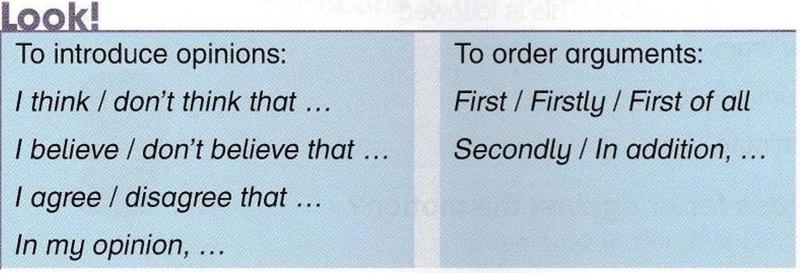
Textbook figure: Academy Stars Year 6 Pupil's Book, p.115.
The class essay on p.115 is "Are school uniforms a good idea?", planned as: introduction (topic and opinion), two main-body paragraphs (topic sentence plus supporting sentences each) and a conclusion (summary).
Main body 1: Firstly, homework helps us remember what we learn. (topic sentence) We practise at home, so we make fewer mistakes in class.
Main body 2: Secondly, ...
Conclusion: To sum up, ...
Show answerHide answer
9.7Speaking: a class debate
The motion on p.116 is "We should have one afternoon of sport at school every week." You sort ideas into F (for) and A (against), using the words for, against, unfair. For example, "doing sport means we lose learning time" is against, and "young people need exercise to stay healthy and strong" is for. Then you add two ideas of your own.
Prepare a one-minute speech and use these phrases: I think that ... / I believe, don't believe that ... / In my opinion, ... / I agree, disagree ... / I see what you mean, but ...
- Two teams: one is for the motion, the other is against.
- A speaker from the "for" team starts, then a speaker from the "against" team, and so on.
- Each speaker talks for one minute.
- Finish with a class vote: is the class for or against the motion?
Academy Stars Year 6 Pupil's Book, p.116.
9.8Think about it! Improve your school
Imagine your school has won a £20,000 prize. The four options are: improve the food in the school canteen, buy new sports equipment, buy new books for the library, or buy a tablet for every student. You do three things:
- Match each option to an argument that supports it (for example "A good brain needs healthy food" goes with improving the canteen food).
- Rank the options with a partner, 1 = most important and 4 = least important.
- Write three supporting arguments for your number 1 option, then persuade your group. The book's model for the canteen: it will be a more popular place; students learn better if they eat healthy food; health is more important than books or technology.
Academy Stars Year 6 Pupil's Book, p.117.
9.9Reading time 4: The power of stories
This is an information text from a website, "The power of stories" (pp.118-120). It has a headline, sub-headings, photos and captions.
| Part | Key points (summary) |
|---|---|
| Introduction | Stories are an important part of every culture. Even before there were languages, people used pictures, signs and sounds to tell stories. Stories express our values, experiences, hopes and dreams. |
| The start of storytelling | Thousands of years ago people sat around fires at night. There were no books or television, so talking was the only entertainment. They told stories to answer questions, such as "Where does fire come from?". Before writing, people could not record stories, so each generation told them to the next. This is called oral storytelling. |
| Earliest forms | Chants, songs, poems and dance. The Aboriginal people of Australia share stories in very long songs called songlines, which also work as a "map" of rivers, rocks and trees, so people could find their way. |
| The oldest stories | Writing appeared about 5,000 years ago in Mesopotamia (modern Iraq and Syria). The first writing system was cuneiform. The Epic of Gilgamesh is one of the oldest written stories; an epic is a long poem about an important person or hero. |
| Other famous stories | The Mahabharata from India is described as the longest poem ever written (author: Vyasa). The Thousand and One Nights (Middle East and South Asia) includes Aladdin, Sinbad and Ali Baba. |
| Storytelling in the 21st century | Many adverts tell stories. Companies use storytelling to sell products because stories create experiences and feelings that we remember better than facts, create connections between people, and are shared with friends. Storytelling is "the most important tradition we have". |
Academy Stars Year 6 Pupil's Book, pp.118-120 (summary; the full article is in the book).
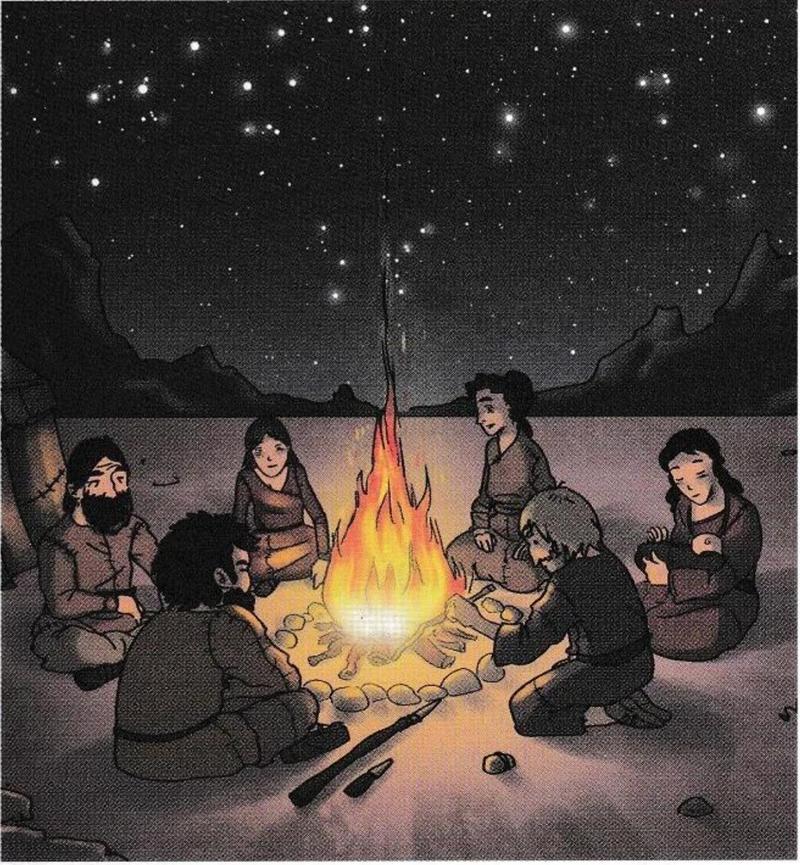
Textbook figure: Academy Stars Year 6 Pupil's Book, p.118.
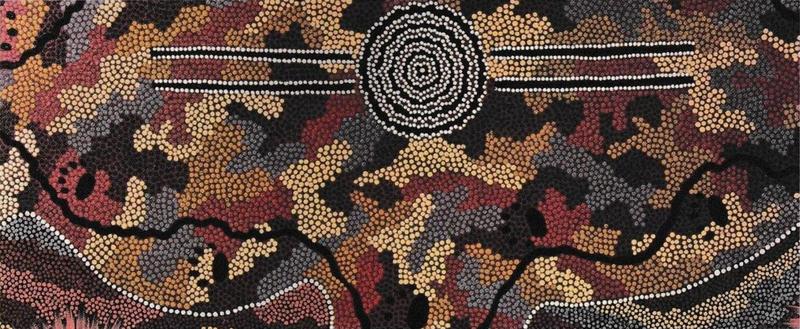
Textbook figure: Academy Stars Year 6 Pupil's Book, p.119.
The activities on p.121 ask you to match descriptions to stories (for example the one about two groups of princes is the Mahabharata), find answers to five questions in the text, and talk about your own favourite childhood stories. Skill: give a personal response: say how the text made you feel and give a reason.
Academy Stars Year 6 Pupil's Book, p.121.
Show answerHide answer
Note: Reading time 4 (pp.118-121) comes straight after Unit 9, before Unit 10. Review 5 is at the end of Unit 10 (pp.132-133).